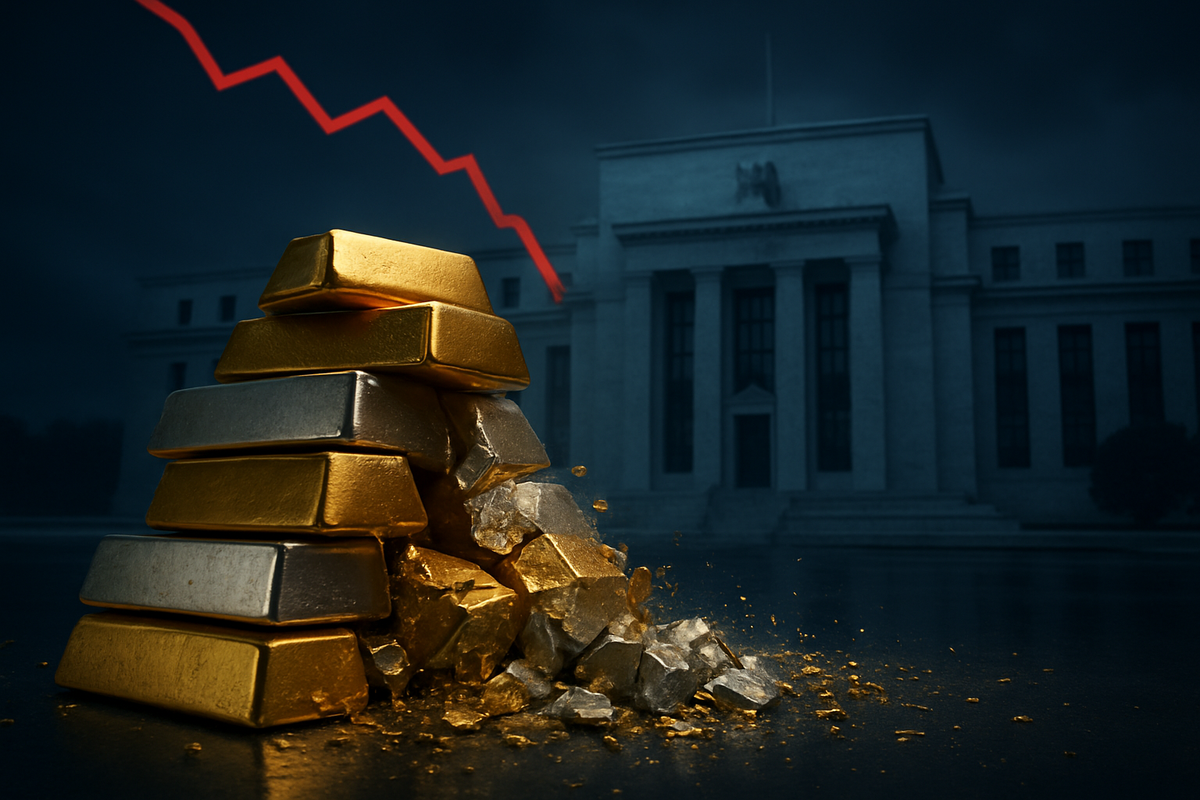
The global financial landscape underwent a seismic shift on January 30, 2026, when the White House announced the nomination of Kevin Warsh to succeed Jerome Powell as the next Chair of the Federal Reserve. What was once a speculative fever in precious metals—driven by fears of fiscal instability and a "politicized" central bank—evaporated almost overnight in what traders are now calling the "Warsh Shock." The nomination acted as a policy earthquake, effectively lancing a massive bubble in gold and silver that many analysts argued had become detached from fundamental reality.
In the eight weeks since the announcement, the "Warsh Effect" has completely restructured global macro expectations. By signaling a return to strict monetary discipline and a "narrow" central bank mandate, the nomination triggered a violent upward repricing of the U.S. Dollar. For gold, which had crested at a staggering record high of $5,600/oz just hours before the news, the fall was precipitous, tumbling toward the $4,800 level in a matter of days. Silver fared even worse, suffering a catastrophic crash from $120/oz to below $85, marking one of the most volatile periods for the metal in decades.
The Anatomy of a Policy Earthquake
The collapse of the 2025-2026 bull run was not merely a technical correction but a fundamental rejection of the "easy money" narrative that had dominated the post-pandemic era. Throughout 2025, gold prices surged on the back of a $38 trillion national debt and a widely held belief in the "June Pivot"—the expectation that the Fed would be forced to slash interest rates by June 2026 to prevent a debt-servicing crisis. Investors flocked to hard assets as a hedge against what they perceived as a Federal Reserve increasingly under the thumb of political pressure to keep liquidity high at any cost.
When Kevin Warsh was nominated, that entire framework was dismantled. Warsh, a former Fed Governor known for his institutionalist views and his 2011 resignation in protest of aggressive monetary expansion, brought with him a reputation as a "monetary hawk." His appointment signaled that the era of the "political Fed" was over. Markets immediately realized that a Warsh-led Fed would likely prioritize "sound money" over short-term growth or fiscal convenience. By late January, the probability of a June 2026 rate cut vanished from the CME FedWatch Tool, replaced by a 0% chance of any easing before September 2026 at the earliest.
The timeline of the crash was brutal for those caught on the wrong side of the trade. On January 29, gold hit its intraday peak of $5,608/oz. By the afternoon of January 30, following the official nomination leak and subsequent press conference, the metal began a $400-per-ounce slide that didn't find a floor for nearly a week. Silver, often referred to as "gold on steroids," lived up to its reputation by plunging 30% in a single trading session, as leveraged hedge funds were hit with massive margin calls, forcing a liquidation spiral that wiped out billions in paper wealth.
Winners and Losers in the Post-Warsh Era
The immediate victims of the Warsh Shock were the major mining conglomerates and precious metals investment vehicles. Newmont Corporation (NYSE: NEM) and Barrick Gold Corporation (NYSE: GOLD) saw their market caps slashed by nearly 15% in the week following the announcement, as the lower spot price for gold drastically altered their projected earnings for the 2026 fiscal year. Silver miners were hit even harder; Pan American Silver (NASDAQ: PAAS) and First Majestic Silver (NYSE: AG) experienced double-digit percentage drops as the silver-to-gold ratio blew out, reflecting the sudden disappearance of industrial and speculative demand.
Exchange-traded funds also saw record outflows. The SPDR Gold Shares (NYSE Arca: GLD) and the iShares Silver Trust (NYSE Arca: SLV) reported their largest single-day liquidations since their inception, as retail and institutional investors alike scrambled to rotate back into the U.S. Dollar. Junior miners, represented by the VanEck Junior Gold Miners ETF (NYSE Arca: GDXJ), faced a liquidity crunch, with many smaller firms seeing their valuations halved as the "speculative premium" that had sustained them throughout 2025 was unceremoniously stripped away.
Conversely, the "Warsh Effect" became a major tailwind for the U.S. financial sector and dollar-denominated assets. Large-cap banks like JPMorgan Chase & Co. (NYSE: JPM) and Goldman Sachs Group Inc. (NYSE: GS) benefited from the steepening yield curve and the prospect of "higher for longer" interest rates, which bolsters net interest margins. The U.S. Dollar Index (DXY) staged a historic rally, as the nomination of a hawk like Warsh reassured global investors that the dollar would remain the world's premier store of value, dampening the "de-dollarization" narrative that had fueled much of the 2025 gold mania.
A Structural Shift in Central Bank Credibility
The wider significance of the Warsh nomination cannot be overstated; it represents a pivot back toward the "Volcker Era" of central banking. For years, the market had operated under the assumption that the Fed was essentially trapped—unable to raise rates or shrink its balance sheet without causing a sovereign debt crisis. By nominating Warsh, the administration effectively called the market's bluff, signaling that it is willing to accept higher borrowing costs and slower growth in exchange for long-term price stability and institutional integrity.
This event has created a massive ripple effect across the commodities sector. It’s not just gold and silver; other inflation hedges like copper and even certain cryptocurrencies have seen their "scarcity premiums" compressed. The ripple effect has also reached America’s trading partners. With the U.S. Dollar surging, emerging market economies are now facing renewed pressure on their own currencies, potentially forcing foreign central banks to hike rates even as their domestic economies cool.
Historically, this event mirrors the 1980 "Volcker Moment," when then-Chair Paul Volcker broke the back of double-digit inflation with aggressive rate hikes. While the current environment is different due to the sheer scale of the national debt, the psychological impact is similar. The "Warsh Shock" has re-anchored inflation expectations, proving that the Fed still possesses the power to shock markets out of a speculative daze.
Navigating the 'Hawkish Hold'
As we look toward the remainder of 2026, the primary challenge for investors will be adapting to a "Hawkish Hold" environment. The narrative of an imminent pivot is dead; the market is now pricing in a sustained period of high real interest rates. This means that the "Goldilocks" scenario of 2025—where growth was just high enough and the Fed was expected to be just soft enough—has been replaced by a much grimmer reality for speculative assets.
In the short term, we may see a period of consolidation in precious metals around the $4,500–$4,800 range for gold, as the market waits to see if Warsh will follow through on his reputation for balance sheet reduction (Quantitative Tightening). If Warsh moves to aggressively shrink the Fed's $7 trillion-plus balance sheet once he takes office in May, we could see another leg down in precious metals as liquidity continues to dry up.
Strategic pivots are already underway. Wealth managers are rotating out of "hard assets" and back into short-duration Treasuries and high-quality corporate bonds. The market opportunity has shifted from betting on a collapse of the fiat system to betting on the resilience of the American institutional framework. However, the risk remains that if Warsh is too hawkish, he could trigger a hard landing, potentially reviving the safe-haven bid for gold later in 2027.
Final Assessment: The End of the Mania
The Warsh Shock serves as a stark reminder that monetary policy remains the ultimate arbiter of market value. The speculative bubble in gold and silver was built on the premise that the Federal Reserve had lost its will to fight. Kevin Warsh’s nomination proved that the institution still has teeth. As of late March 2026, the gold market is finally licking its wounds, with the feverish $5,600 peak now appearing as a distant, irrational memory.
Moving forward, the market will be hyper-focused on Warsh’s first official testimony and the September 2026 rate decision. If inflation data continues to show stickiness above the 3% mark, expect Warsh to remain the "Ice Man" of the FOMC, keeping rates elevated and the dollar strong. For the precious metals bulls who spent 2025 predicting the end of the dollar, the early months of 2026 have been a harsh lesson in the power of a credible central bank.
Investors should watch for the upcoming May transition of power. The definitive end of the Powell era and the official seating of Kevin Warsh will likely be accompanied by a comprehensive "State of the Fed" address that could further define the limits of the new regime. For now, the "Warsh Shock" has achieved its goal: it has drained the excess from the system and reminded the world that, under the right leadership, the Fed is still the most powerful force in global finance.
This content is intended for informational purposes only and is not financial advice.