
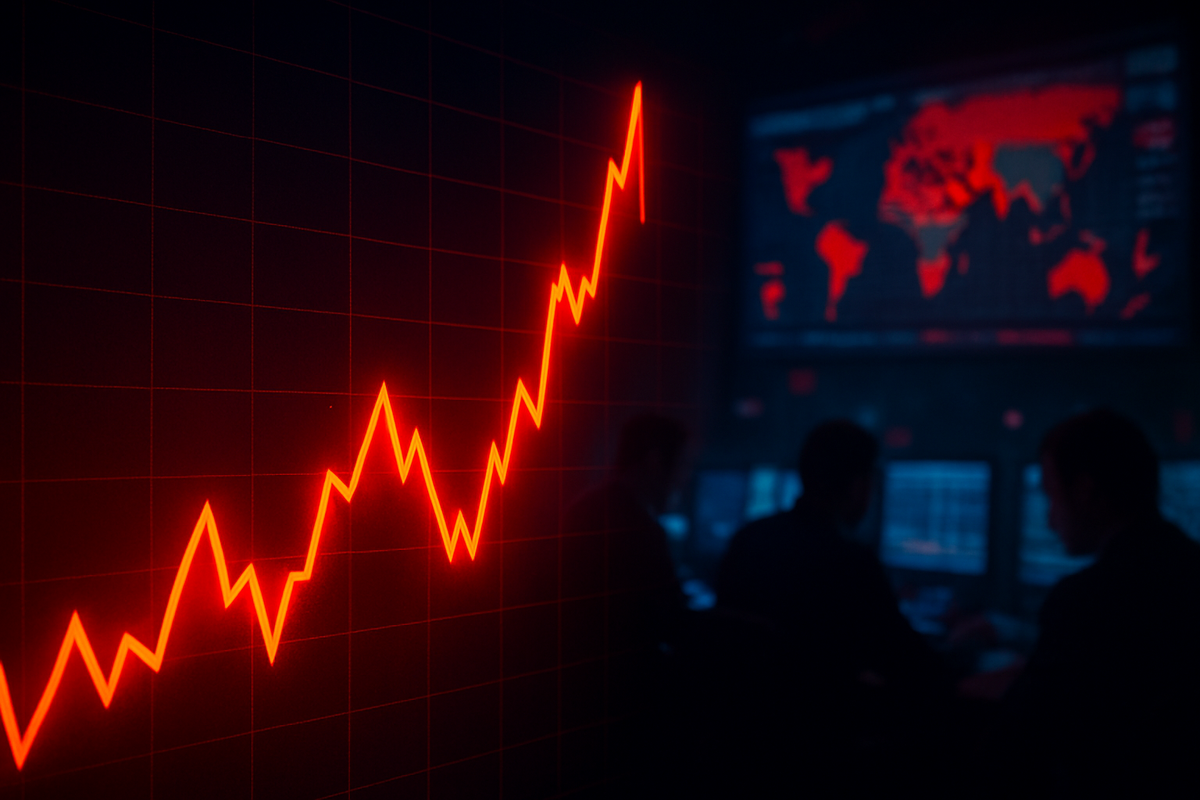
The CBOE Volatility Index (VIX), Wall Street’s premier measure of expected stock market volatility, climbed to a reading of 26.15 this week, marking its highest sustained level in nearly two years. As of March 24, 2026, the index’s ascent reflects a fundamental shift in investor sentiment, moving from the uneasy "Goldilocks" optimism of late 2025 into a regime defined by deep-seated anxiety over global trade stability and persistent inflationary pressures.
The breach of the 26 level is more than just a numerical milestone; it represents a psychological "tripwire" that historically signals a transition from moderate market fluctuations to high-risk environments. With the VIX hovering roughly 33% above its long-term historical average, institutional desks are aggressively recalibrating their portfolios, moving away from high-beta growth assets and toward defensive hedges as the specter of a stagflationary shock looms over the global economy.
The Catalyst of Uncertainty: From Hormuz to the Fed
The surge in market turbulence did not occur in a vacuum. The immediate catalyst for the VIX’s climb to 26 was the escalation of the "Hormuz Crisis" in February 2026, which saw a significant disruption in the Strait of Hormuz following heightened military tensions in the region. This bottleneck, through which approximately one-fifth of the world’s oil supply flows, sent crude prices spiraling toward $115 per barrel. For a global economy already struggling to bring inflation down to central bank targets, the energy shock acted as a massive weight on equity valuations, driving the Cboe Global Markets (BATS:CBOE) volatility products to record trading volumes.
The timeline leading to this moment began in mid-2024, a year characterized by extreme, short-lived "flash" volatility events. Most notably, the August 2024 unwinding of the Japanese yen carry trade sent the VIX briefly to an intraday high of 65, serving as a warning shot to investors about the fragility of global liquidity. While markets recovered by early 2025, the underlying structural issues—sticky service-sector inflation and a widening fiscal deficit in the U.S.—remained unresolved. By early 2026, the Federal Reserve’s refusal to cut interest rates below the 3.50% mark, despite cooling employment data, became the secondary driver of the current market "fear."
Key stakeholders, including major hedge funds and institutional asset managers, have shifted their stance from "buying the dip" to "selling the rip." The Federal Reserve, led by Chair Jerome Powell, remains the central figure in this drama, with his recent hawkish rhetoric suggesting that the central bank is more concerned with energy-driven price spikes than the sagging performance of the S&P 500. This perceived "loss of the Fed put"—the idea that the Fed will step in to save markets—has removed the safety net that kept the VIX suppressed during the early 2020s.
Initial market reactions have been swift and clinical. Trading desks reported a massive surge in the purchase of put options on the S&P 500, as well as a flight to quality in the treasury markets. However, unlike previous crises where treasuries provided a reliable hedge, the "higher-for-longer" interest rate environment has complicated the traditional 60/40 portfolio, leaving investors with fewer places to hide and further fueling the demand for VIX-linked protection.
Winners and Losers in the Volatility Vortex
In this high-volatility environment, the divide between winners and losers is stark. The primary beneficiaries are the "toll collectors" of the financial markets. Cboe Global Markets (BATS:CBOE) and the Intercontinental Exchange (NYSE: ICE) have seen their revenues bolstered by a massive uptick in options and futures trading volume. When uncertainty rises, the demand for hedging tools skyrockets, allowing these exchanges to thrive even as the broader market falters. Similarly, market-making firms like Virtu Financial (NASDAQ: VIRT) benefit from wider bid-ask spreads and increased order flow, turning market chaos into a profitable arbitrage opportunity.
Conversely, the "losers" in a VIX-at-26 world are the high-growth, high-valuation technology companies that dominated the 2023-2024 bull run. Nvidia (NASDAQ: NVDA) and Tesla (NASDAQ: TSLA) have faced significant downward pressure as investors reassess the "risk-free" rate and demand higher premiums for holding volatile assets. In an environment where the daily expected move of the S&P 500 is nearly 1.7%, the premium once afforded to these "AI darlings" has begun to evaporate, leading to a rotation out of tech and into "old economy" sectors.
Consumer discretionary giants are also feeling the pinch. Amazon (NASDAQ: AMZN) and other major retailers are struggling as the combination of triple-digit oil prices and high borrowing costs erodes household purchasing power. With the U.S. personal savings rate dropping to 3.5% in early 2026, the narrative of a "resilient consumer" is being tested. Meanwhile, defensive staples like Coca-Cola (NYSE: KO) and Johnson & Johnson (NYSE: JNJ) have emerged as safety ballasts, outperforming the broader indices as investors seek out predictable dividends and stable cash flows in an increasingly unpredictable world.
The Broader Significance: A New Regime of Risk
The current elevated VIX is a symptom of a broader shift in the global financial architecture. For much of the past decade, markets operated under a regime of low inflation and central bank intervention. The VIX’s move to 26 signifies that we have entered a "new normal" where geopolitical risk is a permanent fixture rather than a temporary aberration. This fits into the wider trend of "deglobalization," where fragmented trade routes and localized conflicts create structural volatility that traditional monetary policy is ill-equipped to handle.
Historically, a VIX reading of 26 has often preceded more significant market corrections. Comparisons are being drawn to the late 1970s and early 1980s—the last time the U.S. faced a sustained period of "energy-push" inflation and geopolitical instability. While the 2020 COVID-19 crash saw the VIX reach much higher levels (peaking above 80), the current 2026 environment is arguably more dangerous for long-term investors because the volatility is "sticky" rather than "spiky," suggesting that the cost of doing business and the cost of capital will remain high for the foreseeable future.
From a regulatory standpoint, the sustained high-volatility environment is likely to trigger increased scrutiny of "zero-days-to-expiration" (0DTE) options. These hyper-short-term derivatives have exploded in popularity since 2024, and critics argue they exacerbate market swings, potentially turning a standard 1% move into a 3% rout. As the VIX remains elevated, the Securities and Exchange Commission (SEC) may face renewed pressure to implement safeguards that prevent these speculative instruments from destabilizing the broader financial system.
Looking Forward: Navigating the Fog
Looking ahead, the short-term trajectory of the market depends heavily on the resolution—or lack thereof—in the Middle East. If the Strait of Hormuz remains contested, a VIX in the 30s could become the new baseline for the remainder of 2026. Companies will likely continue their strategic pivots toward "resilience over efficiency," investing in domestic supply chains and reducing their reliance on volatile international corridors. This "just-in-case" inventory model is inherently more expensive, meaning that corporate margins may continue to be squeezed through the end of the year.
A potential "upside" scenario for the markets would require a dual-de-escalation: a ceasefire in the Middle East and a clear signal from the Federal Reserve that it is willing to tolerate slightly higher inflation in exchange for a stable labor market. Should these occur, we could see a rapid "volatility crush," where the VIX drops back toward the 18-20 range, sparking a massive short-covering rally in equities. However, given the current geopolitical climate, most analysts view this as a low-probability outcome for the first half of 2026.
Market opportunities will likely emerge in the "real assets" space. Commodities, infrastructure, and energy-independent manufacturing are positioned to capture the capital that is currently fleeing the tech sector. Investors should also watch for a potential resurgence in active management; the era of "passive indexing" is difficult to navigate when the underlying index is swinging 2% daily, and stock-pickers who can identify companies with strong pricing power may finally see their time to shine.
A New Baseline for Fear
In summary, the VIX at 26 is a loud and clear message that the age of market complacency is over. The convergence of energy shocks, geopolitical strife, and a hawkish Federal Reserve has created a "perfect storm" of uncertainty. The key takeaway for investors is the importance of risk management: the strategies that worked during the low-volatility years of 2023 and early 2024 are no longer sufficient in a world where "fear" is the dominant market driver.
Moving forward, the market will likely remain in a defensive posture. The transition from a growth-oriented market to a value-oriented one is well underway, and the VIX is the primary scoreboard for this shift. Investors should keep a close eye on credit spreads and the 10-year Treasury yield, as any sign of stress in the debt markets could push the VIX from "elevated" into "panic" territory.
The significance of this moment lies in its duration. If the VIX remains above 25 for several more months, it will confirm that we are in a high-volatility regime that could define the second half of the decade. For now, the "fear gauge" is telling us that the road ahead will be anything but smooth, and that caution, rather than conviction, is the order of the day.
This content is intended for informational purposes only and is not financial advice.