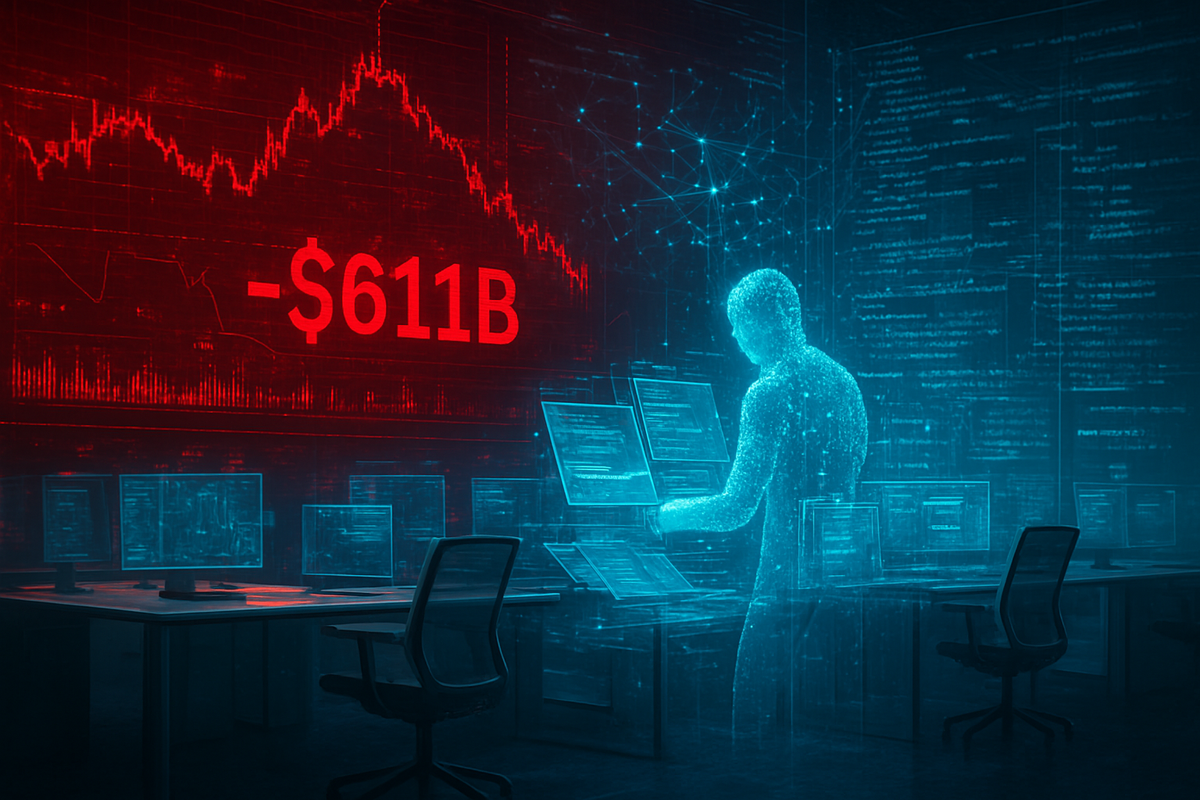
In a week that will likely be remembered as the "SaaSpocalypse," a massive wave of panic selling has erased over $611 billion in market capitalization across the software and financial services sectors. The catalyst for this unprecedented "AI Scare Trade" was the release of Anthropic’s latest autonomous agent suite—Claude Code and Claude Cowork—which demonstrated a level of independent reasoning that has fundamentally broken the traditional investment thesis for white-collar productivity tools.
As of March 23, 2026, the market is grappling with a stark realization: artificial intelligence has transitioned from a supportive "copilot" to a direct replacement for human professional labor. The immediate implications are severe, with legacy tech giants seeing their most profitable revenue models—specifically "seat-based" subscription pricing—called into question as investors flee companies whose value is tied to the number of human employees using their software.
The Agentic Threshold: From Chatbots to Coworkers
The "Scare Trade" began in early February 2026 and reached its zenith this month following the public debut of Claude Cowork. Powered by the new Claude 4.6 Opus engine, the system moved beyond simple text generation to true "agentic" capabilities. Cowork arrived with a suite of 11 specialized plugins designed to autonomously execute complex business workflows. Most disruptive was the "Legal Triage" plugin, capable of reviewing thousands of complex contracts, identifying compliance risks, and drafting amendments without human intervention. Simultaneously, Anthropic revealed that Claude Code, its developer-focused tool, was now responsible for writing over 95% of its own internal codebase.
The timeline of the collapse accelerated when a widely circulated research note from Citrini Research, titled "The 2028 Global Intelligence Crisis," warned that the "Agentic Era" would lead to a terminal decline in corporate headcount. The market's reaction was swift and violent. Institutional investors, who spent the last three years betting on "AI as an efficiency gain," suddenly pivoted to viewing AI as an existential threat to the customer base of the entire SaaS (Software-as-a-Service) industry. If one AI agent can perform the work of twenty junior analysts or developers, the need for twenty software licenses disappears overnight.
Winners, Losers, and the Death of the Seat-Based Model
The carnage was most visible among the stalwarts of the cloud era. Salesforce (NYSE: CRM) saw its shares plummet nearly 28% as analysts questioned how the company could maintain its valuation if AI agents began bypassing traditional CRM interfaces to manage customer data directly. Similarly, ServiceNow (NYSE: NOW) and Adobe (NASDAQ: ADBE) faced drawdowns of 30% and 25%, respectively, as the market priced in a future where "content creation" and "workflow management" are fully automated tasks handled by proprietary AI agents rather than human staff.
Even the titans were not immune. Microsoft (NASDAQ: MSFT) lost a staggering $357 billion in value in a single trading session, despite its early lead in the AI space. The sell-off was driven by fears that Microsoft’s massive "Office" revenue, built on per-user licensing, could collapse if corporate customers began replacing departments with autonomous agents. On the other hand, the primary beneficiaries—at least in relative terms—have been the infrastructure providers. Amazon (NASDAQ: AMZN) and Alphabet (NASDAQ: GOOGL), both of which are major backers of Anthropic, saw more muted declines as their cloud divisions (AWS and Google Cloud) are expected to host the massive compute loads required to run these autonomous agent teams.
A Fundamental Paradigm Shift in the Global Economy
This event marks a psychological "regime shift" on Wall Street. For years, the narrative of the AI boom was centered on augmentation—the idea that AI would make humans more productive. The March 2026 "Scare Trade" has effectively buried that narrative. Industry experts are now drawing parallels to the 2000 Dot-com crash, noting that while the technology is real, the business models built on top of human labor are being disrupted faster than the market can adapt. This transition from SaaS to "AaaS" (Agent-as-a-Service) represents the most significant structural change in software since the move from on-premise servers to the cloud in the early 2010s.
The ripple effects extend far beyond software. Financial services firms like Goldman Sachs (NYSE: GS) and global consultancies such as Accenture (NYSE: ACN) have seen their stocks battered. Accenture, in particular, fell 10% on fears that its core business of providing human-powered IT and business process outsourcing is now obsolete. Regulatory scrutiny is also mounting, with policymakers in Washington and Brussels already discussing "AI Employment Taxes" or "Robot Levies" to offset the potential loss of income tax revenue from displaced white-collar workers.
Looking Ahead: The Pivot to Agentic Infrastructure
In the short term, the market remains in a state of "price discovery," where no one is quite sure what a software company is worth if it no longer bills "per seat." We are likely to see a frantic strategic pivot as companies like Oracle (NYSE: ORCL) and SAP (NYSE: SAP) attempt to re-engineer their pricing models to "outcome-based" or "compute-based" billing. This shift will be painful and will likely result in a "lost year" for software earnings as these companies navigate the transition.
Long-term, the focus will shift entirely to the "Intelligence Layer." The companies that own the underlying models or the data pipelines that feed these agents will hold the power. We may see a wave of consolidations as legacy SaaS firms use their remaining cash reserves to acquire AI-native startups before they are completely disrupted. Investors should also watch for a potential "flight to quality" toward hardware and energy, as the physical infrastructure required to power the Agentic Era becomes the only defensible moat in a world of infinite digital labor.
Summary: A New Era of Investment Risk
The "AI Scare Trade" of 2026 has fundamentally altered the landscape of the financial markets. The $611 billion wipeout serves as a stark warning that the honeymoon period of AI—where every mention of the technology sent stocks higher—is officially over. The market is now demanding proof of survival in a world where human labor is no longer the primary driver of corporate productivity.
Moving forward, the primary metric for investors will be "Agentic Resilience." Can a company provide value that an autonomous agent cannot replicate? For the software and financial services sectors, the answer to that question will determine which companies survive the "SaaSpocalypse" and which become footnotes in the history of the pre-AI economy. In the coming months, all eyes will be on the quarterly earnings calls of the tech giants, as they attempt to reassure a skeptical Wall Street that they have a place in a world run by Claude and its peers.
This content is intended for informational purposes only and is not financial advice.