As the Q2 earnings season comes to a close, it’s time to take stock of this quarter’s best and worst performers in the vehicle retailer industry, including Camping World (NYSE: CWH) and its peers.
Buying a vehicle is a big decision and usually the second-largest purchase behind a home for many people, so retailers that sell new and used cars try to offer selection, convenience, and customer service to shoppers. While there is online competition, especially for research and discovery, the vehicle sales market is still very fragmented and localized given the magnitude of the purchase and the logistical costs associated with moving cars over long distances. At the end of the day, a large swath of the population relies on cars to get from point A to point B, and vehicle sellers are acutely aware of this need.
The 4 vehicle retailer stocks we track reported a mixed Q2. As a group, revenues missed analysts’ consensus estimates by 5.9%.
While some vehicle retailer stocks have fared somewhat better than others, they have collectively declined. On average, share prices are down 1.6% since the latest earnings results.
Camping World (NYSE: CWH)
Founded in 1966 as a single recreational vehicle (RV) dealership, Camping World (NYSE: CWH) still sells RVs along with boats and general merchandise for outdoor activities.
Camping World reported revenues of $1.93 billion, down 2.1% year on year. This print fell short of analysts’ expectations by 2.5%. Overall, it was a softer quarter for the company with full-year EBITDA guidance missing analysts’ expectations significantly and a miss of analysts’ EBITDA estimates.
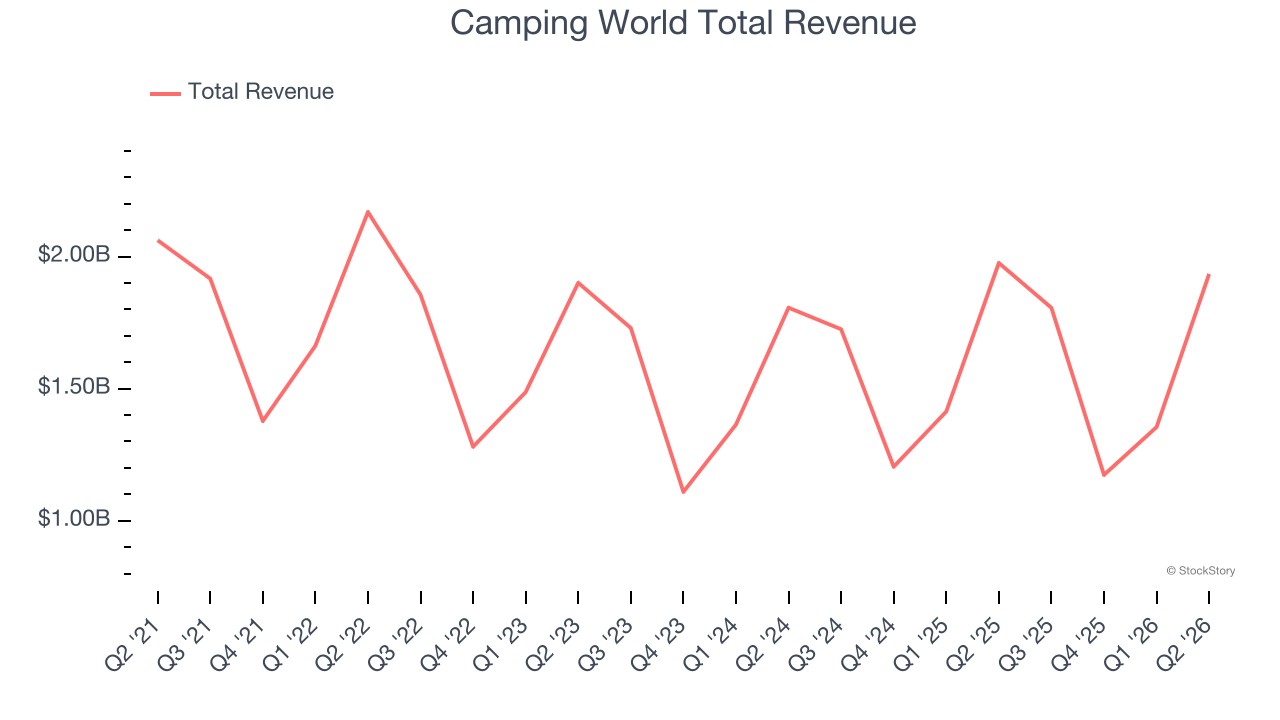
The market was likely pricing in the results, and the stock is flat since reporting. It currently trades at $6.04.
Read our full report on Camping World here, it’s free.
Best Q2: CarMax (NYSE: KMX)
Known for its transparent, customer-centric approach and wide selection of vehicles, Carmax (NYSE: KMX) is the largest automotive retailer in the United States.
CarMax reported revenues of $8.01 billion, up 6.2% year on year, outperforming analysts’ expectations by 8.2%. The business had a stunning quarter with a beat of analysts’ EPS estimates.
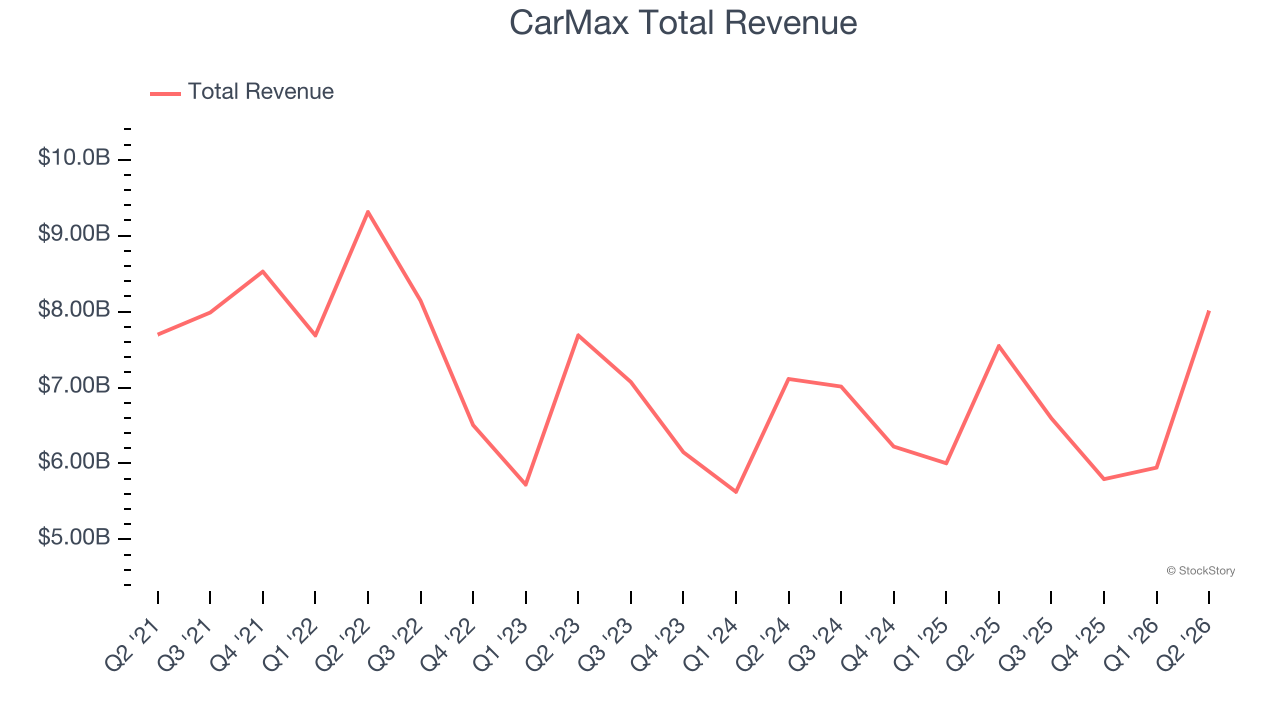
CarMax achieved the biggest analyst estimate beat in the group. The market seems happy with the results as the stock is up 17.7% since reporting. It currently trades at $61.34.
Is now the time to buy CarMax? Access our full analysis of the earnings results here, it’s free.
Weakest Q2: America's Car-Mart (NASDAQ: CRMT)
With a strong presence in the Southern and Central US, America’s Car-Mart (NASDAQ: CRMT) sells used cars to budget-conscious consumers.
America's Car-Mart reported revenues of $144.2 million, down 57.6% year on year, falling short of analysts’ expectations by 36%. It was a disappointing quarter as it posted a significant miss of analysts’ EPS estimates.
America's Car-Mart delivered the weakest performance against analyst estimates and slowest revenue growth among its peers. As expected, the stock is down 22.9% since the results and currently trades at $1.92.
Read our full analysis of America's Car-Mart’s results here.
Penske Automotive Group (NYSE: PAG)
With a diverse global network spanning the US, UK, Canada, Germany, Italy, Japan, and Australia, Penske Automotive Group (NYSE: PAG) operates automotive and commercial truck dealerships across the globe, selling new and used vehicles while providing service, parts, and financing options.
Penske Automotive Group reported revenues of $8.51 billion, up 11.1% year on year. This result topped analysts’ expectations by 6.5%. It was an exceptional quarter as it also logged a solid beat of analysts’ EBITDA estimates and a beat of analysts’ EPS estimates.
Penske Automotive Group delivered the fastest revenue growth of the whole group. The stock is down 1.2% since reporting and currently trades at $217.34.
Read our full, actionable report on Penske Automotive Group here, it’s free.
Market Update
Over the past year, investors have been forced to repeatedly answer the same question: what is the market’s biggest risk? The answer has changed several times, and each shift has reshaped market leadership.
Late in 2025 and early 2026, artificial intelligence became the market’s primary uncertainty. Investors questioned whether AI would erode software pricing power and weaken competitive moats as AI made it easier to replicate once-differentiated products.
By the spring, technology took a back seat to geopolitics. The U.S. conflict with Iran briefly became the market’s dominant narrative, raising concerns about oil prices, inflation, and global growth. But as energy markets remained orderly and fears of a prolonged supply disruption faded, investors quickly turned their focus back to fundamentals.
Want to invest in winners with rock-solid fundamentals? Check out our 9 Best Market-Beating Stocks and add them to your watchlist. These companies are poised for growth regardless of the political or macroeconomic climate.