Agricultural and construction machinery company Deere (NYSE: DE) beat Wall Street’s revenue expectations in Q1 CY2026, with sales up 4.7% year on year to $13.37 billion. Its GAAP profit of $6.55 per share was 14.1% above analysts’ consensus estimates.
Is now the time to buy Deere? Find out by accessing our full research report, it’s free.
Deere (DE) Q1 CY2026 Highlights:
- Revenue: $13.37 billion vs analyst estimates of $13.05 billion (4.7% year-on-year growth, 2.5% beat)
- EPS (GAAP): $6.55 vs analyst estimates of $5.74 (14.1% beat)
- Adjusted Operating Income: $2.24 billion vs analyst estimates of $1.97 billion (16.7% margin, 13.3% beat)
- Operating Margin: 16.7%, down from 18.1% in the same quarter last year
- Market Capitalization: $151.4 billion
"Our performance in the current market environment demonstrates the strength of our diversified portfolio. This is particularly reflected in the strong outcomes achieved by our Small Ag and Construction & Forestry divisions during this year," stated John May, chairman and CEO of John Deere.
Company Overview
Revolutionizing agriculture with the first self-polishing cast-steel plow in the 1800s, Deere (NYSE: DE) manufactures and distributes advanced agricultural, construction, forestry, and turf care equipment.
Revenue Growth
Reviewing a company’s long-term sales performance reveals insights into its quality. Any business can put up a good quarter or two, but many enduring ones grow for years. Unfortunately, Deere’s 3.5% annualized revenue growth over the last five years was sluggish. This fell short of our benchmark for the industrials sector and is a poor baseline for our analysis.
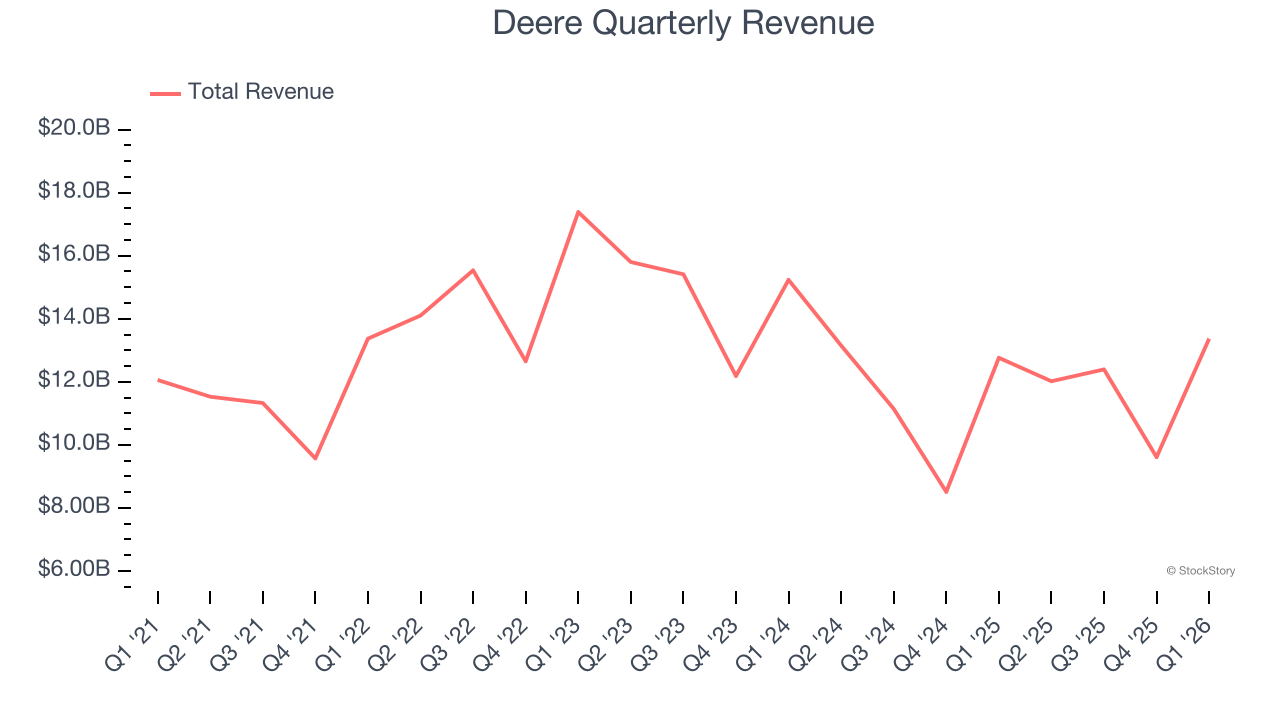
We at StockStory place the most emphasis on long-term growth, but within industrials, a half-decade historical view may miss cycles, industry trends, or a company capitalizing on catalysts such as a new contract win or a successful product line. Deere’s performance shows it grew in the past but relinquished its gains over the last two years, as its revenue fell by 10.1% annually. 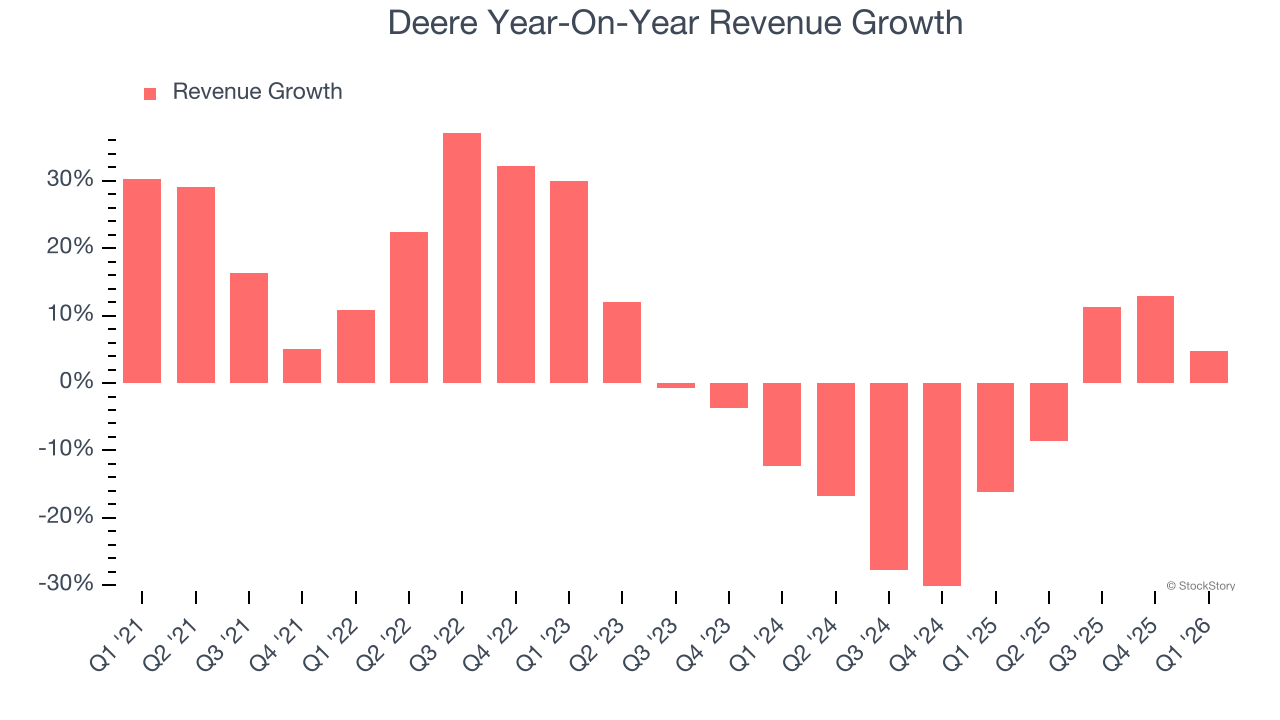
We can better understand the company’s revenue dynamics by analyzing its three most important segments: Production & Precision Agriculture
, Construction & Forestry
, and Small Agriculture & Turf, which are 33.7%, 28.3%, and 26.1% of revenue. Over the last two years, Deere’s Production & Precision Agriculture
(tractors, harvesters, tillage) and Construction & Forestry
(loaders, excavators, dump trucks) revenues averaged year-on-year declines of 10.7% and 5% while its Small Agriculture & Turf revenue (mowers and other small vehicles) averaged 3.6% growth. 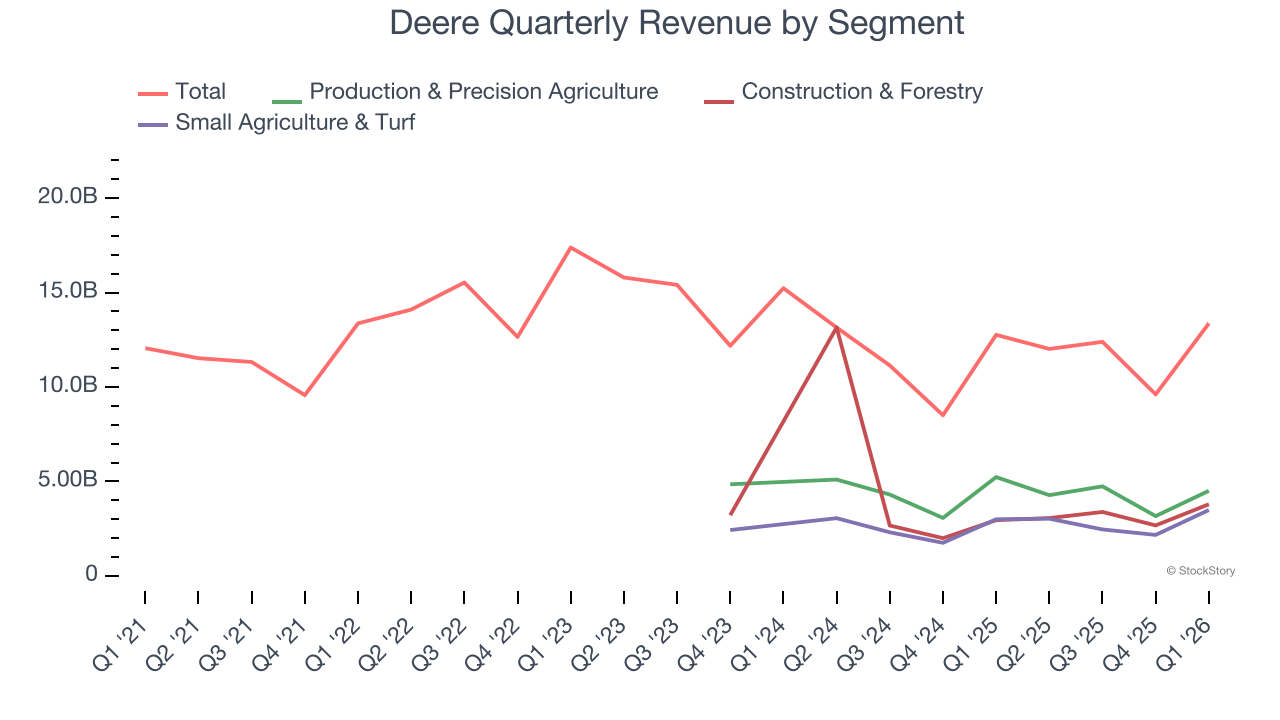
This quarter, Deere reported modest year-on-year revenue growth of 4.7% but beat Wall Street’s estimates by 2.5%.
Looking ahead, sell-side analysts expect revenue to grow 4.9% over the next 12 months. Although this projection implies its newer products and services will catalyze better top-line performance, it is still below average for the sector.
WHILE YOU’RE HERE: The Next Palantir? One satellite company captures images of every point on Earth. Every single day. The Pentagon wants it. Hedge funds are using it to beat earnings. You’ve probably never heard of it.
This is what the early days of Palantir looked like before it became a $437 billion giant. Same playbook. Different technology. If you missed Palantir, you need to see this. Claim The Stock Ticker for Free HERE.
Operating Margin
Operating margin is a key measure of profitability. Think of it as net income - the bottom line - excluding the impact of taxes and interest on debt, which are less connected to business fundamentals.
Deere has been a well-oiled machine over the last five years. It demonstrated elite profitability for an industrials business, boasting an average operating margin of 17.3%. This result was particularly impressive because of its low gross margin, which is mostly a factor of what it sells and takes huge shifts to move meaningfully. Companies have more control over their operating margins, and it’s a show of well-managed operations if they’re high when gross margins are low.
Analyzing the trend in its profitability, Deere’s operating margin decreased by 4.6 percentage points over the last five years. This raises questions about the company’s expense base because its revenue growth should have given it leverage on its fixed costs, resulting in better economies of scale and profitability.
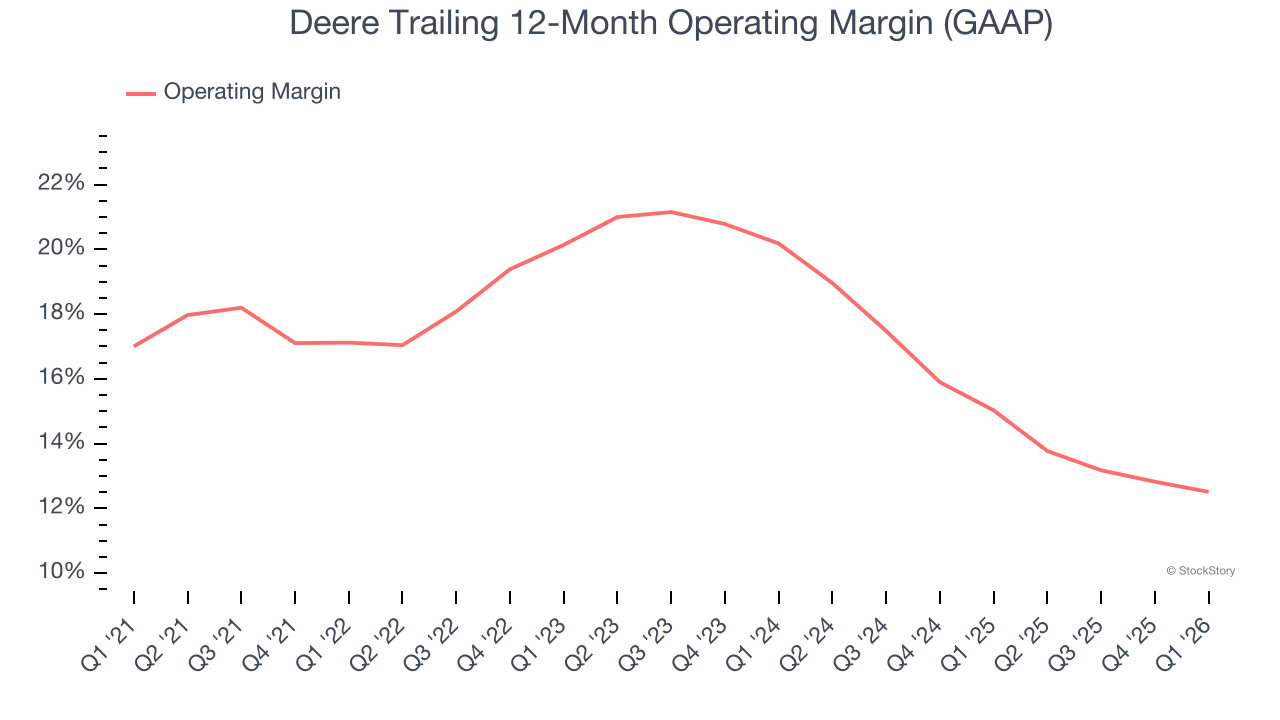
This quarter, Deere generated an operating margin profit margin of 16.7%, down 1.4 percentage points year on year. Conversely, its revenue and gross margin actually rose, so we can assume it was less efficient because its operating expenses like marketing, R&D, and administrative overhead grew faster than its revenue.
Earnings Per Share
Revenue trends explain a company’s historical growth, but the long-term change in earnings per share (EPS) points to the profitability of that growth – for example, a company could inflate its sales through excessive spending on advertising and promotions.
Deere’s unimpressive 4% annual EPS growth over the last five years aligns with its revenue performance. This tells us it maintained its per-share profitability as it expanded.
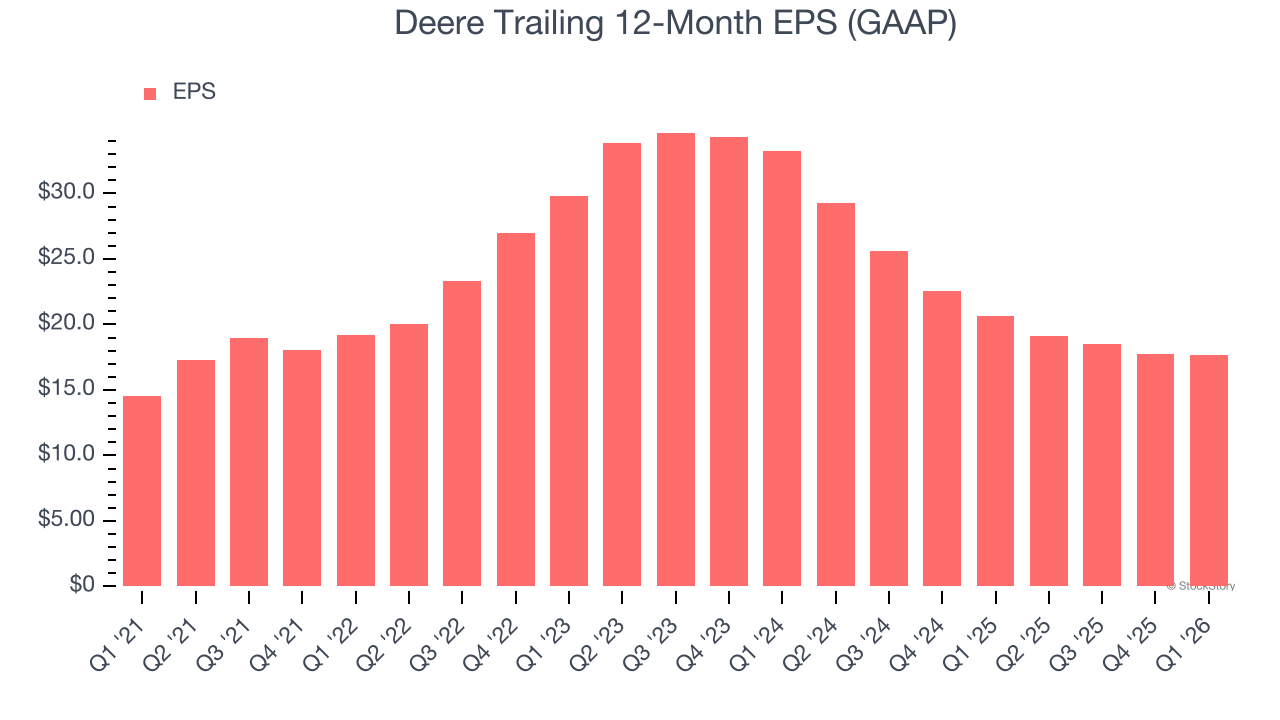
Like with revenue, we analyze EPS over a more recent period because it can provide insight into an emerging theme or development for the business.
Deere’s two-year annual EPS declines of 27.1% were bad and lower than its two-year revenue losses.
We can take a deeper look into Deere’s earnings to better understand the drivers of its performance. Deere’s operating margin has declined over the last two years. This was the most relevant factor (aside from the revenue impact) behind its lower earnings; interest expenses and taxes can also affect EPS but don’t tell us as much about a company’s fundamentals.
In Q1, Deere reported EPS of $6.55, down from $6.64 in the same quarter last year. Despite falling year on year, this print easily cleared analysts’ estimates. Over the next 12 months, Wall Street expects Deere’s full-year EPS of $17.65 to grow 15.6%.
Key Takeaways from Deere’s Q1 Results
We were impressed by how significantly Deere blew past analysts’ adjusted operating income expectations this quarter. We were also glad its revenue outperformed Wall Street’s estimates. Zooming out, we think this was a solid print. The market seemed to be hoping for more, and the stock traded down 3.4% to $541.45 immediately following the results.
Is Deere an attractive investment opportunity right now? If you’re making that decision, you should consider the bigger picture of valuation, business qualities, as well as the latest earnings. We cover that in our actionable full research report which you can read here (it’s free).