Bearings manufacturer RBC Bearings (NYSE: RBC) reported Q1 CY2026 results exceeding the market’s revenue expectations, with sales up 18.3% year on year to $518 million. Guidance for next quarter’s revenue was better than expected at $505 million at the midpoint, 1.4% above analysts’ estimates. Its non-GAAP profit of $3.62 per share was 9% above analysts’ consensus estimates.
Is now the time to buy RBC Bearings? Find out by accessing our full research report, it’s free.
RBC Bearings (RBC) Q1 CY2026 Highlights:
- Revenue: $518 million vs analyst estimates of $506.3 million (18.3% year-on-year growth, 2.3% beat)
- Adjusted EPS: $3.62 vs analyst estimates of $3.32 (9% beat)
- Adjusted EBITDA: $168.9 million vs analyst estimates of $163.7 million (32.6% margin, 3.2% beat)
- Revenue Guidance for Q2 CY2026 is $505 million at the midpoint, above analyst estimates of $498.1 million
- Operating Margin: 23%, in line with the same quarter last year
- Free Cash Flow Margin: 13%, similar to the same quarter last year
- Market Capitalization: $19.35 billion
Dr. Michael J. Hartnett, Chairman and Chief Executive Officer, stated, “We closed out fiscal year 2026 with another strong quarter, driven by continued expansion in our Aerospace & Defense segment and accelerating growth in our Industrial business. As we look ahead to fiscal year 2027, we remain highly encouraged by the strength of our operating environment and the momentum we are seeing across the businesses. This record year for RBC was a true team effort, and I want to thank our employees across the organization for their hard work, dedication, and continued commitment to serving our customers with excellence.”
Company Overview
With a Guinness World Record for engineering the largest spherical plain bearing, RBC Bearings (NYSE: RBC) is a manufacturer of bearings and related components for the aerospace & defense, industrial, and transportation industries.
Revenue Growth
A company’s long-term sales performance can indicate its overall quality. Even a bad business can shine for one or two quarters, but a top-tier one grows for years. Over the last five years, RBC Bearings grew its sales at an incredible 25.2% compounded annual growth rate. Its growth surpassed the average industrials company and shows its offerings resonate with customers, a great starting point for our analysis.
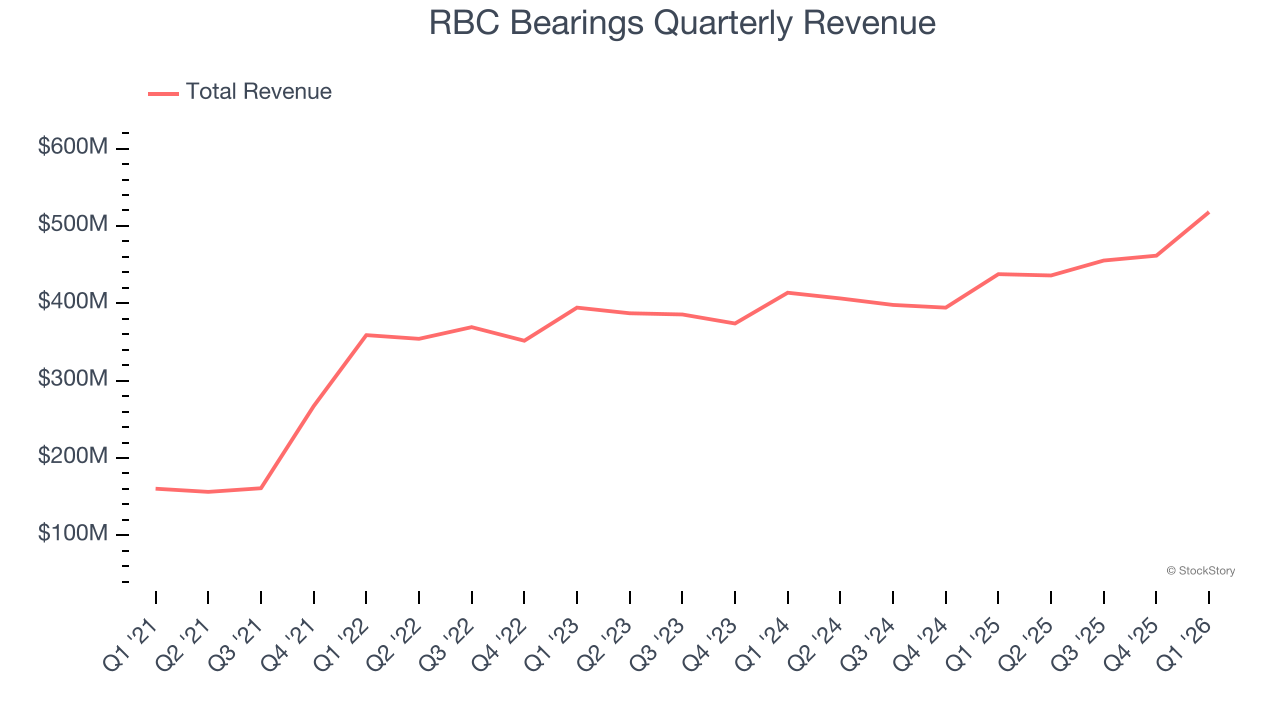
Long-term growth is the most important, but within industrials, a half-decade historical view may miss new industry trends or demand cycles. RBC Bearings’s annualized revenue growth of 9.5% over the last two years is below its five-year trend, but we still think the results suggest healthy demand. 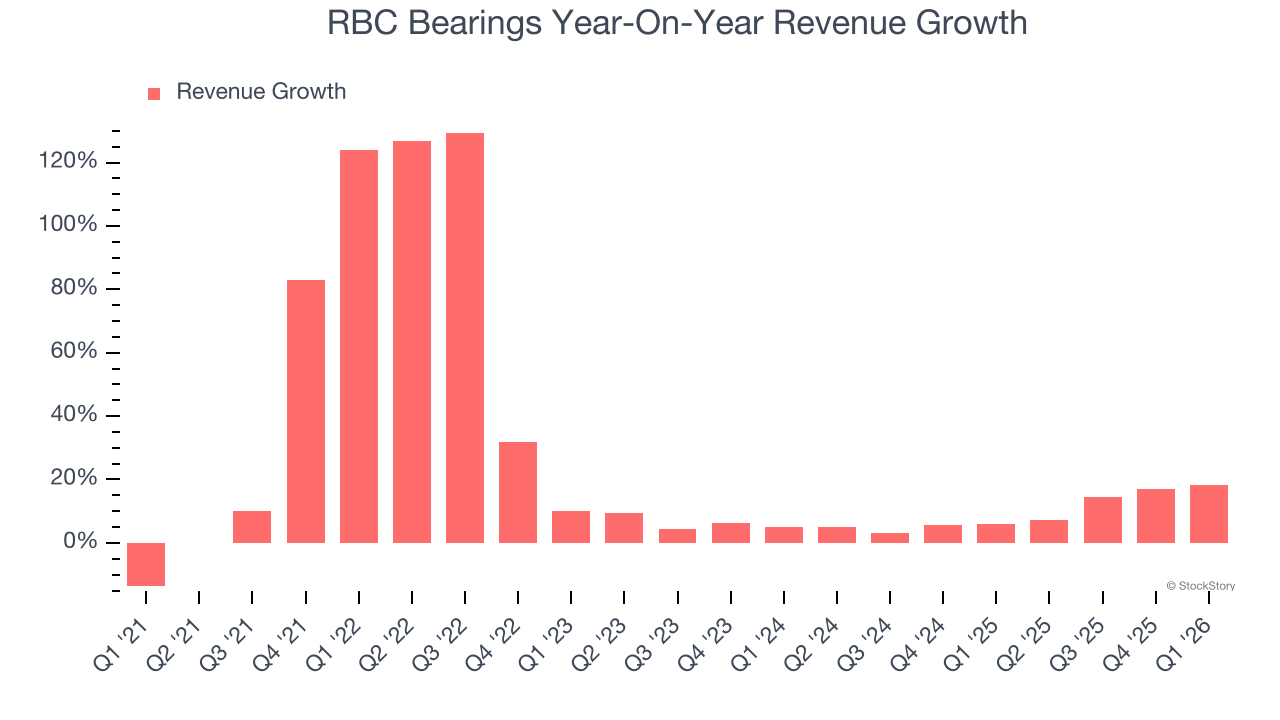
We can dig further into the company’s revenue dynamics by analyzing its most important segments, Diversified Industrials and Aerospace and Defense, which are 42.9% and 57.1% of revenue. Over the last two years, RBC Bearings’s Diversified Industrials revenue (general industrial equipment) averaged 8.7% year-on-year growth while its Aerospace and Defense revenue (aircraft equipment, radar, missiles) averaged 37.7% growth. 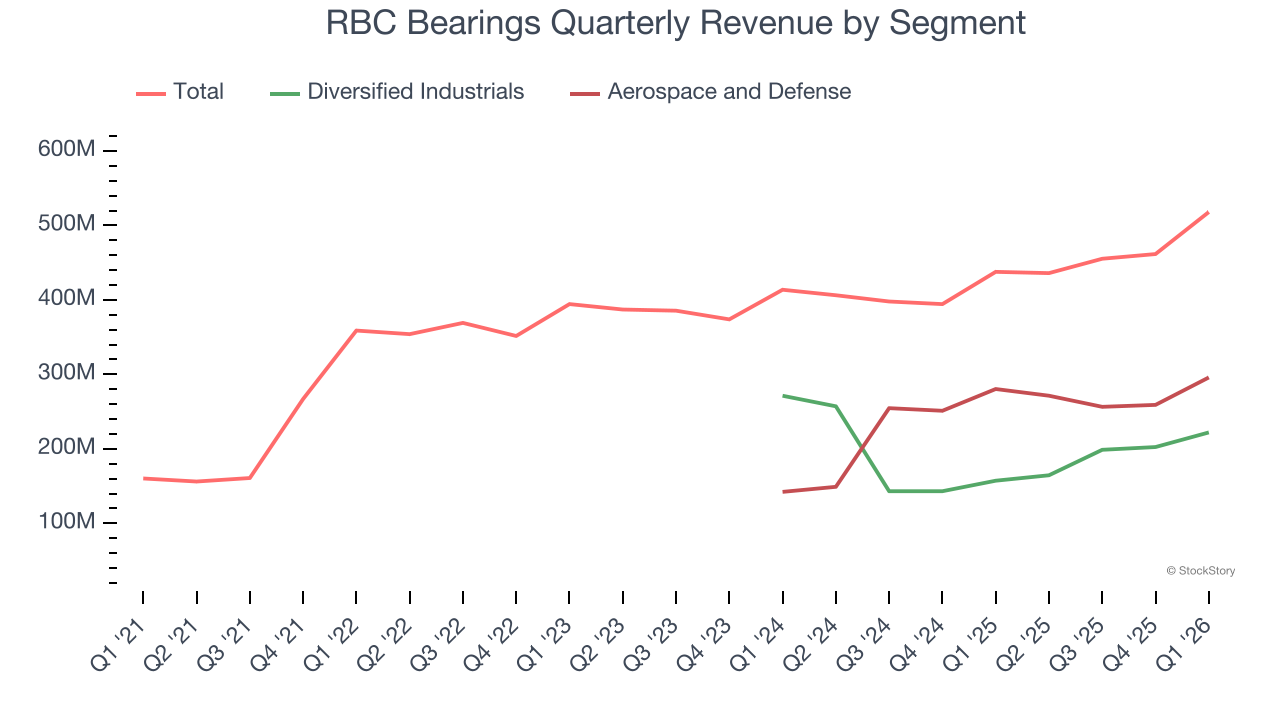
This quarter, RBC Bearings reported year-on-year revenue growth of 18.3%, and its $518 million of revenue exceeded Wall Street’s estimates by 2.3%. Company management is currently guiding for a 15.8% year-on-year increase in sales next quarter.
Looking further ahead, sell-side analysts expect revenue to grow 11.2% over the next 12 months, an improvement versus the last two years. This projection is healthy and indicates its newer products and services will fuel better top-line performance.
WHILE YOU’RE HERE: The Next Palantir? One satellite company captures images of every point on Earth. Every single day. The Pentagon wants it. Hedge funds are using it to beat earnings. You’ve probably never heard of it.
This is what the early days of Palantir looked like before it became a $437 billion giant. Same playbook. Different technology. If you missed Palantir, you need to see this. Claim The Stock Ticker for Free HERE.
Operating Margin
RBC Bearings has been a well-oiled machine over the last five years. It demonstrated elite profitability for an industrials business, boasting an average operating margin of 20.7%. This result isn’t surprising as its high gross margin gives it a favorable starting point.
Looking at the trend in its profitability, RBC Bearings’s operating margin rose by 9.7 percentage points over the last five years, as its sales growth gave it immense operating leverage.
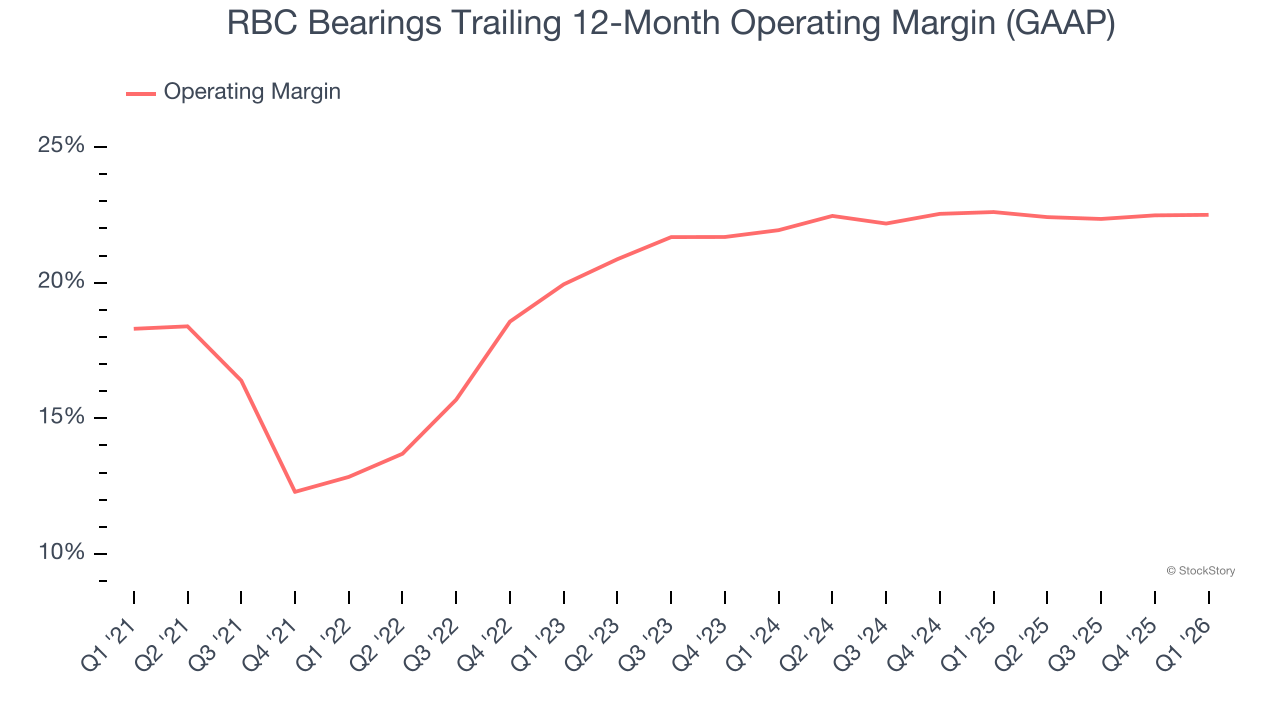
In Q1, RBC Bearings generated an operating margin profit margin of 23%, in line with the same quarter last year. This indicates the company’s cost structure has recently been stable.
Earnings Per Share
We track the long-term change in earnings per share (EPS) for the same reason as long-term revenue growth. Compared to revenue, however, EPS highlights whether a company’s growth is profitable.
RBC Bearings’s astounding 26.2% annual EPS growth over the last five years aligns with its revenue performance. This tells us its incremental sales were profitable.
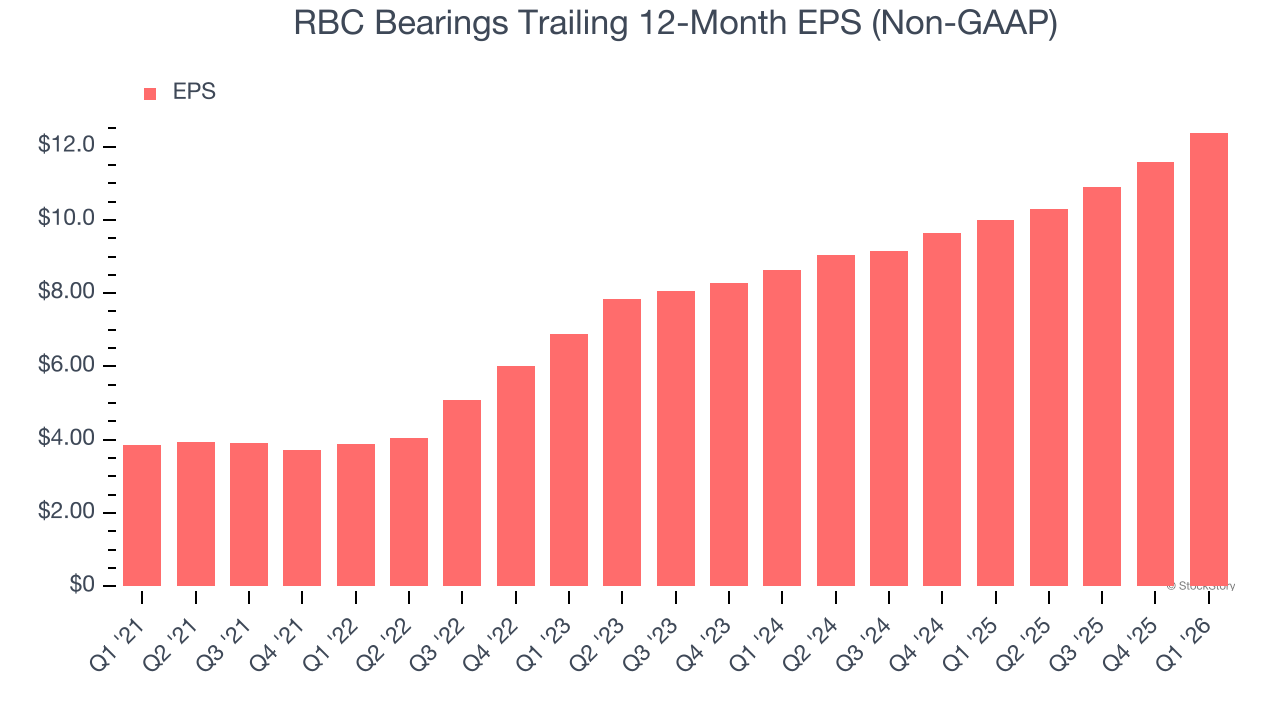
Like with revenue, we analyze EPS over a more recent period because it can provide insight into an emerging theme or development for the business.
For RBC Bearings, its two-year annual EPS growth of 19.8% was lower than its five-year trend. We still think its growth was good and hope it can accelerate in the future.
In Q1, RBC Bearings reported adjusted EPS of $3.62, up from $2.83 in the same quarter last year. This print beat analysts’ estimates by 9%. Over the next 12 months, Wall Street expects RBC Bearings’s full-year EPS of $12.38 to grow 14.1%.
Key Takeaways from RBC Bearings’s Q1 Results
We enjoyed seeing RBC Bearings beat analysts’ revenue expectations this quarter. We were also happy its EPS outperformed Wall Street’s estimates. Looking ahead, revenue guidance also beat. Overall, this print had some key positives. The stock remained flat at $617.48 immediately following the results.
Sure, RBC Bearings had a solid quarter, but if we look at the bigger picture, is this stock a buy? We think that the latest quarter is only one piece of the longer-term business quality puzzle. Quality, when combined with valuation, can help determine if the stock is a buy. We cover that in our actionable full research report which you can read here (it’s free).