As of mid-January 2026, the landscape of broadcast journalism has fundamentally shifted. For decades, viewers tuned into news networks for opinions, expert "hot takes," and statistical polling that often lagged behind reality. That era ended this month. With the full-scale launch of landmark media partnerships between the regulated exchange Kalshi and news giants CNN (NASDAQ: WBD) and CNBC (NASDAQ: CMCSA), prediction market data has moved from the financial fringe to the center of the television screen.
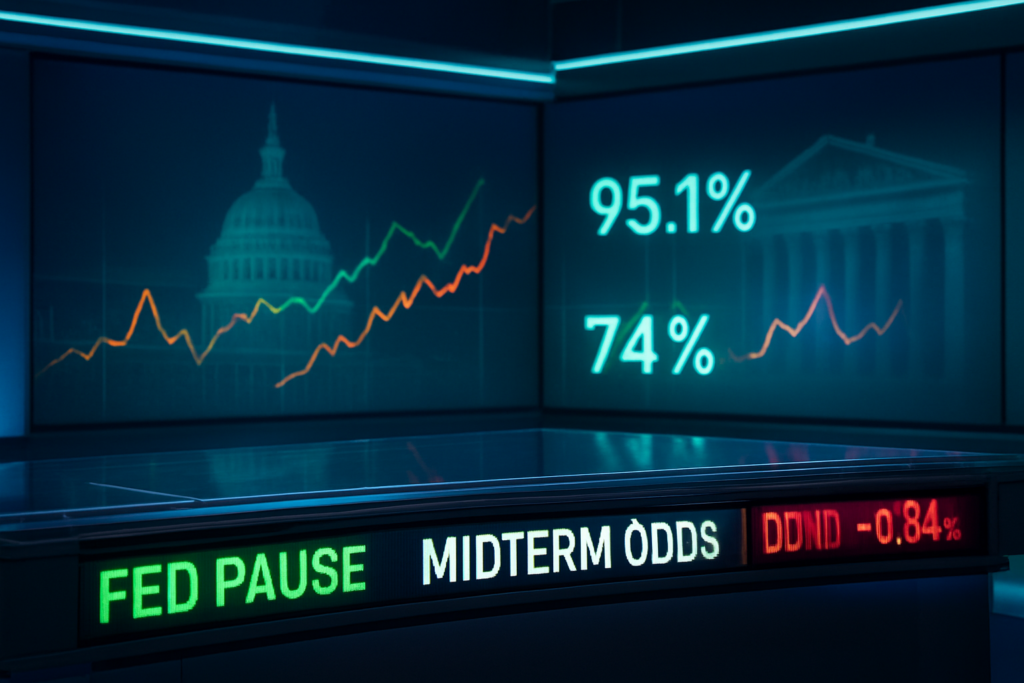
Today, if you tune into "Squawk Box" or "The Lead," you won't just hear a pundit's guess on the next Federal Reserve move or a legislative vote. Instead, you'll see a live, ticker-tape stream of real-money probabilities. As of January 16, 2026, these markets show a staggering 95.1% probability that the Fed will pause interest rate hikes at its upcoming meeting on January 28. This isn't just a survey; it’s the collective "hive mind" of thousands of traders who have hundreds of millions of dollars on the line.
The Market: What’s Being Predicted
The integration of Kalshi data into mainstream media is powered by an explosion in trading volume. In the first full week of January 2026, Kalshi recorded over $2 billion in weekly notional volume, capturing approximately 66% of the U.S. regulated event-trading market. While Polymarket—recently bolstered by a $2 billion investment from the Intercontinental Exchange (NYSE: ICE)—continues to lead in global decentralized markets, Kalshi has become the "official scoreboard" for American domestic affairs.
The specific "Information Finance" contracts being broadcast to millions of households cover a vast array of topics:
- Monetary Policy: Real-time odds on Fed rate cuts, inflation benchmarks, and employment numbers.
- Political Shifts: Probability of the Democrats reclaiming the House (currently 74%) vs. Republicans retaining the Senate (66%) in the 2026 Midterm elections.
- Corporate Events: Likelihood of specific mergers passing regulatory hurdles and CEO transitions.
- Cultural Milestones: From the winner of Super Bowl LX (the Los Angeles Rams currently lead at 14%) to the probability of 2026 becoming the hottest year on record (38%).
These contracts are settled based on verifiable real-world outcomes, and their prices, ranging from $0.01 to $0.99, serve as a direct proxy for the percentage chance of an event occurring.
Why Traders Are Betting
The surge in market participation is driven by a radical "skin in the game" philosophy. Unlike traditional pollsters, who face little consequence for being wrong, prediction market participants are financially incentivized to be right. This has attracted a new class of "truth-seekers," including high-frequency trading (HFT) firms like Jane Street and Susquehanna (SIG), which now act as designated market makers, providing deep liquidity and razor-thin spreads.
Traders are increasingly moving away from traditional forecasting methods. The 2024 and 2025 election cycles proved that polling often fails to capture "shy" voters or rapid sentiment shifts. In contrast, prediction markets reacted in real-time to breaking news, such as the 2025 court rulings that legalized election betting in the U.S. This legal clarity, following Kalshi’s victory over the CFTC, has allowed retail platforms like Robinhood (NASDAQ: HOOD) and Interactive Brokers (NASDAQ: IBKR) to offer event contracts to their millions of users, further deepening the pool of intelligence.
Broader Context and Implications
The deals with CNN and CNBC signal the birth of a new era: the "Information Finance" age. CNN’s Chief Data Analyst, Harry Enten, has largely replaced his traditional "Poll of Polls" segments with "Market-Driven Signals," arguing that a market of incentivized traders is a more reliable filter for truth than a panel of consultants. CNBC has even launched a "Prediction Hub," allowing viewers to see live probabilities directly on the CNBC Pro app.
This shift has profound implications for public discourse. By providing a cold, hard number for the probability of an event, prediction markets help to de-polarize news. It is difficult to argue with a market where people are betting their own money against your bias. Historically, these markets have proven more accurate than experts in predicting everything from Supreme Court decisions to the timing of recessionary dips.
However, the rapid growth has not been without controversy. Legislative battles are currently raging in states like New York, where the "ORACLE Act" (Assembly Bill A9251) seeks to limit political event contracts. Kalshi’s market currently prices the probability of that ban passing at a modest 22%, suggesting that the "truth engine" believes it will ultimately prevail in the courts.
What to Watch Next
As we move deeper into 2026, several key milestones will test the robustness of this new media-market alliance:
- The FOMC Meeting (Jan 27–28): This will be the first major test of the CNBC-Kalshi ticker during a period of high economic volatility.
- The 2026 Primary Season: Watch for how CNN utilizes Kalshi data to forecast primary upsets, potentially influencing donor behavior and campaign strategies in real-time.
- The "Super Bowl Signal": On February 8, the massive liquidity flowing into Super Bowl LX contracts will demonstrate Kalshi's ability to handle high-frequency, mass-market sports data alongside its "serious" economic contracts.
Bottom Line
The 2026 media deals between Kalshi, CNN, and CNBC mark the moment prediction markets ceased being a "sideshow" and became the "truth engine" for the public. By moving probability data from the trading floor to the living room, these platforms are providing a more objective, faster, and more accurate way for the world to understand the future.
In an age of deepfakes and extreme partisanship, "Information Finance" offers a rare commodity: a scoreboard for reality. Whether the event is a rate hike or a presidential primary, the question is no longer "What do the experts think?" but rather "What does the market say?"
This article is for informational purposes only and does not constitute financial or betting advice. Prediction market participation may be subject to legal restrictions in your jurisdiction.
PredictStreet focuses on covering the latest developments in prediction markets.
Visit the PredictStreet website at https://www.predictstreet.ai/.