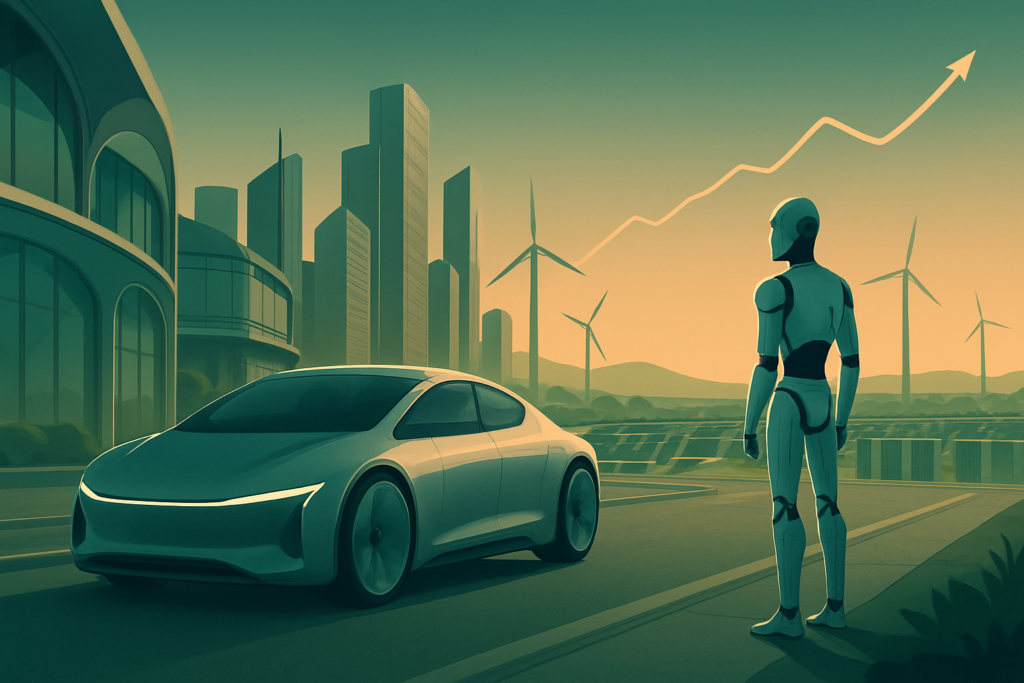
As of December 22, 2025, Tesla, Inc. (NASDAQ: TSLA) finds itself at the epicenter of a transformation that has redefined the boundaries between the automotive industry and the frontier of artificial intelligence. Once viewed purely as a pioneer of electric vehicles (EVs), the company is now increasingly characterized by its ambitions in robotics and autonomous systems. This year has been particularly momentous, marked by the resolution of a multi-year legal saga regarding executive compensation and a strategic shift toward a "Physical AI" future.
With the stock experiencing significant volatility following a post-election rally in late 2024 and major technical milestones in 2025, Tesla remains one of the most scrutinized and debated entities on Wall Street. This deep-dive explores the company’s current standing, its financial health, and the high-stakes roadmap that aims to put thousands of autonomous "Cybercabs" on the road by next year.
Historical Background
Founded in 2003 by Martin Eberhard and Marc Tarpenning, with Elon Musk leading the Series A funding and eventually taking the CEO mantle, Tesla’s journey is one of the most improbable success stories in industrial history. From the niche Roadster in 2008 to the luxury Model S and X, the company initially set out to prove that electric cars could be superior to their internal combustion engine (ICE) counterparts.
The "Master Plan" culminated in the 2017 launch of the Model 3, which brought Tesla to the brink of bankruptcy during its production ramp but ultimately secured its position as a mass-market leader. Following the successful launch of the Model Y—which became the world’s best-selling vehicle in 2023—Tesla expanded its global footprint with "Gigafactories" in Shanghai, Berlin, and Texas. Over the last three years, the company has transitioned from a growth-at-all-costs manufacturer to an efficiency-focused giant, navigating "EV fatigue" in Western markets and fierce competition from Chinese rivals.
Business Model
Tesla’s business model is vertically integrated to an extent rarely seen in the automotive sector. Its revenue streams are categorized into three primary segments:
- Automotive: Sale and leasing of the Model S, 3, X, Y, and Cybertruck. This remains the core revenue driver, though margins have faced pressure due to price cuts intended to stimulate demand.
- Energy Generation and Storage: This segment has emerged as a powerhouse in 2025. By selling the Megapack for utility-scale storage and the Powerwall for homes, Tesla is capitalizing on the global shift toward renewable energy.
- Services and Other: This includes vehicle repairs, supercharging network access (which has now been opened to almost all major OEMs), and software-based revenue such as Full Self-Driving (FSD) subscriptions.
In 2025, the strategic focus has shifted toward "Autonomy-as-a-Service," where Tesla aims to transition from selling hardware once to generating recurring, high-margin software revenue through its Robotaxi network.
Stock Performance Overview
As we conclude 2025, TSLA stock remains a high-beta asset that responds aggressively to both macro trends and "Musk-specific" catalysts.
- 1-Year Performance: The stock is up approximately 10.32% over the trailing 12 months. This reflects a difficult first half of 2025 followed by a massive recovery in the fourth quarter.
- 5-Year Performance: Long-term investors have seen a cumulative return of 122.14%, outperforming the broader S&P 500 significantly during the same period.
- 10-Year Performance: For the truly "diamond-handed," the returns are staggering at 3,003.72%, cementing Tesla’s status as a generational wealth-builder despite its many pullbacks.
The recent surge in late 2025 is largely attributed to the Delaware Supreme Court's decision to reinstate Elon Musk’s compensation package and the removal of the "key-man risk" overhang that had plagued the stock for two years.
Financial Performance
Tesla’s 2024 fiscal year was a period of consolidation. The company delivered 1.79 million vehicles, a slight 1.1% dip from 2023, as high interest rates dampened consumer appetite for new car loans. However, the financial picture for 2025 has improved significantly.
For the full year 2025, Tesla is projected to report revenue of approximately $117.2 billion, a roughly 17.5% increase year-over-year. This growth is being driven by the expansion of the Energy segment, which saw margins exceed 30% this year, and the ramp-up of Cybertruck production to an annualized rate of 250,000 units. Operating margins have stabilized around 11%, as the company continues to lower its cost per vehicle through manufacturing innovations like "unboxed" assembly and increased use of large-scale castings.
Leadership and Management
The leadership narrative at Tesla is dominated by CEO Elon Musk. While his involvement in other ventures like SpaceX and xAI has occasionally led to "part-time CEO" criticisms, his influence remains the primary driver of the company’s valuation.
The management team has seen stabilization under CFO Vaibhav Taneja and Automotive Senior VP Tom Zhu. However, governance remains a central topic. The Delaware Supreme Court ruling on December 19, 2025, which reinstated Musk’s $139 billion pay package (current valuation), was a landmark moment. The court ruled that the 2024 shareholder re-vote effectively ratified the board's decision, ending a period of legal uncertainty that many feared would lead to Musk’s exit or a reduced focus on Tesla.
Products, Services, and Innovations
Tesla’s product pipeline is currently focused on the "AI pivot."
- The Cybercab: Unveiled in late 2024, the Cybercab is a dedicated two-seater without a steering wheel. Pilot production began in late 2025 at Giga Texas, with mass production targeted for April 2026.
- Optimus (Tesla Bot): The second-generation Optimus humanoid robot is now performing basic tasks in Tesla factories. Musk has signaled that limited external sales could begin in 2026, positioning Tesla as a leader in general-purpose robotics.
- FSD v13 & Unsupervised Autonomy: The release of FSD v13 in late 2025 has brought Tesla closer to "Level 4" autonomy. The company has begun filing for regulatory approval to launch an unsupervised Robotaxi pilot in Texas and California by early next year.
Competitive Landscape
Tesla no longer operates in a vacuum. The competitive landscape in 2025 is bifurcated:
- In China: BYD Co. Ltd. (OTC: BYDDY) remains a formidable rival, often trading the title of "world's largest EV maker" with Tesla on a quarterly basis. Other tech-heavy entrants like Xiaomi (OTC: XIACY) have also gained significant market share in the premium sedan segment.
- In the U.S. and Europe: Legacy automakers like Ford (NYSE: F) and General Motors (NYSE: GM) have scaled back their aggressive EV targets in favor of hybrids, leaving Tesla to maintain a dominant share of the pure-EV market. Meanwhile, pure-play rivals like Rivian Automotive (NASDAQ: RIVN) are focusing on their next-generation R2 platform to compete with the Model Y.
Tesla’s competitive edge remains its superior charging infrastructure (Supercharger), its massive data advantage for AI training, and its industry-leading cost structure.
Industry and Market Trends
The global EV industry in 2025 has transitioned into a "second phase." The early adopter phase is over, and the industry is now tackling the "pragmatist" middle market.
- Interest Rates: As the Federal Reserve began easing rates in mid-2025, vehicle affordability improved, providing a tailwind for the entire sector.
- Energy Transition: The massive demand for grid-scale batteries to support intermittent renewable energy has made Tesla’s Energy business a critical infrastructure player, detached from the cyclical nature of the auto market.
- AI Democratization: The race for autonomous compute has intensified, with Tesla’s Dojo supercomputer and NVIDIA-based clusters providing the "brains" for the next generation of transport.
Risks and Challenges
Despite its successes, Tesla faces non-trivial risks:
- Regulatory Hurdles: Achieving technical autonomy is only half the battle. Securing state-by-state approval for steering-wheel-less vehicles like the Cybercab could take years of legal and safety reviews.
- Geopolitical Tension: With a large percentage of production and sales tied to China, any escalation in trade wars or data-security disputes could severely impact Tesla's supply chain and revenue.
- Execution Risk: Moving from pilot production of Optimus and Cybercab to mass manufacturing involves the same "production hell" risks that nearly sank the company in 2017.
- Key-Man Dependency: Despite the pay package resolution, the company's valuation remains tied to Musk’s personal brand and continued presence.
Opportunities and Catalysts
Looking toward 2026, several catalysts could drive the next leg of growth:
- The "Affordable Model": Long-rumored and expected to be priced around $25,000, a smaller Tesla model using the "unboxed" manufacturing process could unlock the mass-market volumes needed to reach the 5-million-vehicle annual target.
- FSD Licensing: Musk has repeatedly mentioned discussions with other OEMs to license FSD. A single major partnership would transform Tesla into a high-margin software provider overnight.
- Energy Scaling: The ramp of the Lathrop and Shanghai Megafactories could see Energy revenue eventually rival Automotive revenue.
Investor Sentiment and Analyst Coverage
Wall Street remains deeply divided on Tesla. "Value-oriented" analysts often value Tesla as an auto company, leading to price targets in the $150–$200 range based on P/E multiples. Conversely, "Growth" and "AI" analysts view Tesla as a robotics play, with targets exceeding $400 based on the projected Net Present Value (NPV) of a future Robotaxi fleet.
Institutional sentiment has improved in late 2025 as the "overhang" of the Musk pay package and the 2024 delivery slump has cleared. Retail sentiment remains fervently bullish, often acting as a floor for the stock during periods of macro volatility.
Regulatory, Policy, and Geopolitical Factors
In the U.S., the regulatory environment for 2025 has been influenced by a shift in federal EV incentives. While some direct consumer tax credits have been modified, the emphasis has moved toward "Made in America" manufacturing credits, which Tesla is uniquely positioned to capture through its domestic battery cell production.
Furthermore, the National Highway Traffic Safety Administration (NHTSA) continues to monitor FSD performance. Any major safety recall or federal ban on unsupervised testing would be a catastrophic event for the current "AI-first" valuation.
Conclusion
As we stand at the end of 2025, Tesla is no longer a "car company" in the traditional sense; it is a high-stakes bet on the future of autonomous intelligence. The resolution of the Delaware court case has secured Elon Musk’s leadership for the foreseeable future, and the shift toward the Cybercab and Optimus marks the beginning of the company's most ambitious chapter yet.
For investors, Tesla represents a unique blend of a mature, profitable manufacturer and a speculative technology startup. The next 12 to 24 months will be a "show-me" period: the company must prove that its FSD software can safely operate without human intervention and that it can successfully transition its robotics prototypes into profitable products. While the path remains fraught with regulatory and technical risks, Tesla’s ability to defy the odds has historically been its most consistent feature.
This content is intended for informational purposes only and is not financial advice.