

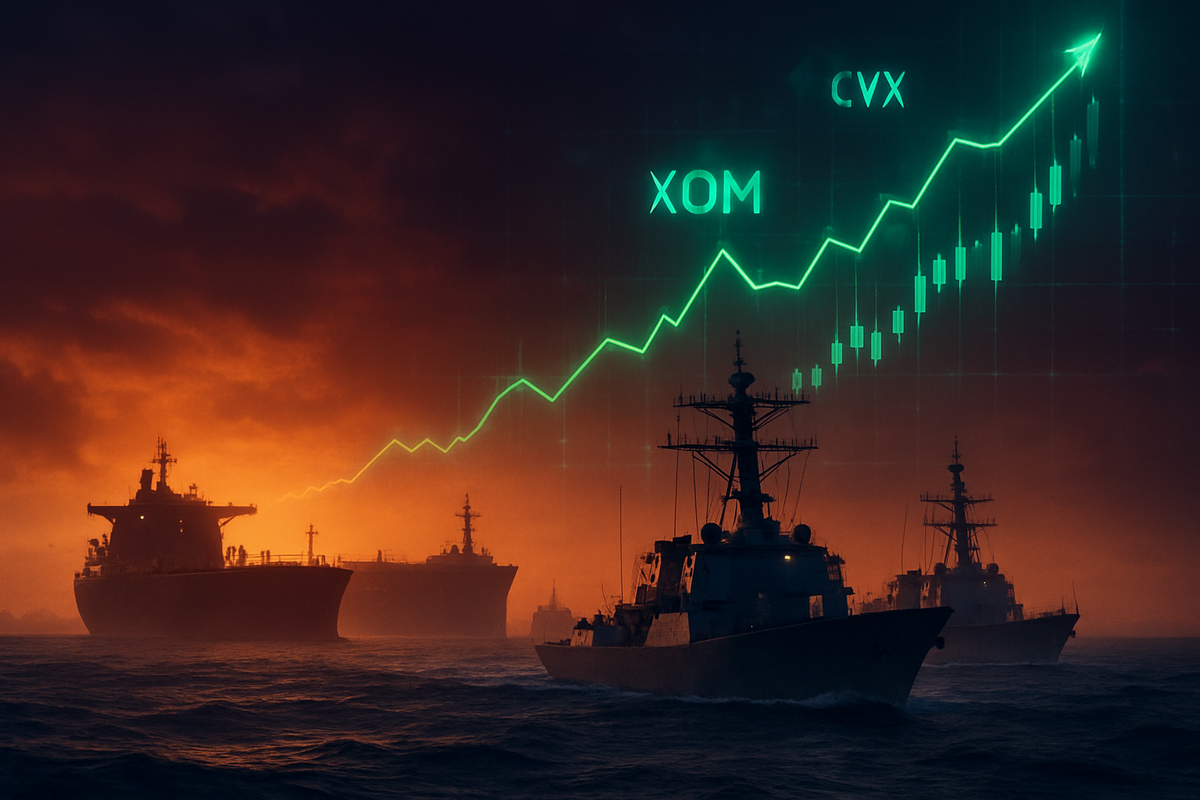
As of mid-April 2026, the global financial landscape is grappling with the most significant energy disruption in decades. The closure of the Strait of Hormuz, a critical maritime artery that facilitates nearly 25% of the world's seaborne oil trade, has sent shockwaves through Wall Street. While the broader S&P 500 has faced intense downward pressure due to inflationary fears and supply chain fractures, the energy sector has emerged as a powerhouse, decoupling from the general market to reach multi-year highs.
The immediate implications are stark: Brent crude prices, which lingered near $70 per barrel late last year, recently tested the $120 mark before settling near $96 following a fragile two-week ceasefire. For the average American, this has manifested as a "tax at the pump," with national gas prices averaging $4.50 per gallon. However, for investors positioned in domestic energy production and infrastructure, the crisis has provided a lucrative, albeit volatile, hedge against geopolitical instability.
A Timeline of Escalation: From Diplomacy to Blockade
The current crisis did not emerge in a vacuum. Tensions began a slow simmer in late 2024 following the collapse of nuclear negotiations in Geneva. By early 2025, a series of targeted airstrikes against Iranian nuclear and missile infrastructure signaled a shift toward open confrontation. The situation reached its zenith on February 28, 2026, with "Operation Epic Fury," a massive coordinated air campaign by U.S. and Israeli forces. The subsequent political vacuum in Tehran led to a desperate strategic move by the Iranian military: the effective mining and blockade of the Strait of Hormuz.
By early March 2026, shipping transits through the Strait plummeted by nearly 97%. This halted not only crude oil but also 20% of global liquefied natural gas (LNG) flows, creating an immediate energy deficit in Europe and Asia. The market's reaction was instantaneous; the "war premium" was priced into commodities overnight. This is not merely a regional conflict but a global supply shock that has forced a complete re-evaluation of energy security and maritime logistics. Key stakeholders, including the U.S. Department of Energy and major global shipping conglomerates, are now scrambling to find overland alternatives that simply do not have the capacity to replace the lost maritime volume.
Winners and Losers: A Tale of Two Markets
The surge in crude prices has created a windfall for U.S. integrated oil majors. ExxonMobil (NYSE: XOM) saw its stock price climb over 40% in the first quarter of 2026 alone, as it hit its highest production levels in four decades by prioritizing its Permian Basin and Guyana assets. Similarly, Chevron (NYSE: CVX) and ConocoPhillips (NYSE: COP) have outperformed, with Chevron focusing heavily on expanding domestic U.S. output to bypass Middle Eastern risk. These companies are now operating with record-high pricing power, signaling increased dividends and share buybacks that have attracted investors fleeing the tech and consumer sectors.
Conversely, the transport and retail sectors are reeling. Delta Air Lines (NYSE: DAL) and United Airlines (NASDAQ: UAL) have been forced to implement aggressive "fuel surcharges" and trim flight capacities to combat jet fuel prices that have nearly doubled since 2025. While Delta’s ownership of the Trainer Refinery provided a slight buffer, both carriers have seen significant margin erosion. In the retail space, a K-shaped recovery is evident. Value-oriented retailers like Burlington (NYSE: BURL) and BJ's Wholesale (NYSE: BJ) have seen sales dip as their core customers divert discretionary income toward essentials. In contrast, luxury-leaning or bulk-buy giants like Ulta Beauty (NASDAQ: ULTA) and Costco (NASDAQ: COST) have shown more resilience, as their affluent customer bases are less impacted by the surge in energy costs.
Wider Significance: The Geopolitical Hedge and the "AI Power Boom"
This event fits into a broader trend of "energy nationalism" that has been growing throughout the mid-2020s. Unlike previous oil shocks, the 2026 crisis coincides with a massive increase in energy demand driven by the global AI infrastructure boom. Data centers require consistent, high-volume electricity, much of which is still fueled by natural gas. The disruption in LNG flows through Hormuz has exacerbated this, making domestic natural gas producers even more critical to the U.S. economy. This "AI-Energy Nexus" has created a floor for energy prices that didn't exist during the shale gluts of the previous decade.
Furthermore, the secondary "fertilizer shock" is a growing concern for global stability. With 25% of global sulfur and nitrogen fertilizer exports blocked by the Iranian blockade, urea prices have jumped 30%. This mirrors the supply chain crises of 2022 but on a larger scale, threatening global food security and suggesting that inflationary pressures will persist long after the Strait reopens. Historically, this bears resemblance to the 1973 oil embargo, yet the modern economy's total dependence on just-in-time energy for both physical and digital infrastructure makes the current stakes significantly higher.
The Path Forward: Ceasefire or Long-Term Attrition?
In the short term, the market is hanging on the success of the current two-week ceasefire. If de-escalation leads to a permanent reopening of the Strait, we could see oil prices retreat toward the $80 range, offering a massive "relief rally" for airlines and consumer stocks. However, the long-term outlook remains clouded by the possibility of a "supply crunch" for refined products. Energy executives have warned that even if the blockade ends tomorrow, the damage to infrastructure and the backlog in shipping could take months, if not years, to fully resolve.
Companies are already beginning to pivot. We are seeing a renewed urgency in the domestic transition to nuclear power and hardened energy grids. Strategic shifts are no longer just about "green" energy but "secure" energy. For the market, this means a likely long-term overweighting of domestic energy infrastructure and defense stocks. The "war premium" may become a permanent fixture of market valuations as long as the Middle East remains in this state of transition and instability.
Summary and Investor Outlook
The April 2026 Hormuz crisis has redefined the risk parameters for the S&P 500. The key takeaways for investors are clear: energy is no longer just a cyclical play but a vital geopolitical hedge. The outperformance of giants like ExxonMobil (NYSE: XOM) and ConocoPhillips (NYSE: COP) during this period underscores the value of domestic production capacity. Moving forward, the market will likely remain in a state of high sensitivity to any news regarding maritime security and diplomatic breakthroughs.
As we look toward the second half of 2026, investors should keep a close eye on inflation data and the "secondary" effects of the fertilizer shortage on the consumer staples sector. While the energy sector's rally has been the headline story, the long-term health of the market depends on whether the U.S. can stabilize its energy costs before they trigger a broader economic recession. The coming months will be a test of resilience for the global supply chain and a defining period for energy policy in the late 2020s.
This content is intended for informational purposes only and is not financial advice