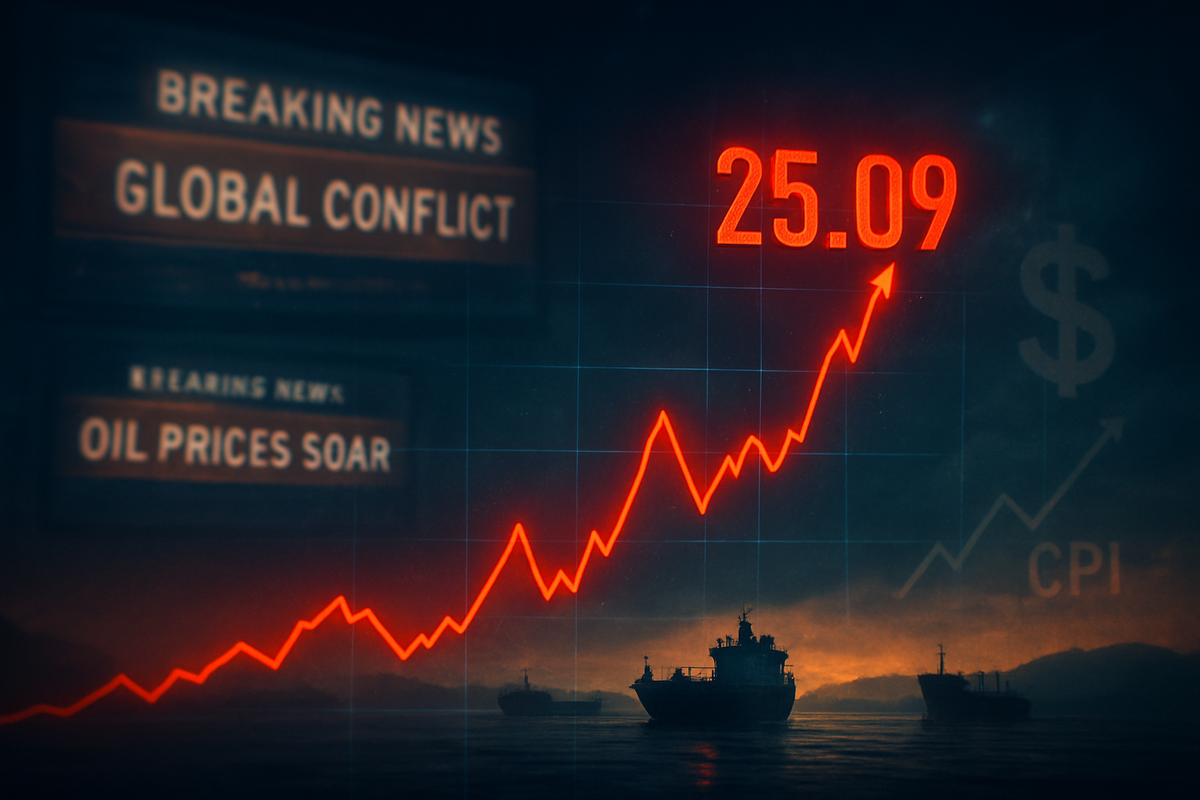
The CBOE Volatility Index (VIX), often referred to as Wall Street’s "fear gauge," experienced a dramatic spike on Thursday, March 19, 2026, jumping 12.2% to close at 25.09. This move represents the highest level of market anxiety seen in over two years, signaling a decisive shift from the relative calm of early 2024 and 2025. The surge was triggered by a "perfect storm" of geopolitical escalation in the Middle East and a stubbornly high inflation print that has all but extinguished hopes for a spring interest rate cut by the Federal Reserve.
For investors, the breach of the 25 level is a significant psychological and technical milestone. Historically, a VIX reading above 20 indicates elevated stress, but pushing past 25 suggests that the market is bracing for daily price swings of nearly 1.7% in the S&P 500. As global energy corridors face physical threats and domestic prices remain uncomfortably high, the spike reflects a fundamental repricing of risk across virtually every asset class.
The Catalysts: A Blockade in the Gulf and "Sticky" Inflation
The primary driver of the day's volatility was the deteriorating situation in the Persian Gulf. Following the initiation of "Operation Epic Fury"—a joint military campaign targeting regional instability—reports emerged on the morning of March 19 that the Strait of Hormuz had been effectively blockaded. This narrow waterway is responsible for the transit of approximately 20% of the world's oil supply. The news sent Brent Crude prices soaring past $110 per barrel, reigniting fears of a global energy shock reminiscent of the 1970s.
Simultaneously, the latest Consumer Price Index (CPI) data released earlier this week revealed that "sticky" service-sector inflation has become entrenched at 3.2%, well above the Federal Reserve's 2% target. The combination of rising energy costs and persistent wage growth in the service sector has created a "stagflationary" nightmare for policymakers. By midday on March 19, traders began pricing in a "higher-for-longer" interest rate environment, leading to a sharp sell-off in equities and a flight to the perceived safety of volatility instruments.
Key stakeholders, including institutional hedge funds and pension managers, were seen aggressively purchasing VIX call options to hedge against a deeper market correction. The initial market reaction was swift, with the Dow Jones Industrial Average dropping over 800 points in a matter of hours as the VIX climbed. The timeline of this week’s events—from the military escalation on Monday to the inflation report on Wednesday—culminated in Thursday’s volatility explosion, marking a definitive end to the "soft landing" narrative that dominated 2025.
Winners and Losers: Defense and Volatility Rise as Tech and Travel Retreat
In a high-volatility, high-inflation environment, the divide between market winners and losers has widened. Defense contractors have seen an influx of capital as global tensions necessitate increased military spending. Companies like Lockheed Martin (NYSE: LMT), RTX Corporation (NYSE: RTX), and Northrop Grumman (NYSE: NOC) have remained resilient, with their order books expanding as NATO and Middle Eastern allies bolster their defenses. Similarly, the energy sector, led by giants such as ExxonMobil (NYSE: XOM) and Chevron (NYSE: CVX), has benefited from the spike in crude prices, acting as a natural hedge against the geopolitical turmoil.
Conversely, the technology sector, particularly high-growth firms that rely on low interest rates for valuation support, has been hit hard. Giants like Apple (NASDAQ: AAPL) and Amazon (NASDAQ: AMZN) faced selling pressure as the prospect of sustained high interest rates dampened future earnings projections. Furthermore, the transportation sector is reeling from the energy shock. Major carriers like Delta Air Lines (NYSE: DAL) and United Airlines (NASDAQ: UAL) saw their stock prices tumble as the cost of jet fuel threatened to erase profit margins for the second half of 2026.
Specialized volatility products have become the most sought-after tools for traders. The ProShares Ultra VIX Short-Term Futures ETF (NYSE: UVXY) and the Barclays iPath Series B S&P 500 VIX Short-Term Futures ETN (BATS:VXX) both saw record trading volumes on March 19. These instruments, which gain value as market uncertainty increases, have become the go-to vehicles for those looking to profit directly from the rising fear gauge. Gold, represented by Newmont (NYSE: NEM), also surged toward new highs as investors sought a store of value away from fluctuating fiat currencies and turbulent equity markets.
Wider Significance: Stagflation Fears and the Ghost of 2008
The significance of the VIX hitting 25.09 extends beyond a single day’s trading. It signals that the market has entered a "regime change." For much of the past decade, investors have been conditioned to "buy the dip," confident that central banks would provide liquidity at the first sign of trouble. However, with inflation remaining "sticky," the Federal Reserve’s hands are tied. This event fits into a broader trend of deglobalization and the weaponization of trade routes, suggesting that the "Great Moderation" of low inflation and low volatility is officially over.
The current situation bears a haunting resemblance to the early stages of the 2008 Financial Crisis and the 2022 geopolitical shocks, where a VIX hovering between 25 and 30 preceded significant market drawdowns. Unlike the sudden 2020 COVID-19 spike which peaked at 82.69, the current rise is a slow-motion escalation. The ripple effects are being felt by global partners, as the "second front" of hybrid warfare in Europe—involving cyberattacks and infrastructure sabotage—further complicates the risk profile for multinational corporations operating in the Eurozone.
From a regulatory standpoint, this volatility may prompt the SEC and other governing bodies to scrutinize the liquidity of volatility-linked ETPs (Exchange Traded Products). If the VIX continues to climb toward the 30-40 range, the potential for a "volatility squeeze"—where forced covering of short positions accelerates the market's decline—could lead to emergency policy interventions or a forced pause in interest rate hikes, despite the inflationary pressures.
The Road Ahead: Strategic Pivots and Scenario Planning
Looking forward, the market faces two primary scenarios. In the short term, if diplomatic efforts manage to reopen the Strait of Hormuz, we could see a rapid cooling of the VIX toward the 18-20 range. However, if the conflict escalates into a broader regional war, the fear gauge could easily breach the 40 level, a threshold historically associated with true market capitulation. Investors must now decide whether to pivot toward "defensive value" stocks or hold cash as they wait for the geopolitical dust to settle.
Strategically, companies will likely accelerate their "onshoring" and "friend-shoring" efforts to mitigate the risks of future supply chain disruptions. The market may also see a renewed focus on nuclear and renewable energy stocks as nations seek to decouple their economies from the volatile oil markets of the Middle East. For the average investor, the coming months will require a transition from a growth-oriented mindset to one focused on capital preservation and risk management.
Summary: A New Era of Uncertainty
The 12.2% jump in the VIX to 25.09 on March 19, 2026, serves as a stark reminder that the global economy remains vulnerable to "black swan" events. The convergence of military conflict and stubborn inflation has shattered the complacency of the early 2020s, ushering in a period where risk is no longer a theoretical concept but a daily reality. The primary takeaway is clear: the era of predictable returns and low volatility is being replaced by a more fragmented and dangerous geopolitical landscape.
Moving forward, the market's direction will be dictated by the headlines coming out of the Persian Gulf and the Federal Reserve’s upcoming policy meeting. Investors should keep a close watch on the $120 per barrel mark for Brent Crude and the 4.0% yield on the 10-year Treasury note; breaches of these levels would likely send the VIX even higher. As we navigate the remainder of 2026, the ability to remain agile in the face of shifting geopolitical tides will be the defining characteristic of a successful investment strategy.
This content is intended for informational purposes only and is not financial advice.