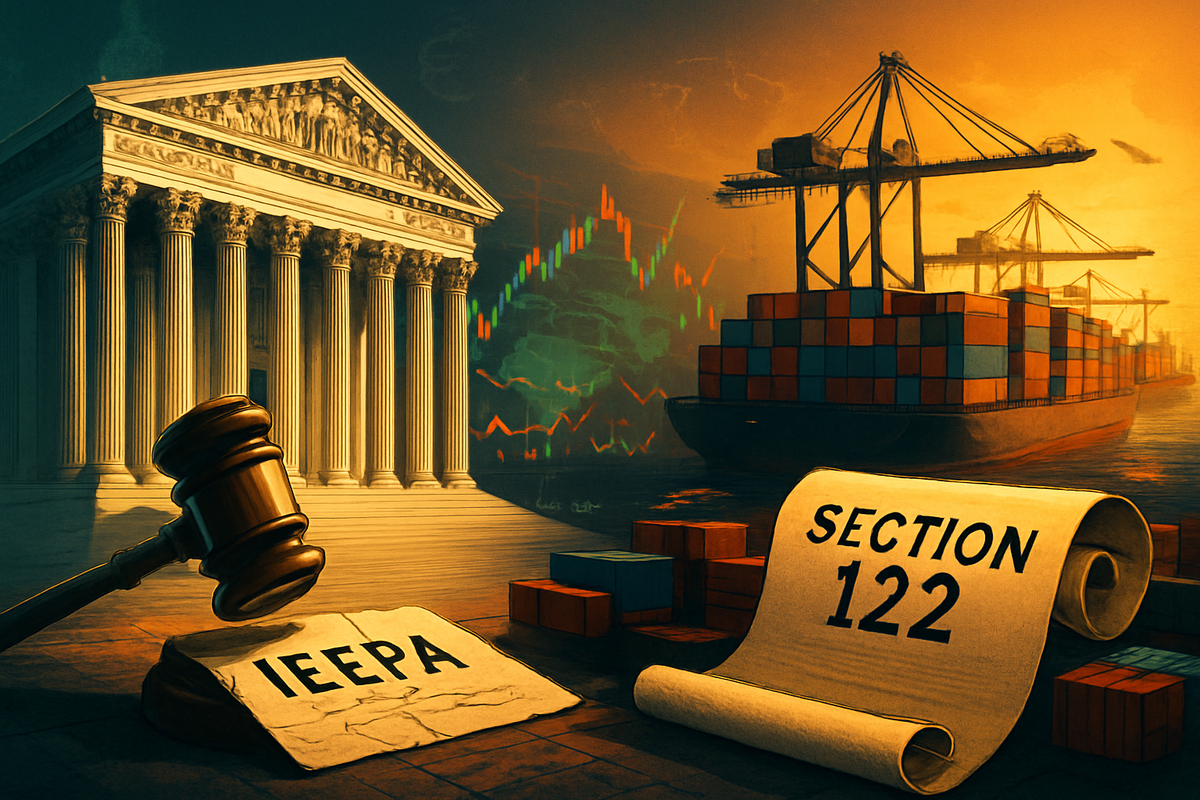
WASHINGTON D.C. — The global financial landscape was thrust into a state of high-stakes uncertainty this morning, February 23, 2026, as investors grappled with the fallout of a landmark U.S. Supreme Court ruling and the administration's aggressive retaliatory trade measures. On Friday, February 20, the Court issued a 6-3 decision in Learning Resources, Inc. v. Trump, effectively dismantling the administration’s broad "reciprocal" tariff regime. While the ruling initially sparked a brief relief rally on Wall Street, that optimism evaporated over the weekend as President Trump invoked "Plan B"—a 15% global import surcharge under Section 122 of the Trade Act of 1974.
The immediate implications are profound: an estimated $142 billion to $175 billion in potential tariff refunds are now owed to U.S. importers, while a new, blanket 15% levy is set to take effect tomorrow, February 24. This "tariff era" whiplash has triggered sharp volatility in currency and commodity markets, with the U.S. Dollar (USD) softening against safe-haven currencies like the Yen, and metals prices fluctuating as traders recalibrate the cost of global commerce. For the public, the ruling offers a temporary reprieve from inflationary pressure, though economists warn that the administration's swift pivot to Section 122 could quickly neutralize any consumer price benefits.
The Legal Earthquake and the 150-Day Clock
The Supreme Court’s ruling in Learning Resources, Inc. v. Trump represents the most significant check on executive trade power in half a century. The majority opinion, authored by Chief Justice John Roberts, concluded that the International Emergency Economic Powers Act (IEEPA) of 1977 does not grant the President the authority to impose sweeping economic taxes under the guise of "national security" or "trade reciprocity." The Court ruled that such taxation is a core constitutional power of Congress, thereby invalidating the aggressive tariff hikes implemented throughout 2025.
The timeline leading to this moment was a collision course between executive overreach and corporate litigation. Since early 2025, the administration had used IEEPA to bypass Congressional approval, targeting a wide array of goods from China, the EU, and Mexico. Learning Resources, Inc., a private educational toy company, became the face of the resistance, leading a consolidated lawsuit that argued these duties were an unconstitutional "usurpation of legislative power." The initial market reaction on Friday afternoon saw the S&P 500 jump nearly 1%, but the mood soured as the White House responded within hours.
By Saturday morning, the President had signed an executive order invoking Section 122 of the 1974 Trade Act, which allows for a temporary, 150-day import surcharge of up to 15% to address "balance-of-payment" deficits. This move effectively replaces the struck-down variable tariffs with a flat, universal 15% rate starting February 24. The administration has also ordered the Department of Commerce to fast-track new "Section 301" and "Section 232" investigations to establish more permanent legal justifications for future duties.
Corporate Winners and the $175 Billion Refund Race
The shift from a complex web of IEEPA-based tariffs to a flat 15% surcharge creates a stark divide between corporate winners and losers. Technology and retail giants stand to be the primary beneficiaries of the ruling, as they are now eligible to file for billions in refunds for duties paid over the last year. Apple Inc. (NASDAQ: AAPL) is estimated by analysts to be owed roughly $3 billion in refunds related to surcharges on Chinese-made components. Similarly, Nike, Inc. (NYSE: NKE) and Lululemon Athletica (NASDAQ: LULU), both of which faced heavy margin pressure from 2025's trade barriers, saw their shares fluctuate wildly as investors weighed the benefit of potential refunds against the cost of the new 15% global surcharge.
Retailers like Walmart Inc. (NYSE: WMT), Costco Wholesale (NASDAQ: COST), and Amazon.com Inc. (NASDAQ: AMZN) are also breathing a sigh of relief. The ruling reinstated the "de minimis" exemption for low-value shipments that the administration had previously narrowed, which should lower logistics costs for e-commerce. However, industrial players and materials producers face a more challenging outlook. Nucor Corp. (NYSE: NUE) and United States Steel (NYSE: X), which thrived under the protection of "emergency" trade barriers, saw their stock prices dip as the legal foundation for some of their protections crumbled.
Automotive giants General Motors (NYSE: GM) and Ford Motor Co. (NYSE: F) are caught in the middle. While the ruling removes punitive "reciprocal" tariffs on Mexican and Chinese parts—a major cost saver—the replacement 15% universal tariff threatens to disrupt their complex, cross-border supply chains just as they were beginning to stabilize. For many of these companies, the coming months will be defined by a frantic effort to file administrative protests with Customs and Border Protection (CBP) to claim their share of the $175 billion refund pool.
A Precarious Pivot for Global Trade Policy
The significance of this event extends far beyond the immediate balance sheets of U.S. companies. It marks a fundamental shift in how the United States interacts with its trading partners. For the past year, "tariff diplomacy" was the administration's primary tool, but the SCOTUS ruling has essentially broken that tool in its current form. The move to Section 122 is widely seen as a "stop-gap" measure, but it carries its own set of risks. Unlike IEEPA, Section 122 is strictly time-limited to 150 days, creating a "tariff cliff" on July 24, 2026.
This regulatory uncertainty is already rippling through international relations. EU lawmakers have reportedly frozen the ratification of the Turnberry Agreement, a key trade deal signed in late 2025, arguing that the new 15% U.S. surcharge violates the deal's fundamental terms. This unpredictability is also impacting commodity markets; while copper and aluminum initially saw price jumps as aggressive duties were removed, those gains have been capped by fears of retaliatory tariffs from China and the EU.
Historically, this moment draws comparisons to the 1971 "Nixon Shock," when a 10% import surcharge was used to force a realignment of global currencies. However, in 2026, the global economy is far more integrated. The administration's attempt to use a 1974 law to bypass a 2026 court ruling sets the stage for a prolonged legal and political battle that could leave the U.S. increasingly isolated in the global market.
The 150-Day Gauntlet: What Lies Ahead
In the short term, the market is bracing for a period of "front-running" and stockpiling. Logistics and freight companies such as FedEx (NYSE: FDX) and United Parcel Service (NYSE: UPS) are expected to see a surge in volume over the next few months as importers rush to bring goods into the country before the July 24 expiration of the Section 122 surcharge, fearing even more restrictive measures might follow.
Strategic pivots are already underway. Heavy machinery manufacturers like Caterpillar Inc. (NYSE: CAT) and Deere & Co. (NYSE: DE) are reportedly re-evaluating their sourcing strategies to hedge against the possibility that the "Plan B" tariffs become permanent through new Section 301 investigations. The primary challenge for these companies is the lack of a long-term trade roadmap; the administration's "policy-by-executive-order" approach has made multi-year planning nearly impossible.
Potential scenarios for the second half of 2026 range from a negotiated "grand bargain" with major trading partners to an all-out trade war if the administration seeks to extend the 15% surcharge beyond the 150-day limit. Investors should also watch for the "refund effect"—if the U.S. Treasury begins issuing $175 billion in checks to corporations, it could provide an unexpected liquidity injection into the market, potentially fueling another round of equity gains even amidst the trade chaos.
Navigating the 'Tariff Era' Uncertainty
As the dust settles on this historic Supreme Court decision, the key takeaway is that the "tariff era" is not ending—it is simply entering a new, more legally contentious phase. The ruling in Learning Resources, Inc. v. Trump has restored the constitutional balance of power, but the administration’s immediate pivot to Section 122 proves that the desire for protectionist trade policy remains undiminished.
Moving forward, the market will likely remain in a state of high sensitivity to trade-related news. The relief from the removal of IEEPA tariffs is a clear positive for consumer-facing sectors and tech giants, but the 15% "Plan B" surcharge ensures that inflationary fears will remain a "sticky" problem for the Federal Reserve. The next few months will be a test of resilience for global supply chains and a period of intense litigation as companies fight for their refunds.
Investors should keep a close watch on three specific areas: the progress of the $175 billion refund claims, the administration's new "Section 301" investigations, and the rhetoric from major trade partners like China and the EU. The July 24 "tariff cliff" is now the most important date on the 2026 financial calendar. Until a more permanent and legally sound trade framework is established, volatility remains the only certainty in the market.
This content is intended for informational purposes only and is not financial advice.