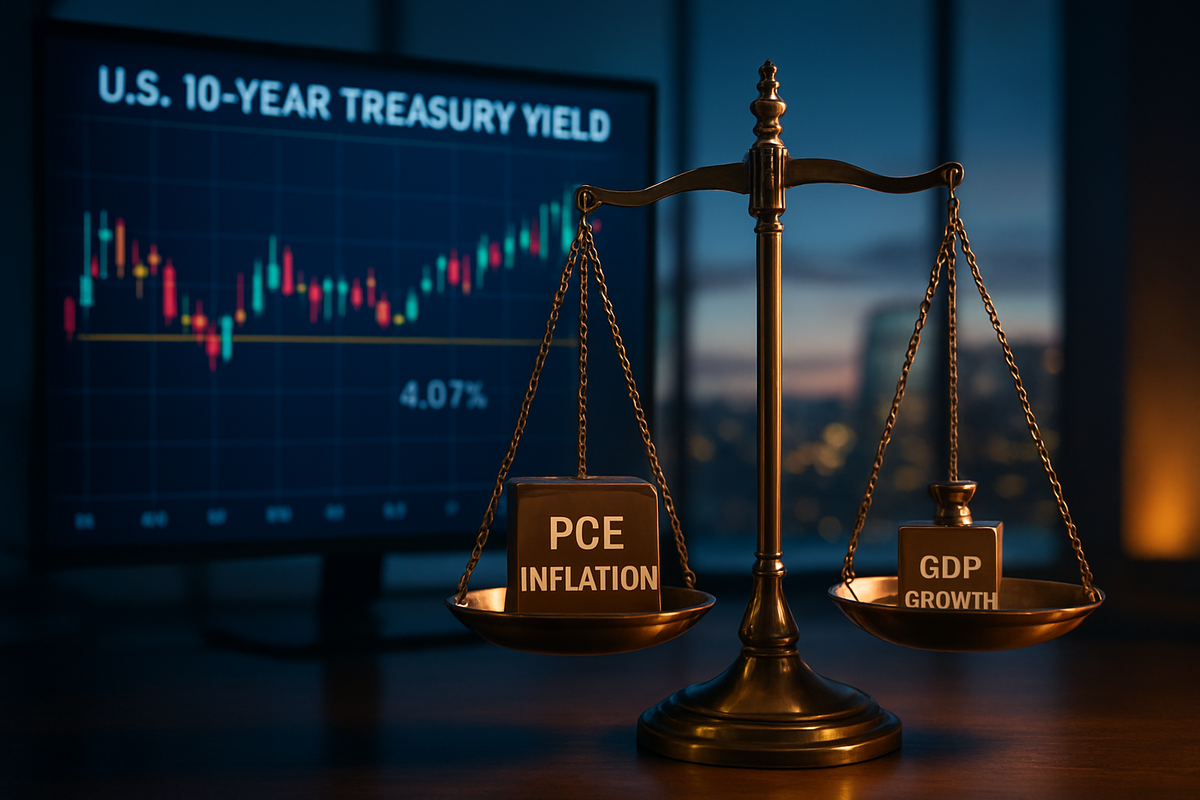
As of February 20, 2026, the U.S. Treasury market is locked in a high-stakes tug-of-war, with the benchmark 10-year yield hovering stubbornly near 4.07%. This level has become a psychological and technical battleground for investors who are increasingly caught between two conflicting economic signals: a disappointing 1.4% annualized GDP growth rate from the final quarter of 2025 and a "sticky" December PCE inflation print of 3.0% that refuses to retreat toward the Federal Reserve’s 2% target. The result is a market that has significantly dialed back its expectations for early 2026 rate cuts, forcing a repricing across the fixed-income landscape.
The immediate implication of this "higher-for-longer" reality is a notable narrowing of spreads between short-term and long-term debt, as the market prices in a more hawkish path for the Federal Reserve under its incoming leadership. While the 2s10s spread had previously normalized to nearly 75 basis points earlier in the year, it has compressed back toward 60 basis points this week. This narrowing suggests that while investors still anticipate eventual rate cuts, they are bracing for a terminal rate that remains significantly higher than the pre-pandemic norm. For the average American, this means mortgage rates and corporate borrowing costs are unlikely to see the relief many had hoped for by the spring of 2026.
Economic Friction: Weak Growth Meets Persistent Inflation
The current market volatility traces back to a tumultuous end to 2025, marked by a brief but disruptive government shutdown that distorted labor and growth statistics. When the "clean" data finally emerged this month, it painted a picture of an economy losing steam. The Q4 2025 GDP reading of 1.4% was far below the 3.0% consensus, signaling that the aggressive fiscal expansion of 2025 may be meeting its limits. However, any hopes that this slowdown would force the Fed’s hand into an immediate rate cut were dashed by the December Personal Consumption Expenditures (PCE) report, released today, February 20, 2026. With Headline PCE at 2.9% and Core PCE at 3.0%, inflation is proving to be far more resilient than the 2.1% forecast many analysts held just six months ago.
At the center of this storm is the Federal Reserve itself, currently in the midst of a historic leadership transition. With Jerome Powell’s term set to expire in May 2026, the nomination of Kevin Warsh as his successor has introduced a new layer of uncertainty. Warsh, known for his historically hawkish leanings, is seen by many as less likely to tolerate "sticky" inflation, even in the face of cooling GDP. At the January FOMC meeting, the Fed held the federal funds rate steady at 3.50%–3.75%, but the tone was decidedly cautious. Market participants who were betting on a March rate cut have now largely moved those expectations to June or September, reflecting a "wait-and-see" stance that has kept the 10-year yield anchored above 4%.
Corporate Winners and Losers in a High-Yield Environment
The 4.07% yield environment is creating a "K-shaped" outcome for public companies. In the banking sector, JPMorgan Chase & Co. (NYSE: JPM) continues to benefit from robust Net Interest Income (NII) as loan pricing remains high. However, the persistence of "sticky" inflation means deposit costs are also staying elevated, preventing the windfall profits seen in 2024. Meanwhile, investment banks like The Goldman Sachs Group, Inc. (NYSE: GS) are seeing a stabilization in capital markets; a 4% yield is now viewed as "the new normal," providing enough predictability for M&A and IPO activity to resume, even if the total volume is dampened by sluggish GDP growth.
In the real estate and utilities sectors, the impact is more nuanced. Prologis, Inc. (NYSE: PLD), a giant in industrial real estate, has seen its traditional logistics business pressured by the weak 1.4% GDP growth, as consumer demand for shipped goods softens. However, the company has mitigated these losses through its aggressive pivot into data center development, fueled by the ongoing AI infrastructure boom. Similarly, NextEra Energy, Inc. (NYSE: NEE) has faced headwinds as its dividend yield becomes less attractive relative to the 4% "risk-free" return of Treasuries. Yet, NEE remains a favorite for some institutional investors due to its role as a primary power provider for the very data centers driving the AI cycle, allowing it to maintain growth targets despite higher borrowing costs.
Historical Echoes and the Structural Shift
The current market environment bears a striking, if imperfect, resemblance to 2011. During that period, the U.S. faced weak GDP growth alongside a spike in inflation driven by energy prices. However, in 2011, the 10-year yield eventually collapsed as a "flight to quality" took hold during the European Debt Crisis. In 2026, the dynamic is different: there is no flight to quality because the "quality" asset—the U.S. Treasury—is the very thing being repriced upward due to structural fiscal deficits and a higher long-term inflation floor. This suggests that the 4% yield is not a temporary spike, but a fundamental realignment of the "neutral rate" of interest.
Furthermore, the recent Supreme Court ruling on February 20, 2026, which struck down broad emergency tariffs, has added another layer of complexity. While the ruling is viewed as a long-term disinflationary force, its immediate impact has been a rally in equities and a slight softening of the dollar, which could ironically keep consumer demand—and thus inflation—higher for longer. This policy uncertainty, combined with the "One Big Beautiful Bill Act" of 2025, has left the Treasury market in a state of "term premium" expansion, where investors demand more yield to hold long-term debt in an increasingly unpredictable fiscal and legal environment.
The Path to June: What Comes Next?
In the short term, the market will be hyper-focused on the "Warsh transition." If Kevin Warsh signals a commitment to the 2% inflation target at any cost during his confirmation hearings, we could see the 10-year yield test the 4.25% or even 4.5% level. Conversely, if the weak GDP data begins to bleed into the labor market—which has remained surprisingly resilient thus far—the Fed may be forced to prioritize growth, potentially leading to a sharp rally in bonds and a drop in yields. Strategically, corporations are likely to accelerate debt issuance in early 2026, fearing that if inflation doesn't break, the window for sub-4% long-term financing may close for good.
The possibility of a "soft landing" is still on the table, but the runway is narrowing. The most likely scenario involves a "gentle glide" of two 25-basis-point rate cuts in the second half of 2026, aiming for a terminal rate near 3.25%. However, this assumes that the current 3.0% PCE inflation is indeed the "last mile" and not a sign of a more permanent structural shift. Investors should prepare for a period of "sideways volatility," where the 10-year yield remains range-bound between 3.8% and 4.2% until a clear trend emerges in either growth or inflation.
Investing in the "New Normal"
As we move toward the middle of 2026, the U.S. Treasury market stands as a testament to an economy in transition. The key takeaway for investors is that the era of "easy money" and zero-bound rates is firmly in the rearview mirror. The current 4.07% yield is a reflection of an economy that is growing more slowly than hoped but remains more inflationary than expected. This "stagflation-lite" backdrop requires a more disciplined approach to asset allocation, prioritizing companies with strong cash flows and the ability to pass on costs.
Moving forward, the primary milestones to watch will be the March FOMC meeting and the subsequent leadership change at the Fed in May. These events will determine whether the current narrowing of spreads is a precursor to a recession or merely a healthy adjustment to a more sustainable interest rate environment. For now, the bond market is sending a clear message: patience is required, and the road to 2% inflation will be long, winding, and potentially paved with higher yields.
This content is intended for informational purposes only and is not financial advice