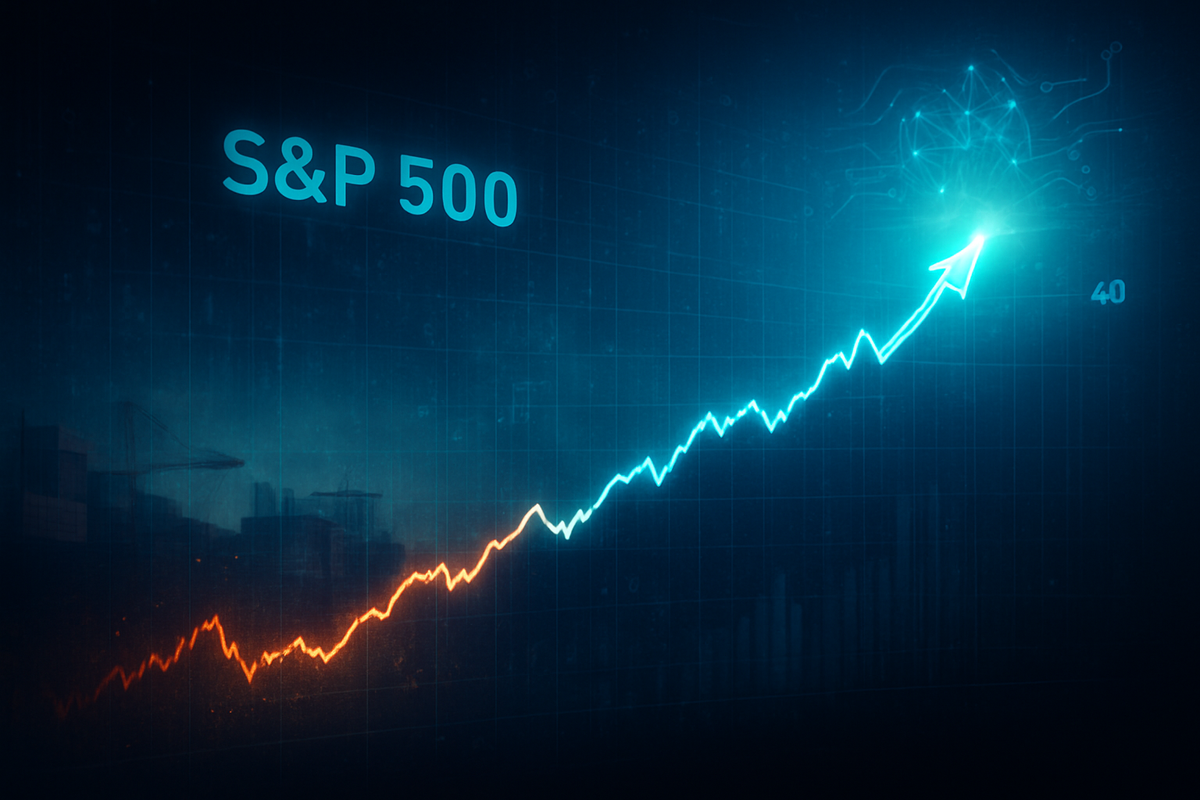
As the calendar turns to January 1, 2026, the S&P 500 stands at a remarkable crossroads. After a year defined by extreme volatility, the index managed to close 2025 with a total return of approximately 17.8%, ending at 6,845.50. This resilience came despite a "tariff storm" that threatened to derail the global economy and a highly publicized, often acrimonious dispute between the executive branch and the Federal Reserve. Investors are now entering the new year with a mixture of euphoria and caution, as the market’s valuation metrics reach heights not seen in a quarter-century.
The immediate implication for 2026 is a market that is "priced for perfection." While the transition of Artificial Intelligence from speculative hype to a tangible utility has provided a powerful tailwind, the looming expiration of Jerome Powell’s term as Fed Chair and the shadow of the 2026 midterm elections suggest that the path forward will be anything but linear. With the Shiller PE ratio now exceeding 40, the margin for error has narrowed significantly, leaving market participants to wonder if 2026 will be the year the "Great Reversion" finally takes hold.
The Year of the "April Storm" and the Fed Feud
The journey to the current record highs was marked by a severe mid-year correction that tested the nerves of even the most seasoned traders. On April 4, 2025—a day now referred to in financial circles as "Liberation Day"—the S&P 500 suffered a sharp 10.5% decline following the implementation of sweeping global tariffs. By November, the average effective U.S. tariff rate had climbed to 16.8%, the highest level since the mid-1930s. This policy shift initially sent shockwaves through supply chains, causing a temporary plunge in consumer confidence and leading analysts at Goldman Sachs (NYSE: GS) to estimate that 80% of the costs were being split between American businesses and consumers.
Compounding this trade-related anxiety was an unprecedented level of friction between the White House and the Federal Reserve. Throughout 2025, the executive branch exerted heavy pressure on the Fed to slash interest rates to zero to mitigate the impact of tariffs. The dispute took a bizarre turn when the administration publicly criticized Chair Jerome Powell over a $2.5 billion renovation of the Fed’s headquarters, claiming costs had ballooned to over $3.1 billion as a sign of "gross incompetence." Despite this political theater and a legal battle over the attempted removal of Fed Governor Lisa Cook, the central bank maintained its independence, cutting rates only three times in the latter half of the year to a terminal range of 4.25%–4.50%.
Winners and Losers: The AI Divide and the Tariff Toll
The divergent performance of individual sectors in 2025 has created a clear roadmap for 2026. The undisputed winners were the "AI Utility" giants, led by Nvidia (NASDAQ: NVDA) and Microsoft (NASDAQ: MSFT). These companies successfully moved beyond selling the "shovels" of the AI gold rush and began reporting significant margin expansions from AI-integrated software and services. Apple (NASDAQ: AAPL) also emerged as a late-year winner, as its "Apple Intelligence" ecosystem drove a massive hardware replacement cycle, helping the company navigate the tariff-induced price hikes on its global supply chain.
Conversely, the losers of 2025 were found in trade-sensitive sectors. Retailers like Walmart (NYSE: WMT) and industrial manufacturers like Caterpillar (NYSE: CAT) faced significant headwinds as they struggled to pass on increased costs to consumers. While many investors adopted the "TACO" (Trump Always Chickens Out) trade—betting that the most extreme tariffs would be rolled back—the reality of higher input costs bit into the earnings of mid-cap manufacturers. Financial institutions like JPMorgan Chase (NYSE: JPM) also faced a complex environment, benefiting from higher-for-longer interest rates but dealing with a slowdown in mortgage and commercial lending due to policy uncertainty.
The CAPE Conundrum and Historical Precedents
The most pressing concern for 2026 is the S&P 500’s Cyclically Adjusted Price-to-Earnings (CAPE) ratio, which currently sits at 40.54. This level is significantly above the long-term mean of 17 and has surpassed the 2021 peak of 36.9. Historically, a CAPE ratio above 40 has only been seen during the peak of the Dot-com bubble in 1999–2000, when it reached 44.2. This metric suggests that the market is currently more expensive than it was before the 1929 crash, raising the specter of a significant valuation reset if earnings growth fails to meet the lofty expectations set by AI optimists.
This environment fits into a broader trend of "fiscal dominance," where government spending and trade policy have become as influential as monetary policy in driving market returns. The 2025 experience showed that the market can "price in" geopolitical friction if it is accompanied by domestic stimulus, such as the "One Big Beautiful Bill Act." However, the historical precedent of the 1970s reminds us that prolonged trade barriers and executive-central bank disputes can lead to stagflationary pressures that eventually erode equity multiples.
The Road Ahead: Powell’s Successor and the "Show Me" Year
Looking forward to the rest of 2026, the market faces two critical turning points. The first is the expiration of Jerome Powell’s term as Fed Chair in May. The announcement of his successor in the first quarter—with names like Kevin Warsh and Christopher Waller being floated—will be a major catalyst for the bond market. Any signal that the Fed’s independence might be compromised could trigger a spike in yields and a corresponding sell-off in high-growth tech stocks.
Furthermore, 2026 is being termed the "Show Me" year for AI. After two years of massive capital expenditure, investors are no longer content with promises of future efficiency; they are demanding to see revenue and margin expansion on the balance sheet. Additionally, as a midterm election year, 2026 is historically prone to summer volatility. Analysts at UBS (NYSE: UBS) predict a "speed bump" in the first half of the year, followed by a potential broadening of the rally into lower-quality cyclical stocks if the Fed manages a "soft landing" amidst the leadership transition.
Final Thoughts for the 2026 Investor
As we navigate the opening weeks of 2026, the S&P 500 remains a testament to the resilience of the U.S. economy and the transformative power of technological innovation. The index has successfully climbed a "wall of worry" built on tariffs and political disputes, but the current valuation levels suggest that the easy gains have been made. The market’s ability to sustain its current levels will depend entirely on whether the AI-driven productivity gains can outpace the inflationary pressures of a protectionist trade regime.
Investors should watch closely for the Fed Chair nomination in Q1 and the Q1 earnings season, which will provide the first real evidence of AI’s impact on 2026 bottom lines. While the bull market remains intact, the high CAPE ratio serves as a stark reminder that gravity eventually applies to all assets. Diversification and a focus on quality earnings will be the hallmarks of a successful strategy in what promises to be another year of historic significance for the financial markets.
This content is intended for informational purposes only and is not financial advice