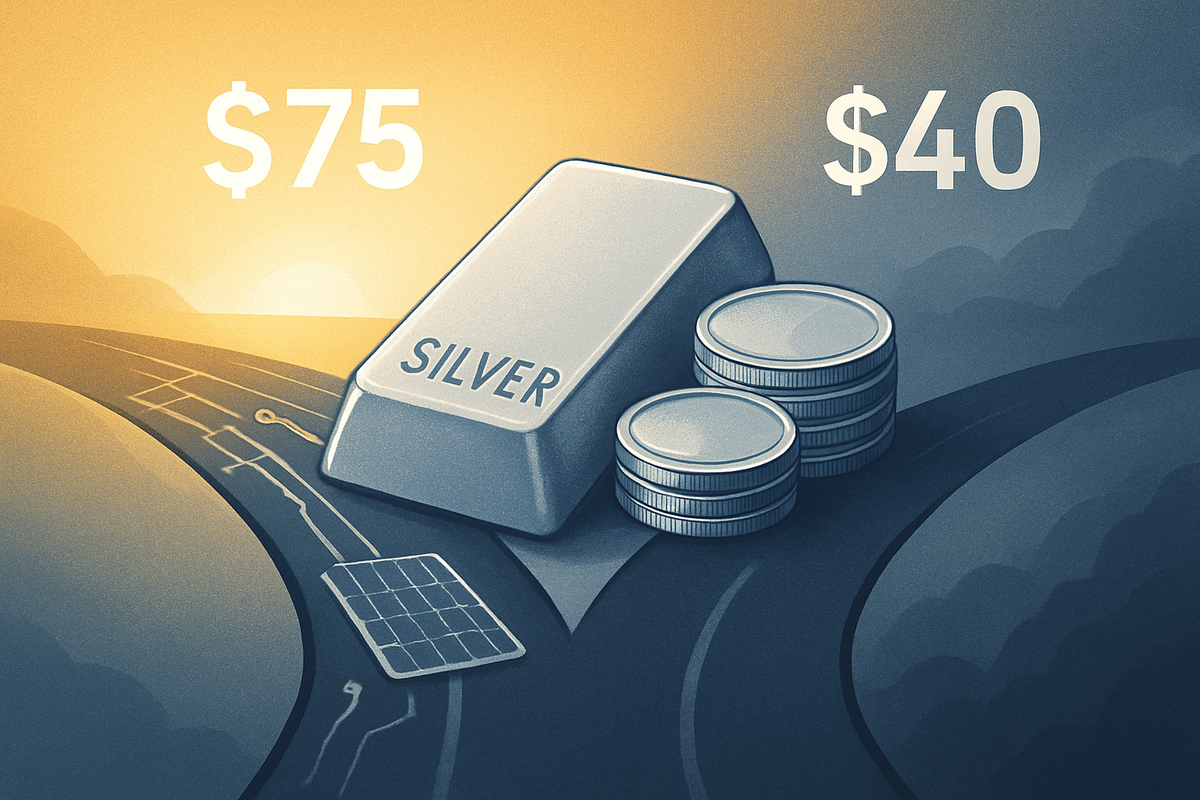
The global silver market finds itself at a pivotal and precarious juncture as of December 3, 2025, with the precious metal exhibiting characteristic volatility following a remarkable parabolic rally throughout the year. With spot prices hovering around $58-$59 per ounce, nearing all-time highs and boasting a staggering 100% year-to-date increase, all eyes are on the next major move. This intense speculation is amplified by a stark forecast from Bloomberg Intelligence Senior Commodity Strategist Mike McGlone, who posits that silver is at a critical crossroads, destined for either a surge to $75 or a precipitous drop to $40 per ounce.
This dramatic divergence in potential outcomes underscores an environment of extreme uncertainty and heightened risk for investors and producers alike. While the prospect of silver reaching $75 an ounce promises unprecedented profitability for mining operations and significant gains for long-positioned investors, the equally plausible scenario of a retreat to $40 an ounce looms as a threat of substantial losses and margin compression. The market is currently a battleground of speculative capital, robust industrial demand, and shifting macroeconomic forces, all contributing to a period of intense price discovery and strategic re-evaluation.
Unpacking Silver's Ascent and McGlone's Dire Warning
Silver's journey to its current elevated position, briefly touching a new all-time high of $61.44 and then $59.655 per ounce on the current date, has been nothing short of spectacular. This "parabolic rally" in 2025 marks its best annual performance since 1979, with the metal significantly outperforming its counterpart, gold, and pushing the gold/silver ratio to a four-year low of 72-75 points. This rapid ascent, however, is precisely what gives seasoned analysts like Mike McGlone pause. He describes the rally as "a little scary," drawing parallels to historical precedents where such extreme upward movements "never ended well," referencing the dramatic crashes that followed peaks in 1980 and 2011.
McGlone's specific forecast of either $75 or $40 an ounce is not arbitrary but rooted in silver's inherent volatile nature and historical price action. His previous analyses in late summer 2025 had already identified strong support around $35-$40, anticipating an eventual climb to $50, largely on the back of gold's expected push towards $4,000. Now, with silver far exceeding those earlier targets, the stakes are considerably higher. The current market dynamics are being shaped by a confluence of factors: robust industrial demand, particularly from the burgeoning solar and electric vehicle (EV) sectors, which has led to a physical deficit for five consecutive years; record inflows into speculative Exchange Traded Funds (ETFs) and leveraged positions; and strategic accumulation by central banks hedging against monetary debasement.
The immediate implications for the market are profound. For tactical investors, the current volatility necessitates extreme caution, balancing the allure of significant profit opportunities with the palpable risk of sharp declines. Producers, on the other hand, are faced with strategic dilemmas: a sustained rally to $75 would trigger expansion plans and unprecedented profitability, while a drop to $40 would force cost-cutting measures and potentially halt growth. The market is navigating significant structural shifts, including central banks diversifying their reserves, industrial demand outstripping supply, and speculative capital amplifying price movements, ensuring that volatility remains a dominant feature for the foreseeable future.
Corporate Fortunes Tied to Silver's Fate
The dramatic bifurcation in silver's forecast—$75 or $40 an ounce—presents a high-stakes scenario for public companies operating within the silver mining and related industries. A move towards $75 would unleash a wave of profitability, investment, and expansion, while a decline to $40 would trigger significant financial strain, project re-evaluations, and potential industry consolidation.
Major silver producers such as Fresnillo PLC (LSE: FRES), Pan American Silver Corp. (NASDAQ: PAAS), and Wheaton Precious Metals Corp. (NYSE: WPM) stand to be most directly impacted. At $75 an ounce, these companies would see their revenue and profit margins soar to unprecedented levels. This scenario would likely encourage increased exploration budgets, the accelerated development of new projects, and potentially higher dividend payouts to shareholders. Companies with higher all-in sustaining costs (AISC) would suddenly become highly profitable, extending the life of existing mines and making previously uneconomic deposits viable. For Fresnillo, a dominant player in Mexico, enhanced cash flows could fuel further regional expansion and technological upgrades. Pan American Silver, with its diverse portfolio across the Americas, would experience a significant boost to its operational cash flow, allowing for debt reduction and strategic acquisitions. Wheaton Precious Metals, a streaming and royalty company, would see the value of its existing silver streams and royalties dramatically increase, leading to higher revenue without direct exposure to mining operational costs.
Conversely, a plummet to $40 an ounce would present a formidable challenge. While still above the AISC for some of the most efficient producers, it would severely compress margins for most, and render many higher-cost operations unprofitable. Companies would be forced to review their capital expenditure plans, potentially deferring or canceling new projects, and implementing cost-cutting measures, including workforce reductions. Exploration activities would likely dwindle, impacting future supply. For companies like First Majestic Silver Corp. (NYSE: AG), which has a higher operational leverage to silver prices, a drop to $40 could lead to significant financial stress, potentially impacting its ability to service debt or fund ongoing operations. Even for streamers like Wheaton Precious Metals, while less exposed to operational costs, the value of their future silver receipts would diminish, impacting their valuation and ability to secure new deals. The ripple effect could also extend to companies supplying equipment and services to the mining sector, facing reduced demand.
Furthermore, companies involved in the industrial applications of silver, such as solar panel manufacturers like Canadian Solar Inc. (NASDAQ: CSIQ) or electronics giants, would face a mixed bag. At $75 an ounce, their input costs for silver would rise significantly, potentially squeezing their own margins unless they can pass on costs to consumers or find alternative materials. However, if the demand for these products remains robust, the higher silver price might not deter overall growth. At $40 an ounce, these industrial users would benefit from lower raw material costs, potentially boosting their profitability and allowing for more competitive pricing of their end products, further stimulating demand for silver in industrial applications.
Broader Implications and Market Resonance
Silver's current volatility and McGlone's divergent forecast are not isolated events but deeply embedded within broader industry trends and macroeconomic shifts. The metal's dual role as both a precious safe-haven asset and a critical industrial commodity makes its price movements particularly sensitive to a wide array of global factors. This duality means that silver often acts as a "high-beta" version of gold, amplifying gold's movements but also reacting strongly to industrial demand cycles.
One of the most significant broader trends is the accelerating global push towards decarbonization and renewable energy. Silver is an indispensable component in photovoltaic (PV) solar cells, electric vehicles (EVs), and various other green technologies. The solar industry alone accounts for roughly 10% of global silver demand, with PV applications growing at an impressive 8-12% annually. This surging industrial demand, coupled with persistent supply constraints, has led to a physical deficit for five consecutive years, with 2025 marking another record year for PV consumption. This structural imbalance provides a strong fundamental underpinning for higher silver prices, suggesting that the $75 scenario could be driven by an intensifying supply crunch.
Potential ripple effects extend far beyond direct silver market participants. Competitors in the broader precious metals space, such as platinum and palladium, might see correlated movements, albeit with different demand drivers. Partners in the supply chain, from refiners to fabricators, would need to adapt to fluctuating input costs and demand signals. Regulatory and policy implications are also significant; governments promoting green energy might find themselves navigating higher raw material costs, potentially leading to subsidies or incentives to maintain momentum. Central bank policies, particularly the Federal Reserve's rate-cutting cycle initiated in mid-2025, have already played a crucial role by reducing real yields and making non-yielding assets like silver more attractive. A weakening U.S. dollar further enhances silver's appeal to international buyers.
Historically, silver has a notorious track record of extreme volatility. The 1980 spike to nearly $50 an ounce, followed by a dramatic crash, and the similar surge to $49 in 2011, serve as stark reminders of the metal's boom-and-bust cycles. These historical precedents lend weight to McGlone's caution, suggesting that while the current rally is impressive, its sustainability is far from guaranteed. The current environment, however, differs due to the unprecedented industrial demand from green technologies and strategic central bank accumulation, which was less prominent in previous cycles. This unique confluence of factors suggests that while volatility remains a constant, the underlying drivers for silver's potential upward trajectory might be stronger than in the past.
The Path Ahead: Scenarios and Strategic Shifts
Looking ahead, silver's trajectory will be shaped by a complex interplay of economic, industrial, and geopolitical forces. The short-term future is likely to remain characterized by extreme volatility, with sharp price swings as market participants react to new data points, policy announcements, and technical levels. In the long term, however, the fundamental drivers of supply and demand will likely dictate whether silver gravitates towards McGlone's $75 bullish target or recedes to the $40 bearish threshold.
In a scenario where silver climbs to $75, propelled by sustained industrial demand, further central bank accumulation, and a weakening dollar, we could see a significant influx of capital into the sector. This would create substantial market opportunities for silver miners to expand operations, for technology companies to invest in silver-efficient designs, and for investors to capitalize on a booming commodity market. Strategic pivots for miners would involve accelerating exploration and development of new projects, potentially even re-opening marginal mines that become profitable at higher prices. For industrial users, innovation in silver recycling and substitution might become more urgent to manage input costs.
Conversely, a retreat to $40 could be triggered by a global economic slowdown impacting industrial demand, a stronger-than-expected rebound in the U.S. dollar, or a significant unwinding of speculative positions. In this scenario, market challenges would include reduced profitability for miners, potential project deferrals, and a contraction in exploration activity. Strategic adaptations for mining companies would focus on cost optimization, balance sheet strengthening, and prioritizing only the highest-grade, lowest-cost operations. Investors would need to reassess their risk exposure, potentially shifting towards more stable assets or shorting silver-related equities. Such a downturn could also present opportunities for long-term investors to acquire assets at discounted prices, anticipating a future rebound driven by the underlying industrial demand.
Ultimately, the market will need to contend with the ongoing physical deficit, which points to a structural undersupply. Whether this deficit can be met by increased mining output or whether it will continue to drive prices higher remains a critical question. Potential strategic pivots for the entire industry include greater investment in sustainable mining practices, enhanced recycling infrastructure, and closer collaboration between producers and industrial consumers to ensure a stable supply chain. The emergence of new technologies that either increase silver demand or reduce its usage will also play a significant role in shaping these future scenarios.
A Comprehensive Wrap-Up: Navigating the Silver Storm
Silver's current position at a critical juncture, as highlighted by Mike McGlone's $75 or $40 forecast, encapsulates the metal's intrinsic volatility and its evolving role in the global economy. The year 2025 has been remarkable for silver, marked by a parabolic rally driven by a potent mix of robust industrial demand from green technologies, increasing safe-haven investment, and strategic central bank diversification. This has pushed prices near all-time highs, creating both immense opportunities and significant risks.
Moving forward, the silver market will continue to be a dynamic arena influenced by macroeconomic trends, geopolitical developments, and the delicate balance between supply and demand. The structural deficit in physical silver, fueled by insatiable industrial consumption, particularly in solar and EVs, provides a compelling long-term bullish argument. However, the metal's history of sharp corrections following rapid ascents serves as a powerful reminder of its speculative nature. Investors and market participants must therefore maintain a vigilant stance, prepared for rapid shifts in sentiment and price.
The lasting impact of this period of heightened volatility will likely be a re-evaluation of silver's strategic importance, both as a monetary metal and as an indispensable industrial commodity. Companies will need to demonstrate agility in adapting their operational and financial strategies to navigate either extreme of McGlone's forecast. What investors should watch for in the coming months includes sustained trends in industrial demand data, particularly from the renewable energy sector, any shifts in central bank monetary policies that could impact the U.S. dollar, and the ongoing accumulation patterns of central banks and large institutional investors. The gold/silver ratio will also serve as a key indicator, potentially signaling further strength or weakness in silver relative to gold. The market's ability to absorb or resolve the physical supply deficit will ultimately be the determining factor in which path silver takes.
This content is intended for informational purposes only and is not financial advice