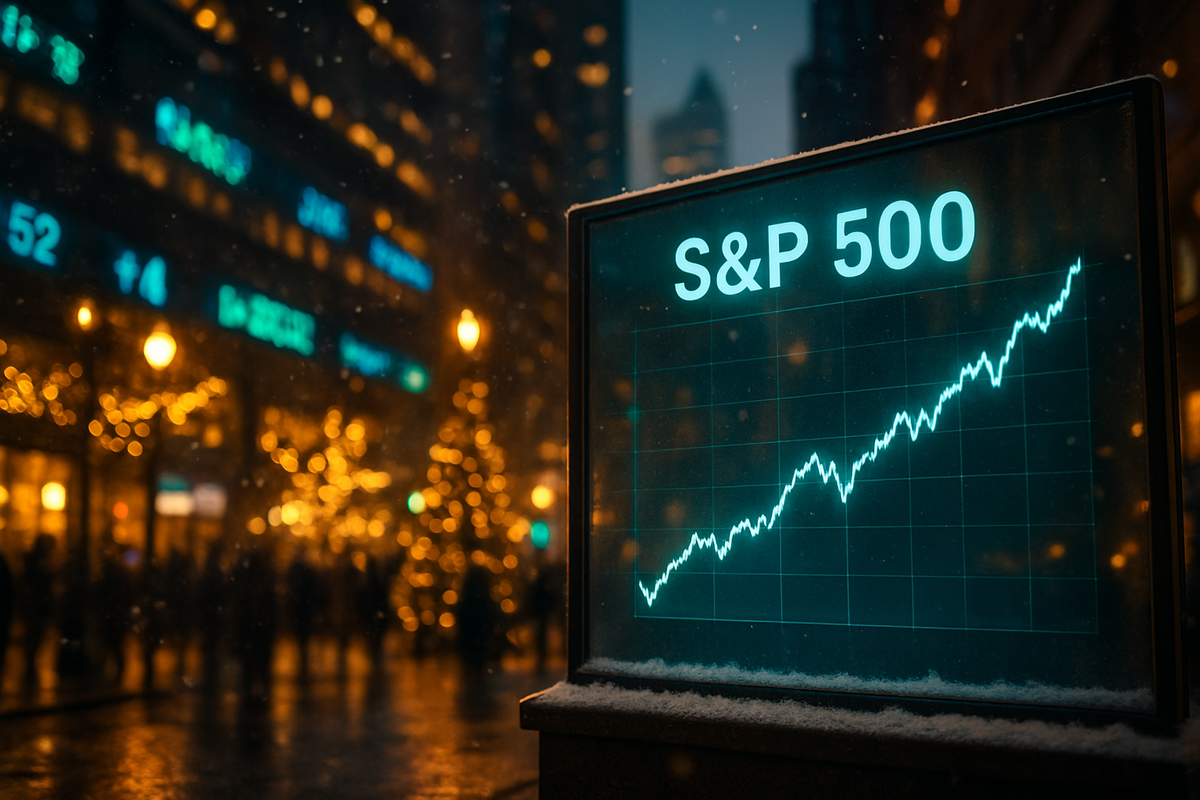
As the 2025 calendar winds down, Wall Street is celebrating a historic milestone that few predicted during the volatile opening months of the year. On December 24, 2025, the S&P 500 (INDEXSP:.INX) officially notched a fresh all-time closing high of 6,932.05, capping off a remarkable turnaround and ushering in the fabled "Santa Claus" rally with significant momentum. This surge, occurring in the final trading days of December, has pushed the index to a year-to-date gain of approximately 18%, solidifying 2025 as a banner year for equity investors who weathered early-year recession fears and political instability.
The immediate implications of this record-breaking run are profound for both institutional and retail participants. The breach of the 6,900 level represents a psychological victory that has triggered a "fear of missing out" (FOMO) among sidelined investors, driving trading volumes higher even during the typically quiet holiday period. With the Federal Reserve shifting toward a more accommodative stance and corporate earnings remaining resilient, the current market sentiment is overwhelmingly "risk-on," setting a bullish tone for the transition into 2026.
A Resilient Path to 6,900: The 2025 Market Journey
The road to this all-time high was anything but linear. The year began under a cloud of uncertainty, with the S&P 500 sliding 4.6% in the first quarter as trade tensions and "tariff man" jitters weighed on global sentiment. However, the market found what analysts now call the "April bottom," a turning point that sparked a massive recovery, adding roughly $18 trillion in market capitalization over the following eight months. A critical hurdle was cleared in mid-November when the United States emerged from a 43-day government shutdown—the longest in the nation’s history—which had previously clouded economic data and tested investor patience.
The primary catalyst for the year-end surge was the Federal Reserve’s decisive pivot. At the December 10 meeting, the Federal Open Market Committee (FOMC) announced its third consecutive interest rate cut, lowering the federal funds rate by 25 basis points to a target range of 3.50%–3.75%. Chair Jerome Powell emphasized the need to support a "cooling labor market" despite the "foggy" data caused by the recent shutdown. This easing cycle, combined with a robust 4.3% annualized GDP growth rate in the third quarter, provided the liquidity and confidence necessary for the S&P 500 to break its previous records.
The "Santa Claus" rally—historically defined as the final five trading days of December and the first two of January—officially commenced on Christmas Eve. The index entered this period on a five-day winning streak, bolstered by a "Goldilocks" economic environment where inflation appears contained while growth persists. This seasonal phenomenon has been amplified this year by the resolution of domestic political gridlock and a clarity in monetary policy that was absent throughout much of 2024 and early 2025.
The AI Infrastructure Boom: Winners and Losers of 2025
The 2025 rally was characterized by a shift in leadership within the technology sector. While 2024 was defined by general "AI hype," 2025 became the year of "AI Infrastructure and Maturity." Companies specializing in data storage and high-bandwidth memory emerged as the primary beneficiaries. Micron Technology (NASDAQ: MU) saw its stock price soar by 222% this year, driven by insatiable demand for HBM chips used in AI data centers. Similarly, Western Digital (NASDAQ: WDC) and its recently re-listed spin-off, SanDisk (OTC:SNDK), dominated the headlines; SanDisk surged over 500% since its February re-listing, riding the wave of enterprise SSD adoption.
Retail and fintech also saw significant gains as consumer confidence rebounded. Robinhood Markets, Inc. (NASDAQ: HOOD) experienced a 225% increase in its share price, fueled by a resurgence in retail trading and record-high volumes in the cryptocurrency market. Meanwhile, Palantir Technologies Inc. (NYSE: PLTR) solidified its position as an enterprise AI powerhouse, with its stock rising 158% as its software became a standard for corporate AI integration. Alphabet Inc. (NASDAQ: GOOGL) remained the standout among the original "Magnificent Seven," gaining over 60% as it successfully monetized its generative AI tools across its search and cloud ecosystems.
Conversely, not all sectors shared in the holiday cheer. Consumer Staples and Materials were the primary underperformers of 2025. Companies like The Procter & Gamble Company (NYSE: PG) and Newmont Corporation (NYSE: NEM) struggled as persistent, though cooling, inflation squeezed margins and earlier tariff concerns hampered global supply chains. Additionally, defensive sectors like Health Care, which performed well during the recession scares of Q1, saw capital outflows as investors rotated into high-growth tech and communication services to capture the year-end momentum.
Historical Precedents and the New Market Paradigm
The current all-time high is significant not just for its numerical value, but for what it signals about the broader industry trends. This year marked the third consecutive year of the current bull market, a feat that draws comparisons to the mid-1990s technology boom. However, unlike the dot-com era, the 2025 rally is backed by substantial earnings growth and the tangible integration of AI into the global economy. The S&P 500's ability to reach 6,900 despite a historic government shutdown and geopolitical friction suggests a decoupling of equity markets from traditional political risks.
Furthermore, the 2025 rally has occurred alongside a "debasement trade," where hard assets like gold and silver also reached record highs. This indicates that while investors are bullish on stocks, there is a lingering concern regarding rising global debt levels. The synergy between equities and precious metals suggests that the market is hedging against long-term currency devaluation even as it cheers short-term corporate profits. This dual-track rally is a relatively rare historical occurrence, often seen during periods of significant structural shifts in the global financial system.
From a regulatory standpoint, the year-end surge has quieted some of the more aggressive antitrust rhetoric seen in previous years. As the "AI Infrastructure" companies become vital to national security and economic competitiveness, policymakers have shown a greater willingness to allow market leaders to expand. This "policy tailwind" has been a hidden driver of the S&P 500’s performance, as large-cap tech companies face fewer hurdles for mergers and acquisitions compared to the regulatory environment of 2023-2024.
Looking Ahead to 2026: Opportunities and Tail Risks
As we move into the new year, the primary question for investors is whether this momentum is sustainable. Short-term projections remain optimistic, with many analysts expecting the Santa Claus rally to carry the S&P 500 above the 7,000 mark in early January. The Federal Reserve is expected to maintain its easing bias, with at least two more rate cuts projected for the first half of 2026. This continued liquidity should provide a floor for equity valuations, particularly for growth-oriented sectors that are sensitive to interest rates.
However, challenges remain on the horizon. The "April bottom" of 2025 proved that the market is susceptible to rapid shifts in sentiment regarding trade policy and inflation. If the cooling labor market that Jerome Powell mentioned begins to cool too quickly, the narrative could shift from a "soft landing" to a "growth scare." Additionally, the massive gains in AI-related stocks have led to stretched valuations in certain pockets of the market, necessitating a strategic pivot toward "value" or "quality" stocks if earnings growth fails to meet the high expectations set for 2026.
Potential scenarios for the coming year include a "broadening out" of the rally, where mid-cap and small-cap stocks—represented by the Russell 2000 (INDEXRUSSELL:RUT)—begin to catch up to their large-cap counterparts. For investors, the key will be monitoring the January Effect, where tax-loss harvesting in December often leads to a surge in underperforming stocks in the new year. A successful transition from a tech-led rally to a more diversified market advance would be the healthiest outcome for the longevity of the bull market.
Conclusion: A Landmark Year for the American Investor
The S&P 500 reaching an all-time high in late December 2025 is a testament to the resilience of the U.S. economy and the transformative power of technological innovation. From the depths of the April correction to the heights of the Christmas Eve record, the market has rewarded those who maintained a long-term perspective. The "Santa Claus" rally of 2025 is not just a seasonal anomaly; it is the culmination of a year where the Federal Reserve, corporate America, and retail investors aligned to drive the market to unprecedented levels.
Moving forward, the market appears poised for continued growth, but the "easy money" of the 2025 recovery may soon give way to a more discerning investment environment. Investors should keep a close eye on upcoming inflation prints and the Fed’s commentary in January to gauge the pace of future rate cuts. While the milestone of 6,900 is a cause for celebration, the lessons of 2025—volatility, policy pivots, and the importance of infrastructure—will remain the guiding principles for navigating the year ahead.
This content is intended for informational purposes only and is not financial advice.