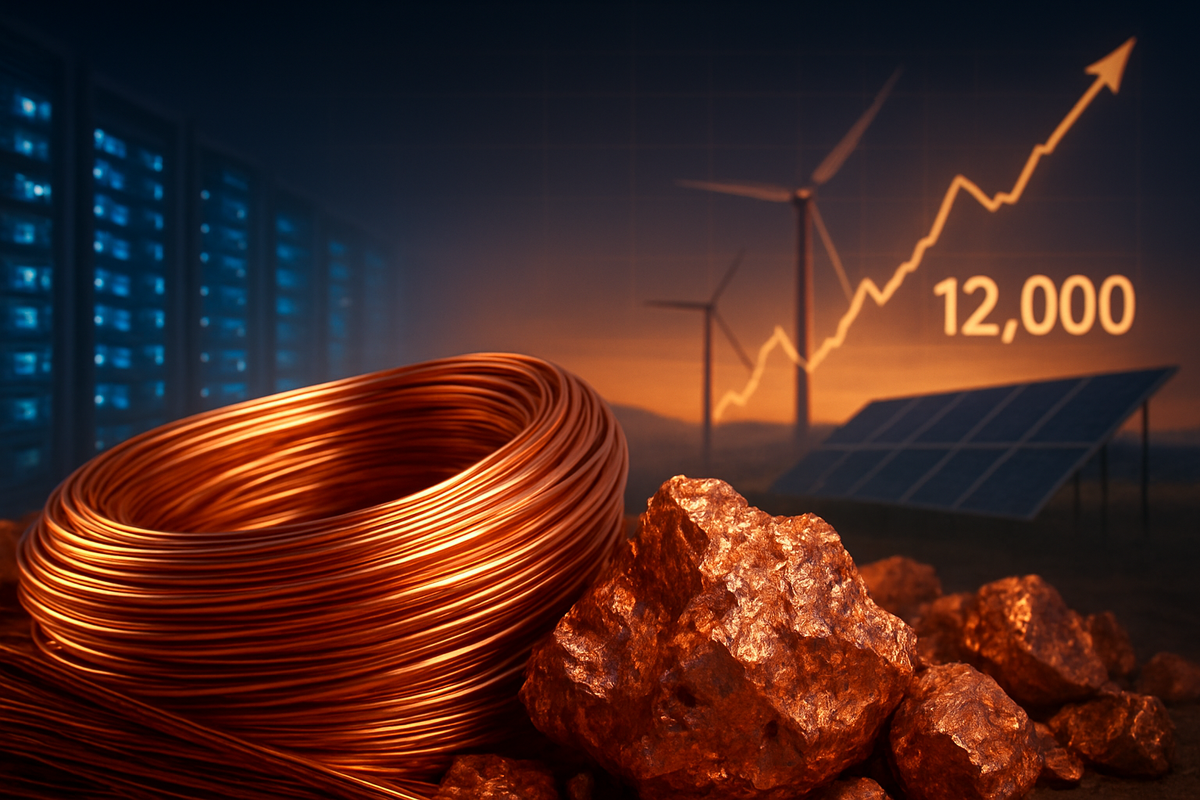
As of late December 2025, the global commodities market is grappling with a historic milestone: copper has officially breached the $12,000 per metric tonne mark on the London Metal Exchange (LME). This unprecedented rally, which saw the "red metal" gain over 20% in the final quarter of the year alone, has sent shockwaves through industrial supply chains and forced a re-evaluation of the global economic outlook. Often referred to as "Dr. Copper" for its ability to diagnose the health of the world economy, the metal’s current trajectory suggests a world transitioning from a period of inflationary caution into a high-stakes "Electrification Supercycle" driven by artificial intelligence and the green energy transition.
The immediate implications of this surge are dual-edged. For mining giants and resource-rich nations, the price spike represents a windfall of historic proportions. However, for manufacturers of consumer electronics, electric vehicles, and renewable energy infrastructure, the rising cost of this essential conductor is threatening to erode margins and delay critical projects. With the U.S. and Europe simultaneously pushing for domestic manufacturing reshoring, the scramble for physical copper has turned into a geopolitical chess match, where securing supply is no longer just a business necessity but a matter of national security.
The Perfect Storm: Supply Shocks and the AI "Collision"
The journey to $12,000 per tonne was paved by a series of systemic supply failures and a sudden, massive demand pivot. The timeline of this crisis accelerated in mid-2025 when a catastrophic mudslide and flooding at the Grasberg Block Cave mine in Indonesia—operated by Freeport-McMoRan (NYSE: FCX)—triggered a force majeure. This single event removed an estimated 250,000 tonnes of copper from the 2025 global supply curve. This followed a string of production downgrades from Chile’s state-owned Codelco, which struggled with a major tunnel collapse at its flagship El Teniente mine earlier in the year.
While supply was faltering, demand was being supercharged by the "AI Arms Race." In 2025, the proliferation of hyperscale data centers—spearheaded by tech giants like Microsoft (NASDAQ: MSFT) and Alphabet (NASDAQ: GOOGL)—emerged as a top-tier demand catalyst. These facilities require three to eight times more copper than traditional data centers for high-power cooling systems and electrical distribution. By December 2025, AI-related infrastructure alone accounted for nearly 500,000 tonnes of annual copper demand, a figure that was virtually non-existent in market models just three years prior.
The market reaction has been one of "acute tension." In the physical markets, Chinese smelters—which process over half of the world’s copper—found themselves in an unsustainable position as treatment and refining charges (TC/RCs) turned negative. This forced a historic 10% production cut across major Chinese smelting groups in November 2025, further tightening the availability of refined copper cathode and sending spot premiums to record highs in both Shanghai and Rotterdam.
Winners and Losers in the New Copper Economy
The primary beneficiaries of this rally are the diversified mining majors with low-cost production profiles. Freeport-McMoRan (NYSE: FCX) and Southern Copper (NYSE: SCCO), despite the operational setbacks at Grasberg, have seen their stock prices reach all-time highs as the realized price of copper far outpaces their cash costs of production. BHP Group (NYSE: BHP) has also emerged as a winner, not just through its existing mines, but through its strategic 2025 acquisition of Filo Corp in partnership with Lundin Mining (TSX:LUN), securing a massive new copper-gold district in the Andes just as prices peaked.
On the losing side of the ledger are the "end-users" who cannot easily substitute copper. Electric vehicle manufacturers like Tesla (NASDAQ: TSLA) and Rivian (NASDAQ: RIVN) are facing significant headwinds. With an average EV requiring roughly 60kg to 80kg of copper, the price jump from $8,000 to $12,000 per tonne adds approximately $250 to $350 in raw material costs per vehicle. In a market already defined by aggressive price wars, these rising input costs are squeezing margins to the breaking point. Similarly, the construction sector and homebuilders are seeing the cost of wiring and plumbing skyrocket, potentially cooling the U.S. housing market recovery.
Furthermore, the "mid-stream" manufacturers—companies that turn raw copper into wire and tube—are caught in a liquidity trap. High prices require more working capital to maintain inventory, and many smaller players are struggling to secure the credit lines necessary to keep their factories running. This has led to a consolidation in the manufacturing sector, where only the largest, most well-capitalized firms can afford to hold the physical metal.
A Bellwether for the "Electrification Economy"
The current copper rally is more than just a commodity price spike; it represents a fundamental shift in the global industrial trend. Historically, copper prices were tied to Chinese property cycles and global manufacturing PMIs. In 2025, however, the metal has decoupled from traditional industrial indicators. While the Chinese property market remains subdued, the "Green Energy" and "Digitalization" sectors have become the new masters of the copper market. This shift suggests that copper is no longer just a cyclical industrial metal but a critical "tech metal" essential for the 21st-century economy.
The ripple effects are also being felt in trade policy. In July 2025, the U.S. government imposed a 50% tariff on semi-finished copper products to protect domestic manufacturers. This move initially caused a "two-tier" market, with U.S. domestic copper trading at a significant premium to the LME. This policy has sparked a domestic manufacturing boom in copper processing but has also made the U.S. one of the most expensive places in the world to build a data center or an EV battery plant, highlighting the difficult trade-offs between protectionism and the energy transition.
Comparisons are being drawn to the "Oil Shock" of the 1970s. Just as oil was the indispensable fuel of the 20th century, copper is becoming the indispensable conductor of the 21st. The 2025 surge is forcing governments to reconsider their "critical minerals" strategies, with the U.S. and EU increasingly looking to fast-track mining permits—a process that has historically taken over a decade—to ensure they aren't left behind in the race for electrification.
What Comes Next: Substitution or Sustained Scarcity?
In the short term, the market is watching for a potential "demand destruction" event. If prices remain above $12,000, industries may be forced to pivot toward aluminum substitution, particularly in high-voltage power lines and certain automotive applications. However, aluminum is less efficient and requires larger volumes to achieve the same conductivity, making it an imperfect fix. Analysts at Goldman Sachs suggest that while some substitution will occur, the structural deficit is so deep—projected at 330,000 tonnes for 2026—that prices are likely to remain "higher for longer."
The next 12 to 24 months will likely see a wave of "urban mining" and recycling initiatives. As the price of virgin copper climbs, the economics of recycling old electronics and industrial scrap become increasingly attractive. We may also see a pivot in mining technology, with companies investing heavily in "leaching" technologies that can extract copper from lower-grade waste piles that were previously considered uneconomical.
Strategic shifts are already underway at the corporate level. We expect to see more "downstream" companies—like auto manufacturers and tech giants—seeking direct equity stakes in mining projects or signing long-term "off-take" agreements to bypass the volatility of the spot market. The era of buying copper "just in time" is over; the era of "just in case" stockpiling has begun.
Wrap-Up: The Red Metal’s New Reality
The copper surge of 2025 is a definitive signal that the global economy is entering a new phase of development. The metal’s climb to $12,000 per tonne is a symptom of a world that is trying to rebuild its energy and data infrastructure simultaneously, all while facing a decade of underinvestment in new mining capacity. The "Dr. Copper" of old might have signaled a simple economic expansion; the "Dr. Copper" of today is signaling a fundamental, structural transformation of how we power and connect our world.
Moving forward, the market will remain highly sensitive to any news regarding mining restarts—particularly the idle Cobre Panama mine—and the pace of interest rate adjustments by the Federal Reserve, which will dictate the cost of financing the massive new projects needed to close the supply gap. Investors should keep a close eye on inventory levels at the LME and COMEX, as well as any shifts in Chinese smelting capacity.
For the public and for investors, the message is clear: the transition to a greener, more digital world is not just a technological challenge, but a resource challenge. Copper is the bottleneck of the future, and its price performance in late 2025 is likely just the opening chapter in a long-term story of scarcity and strategic competition.
This content is intended for informational purposes only and is not financial advice.