
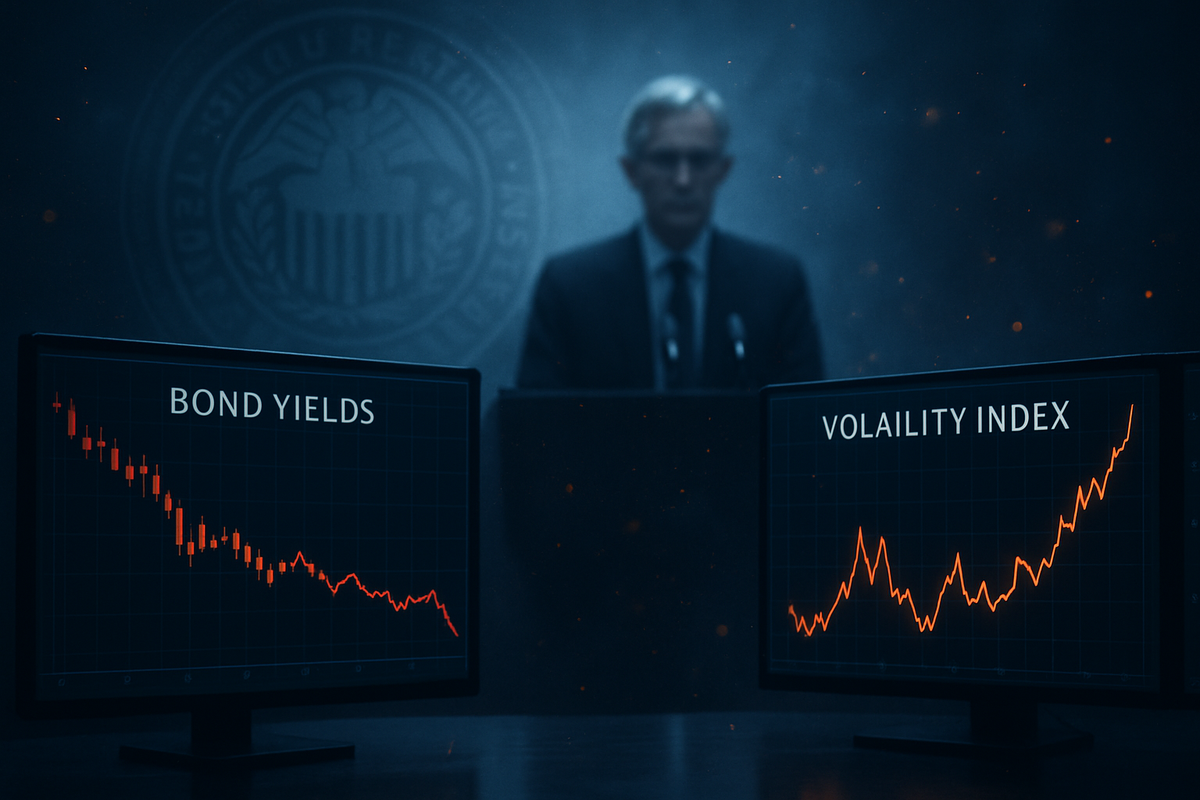
In a move that underscored the Federal Reserve's delicate balancing act, the central bank delivered its third interest rate cut of 2025 on December 10, reducing the benchmark federal funds rate by 25 basis points to a range of 3.50%–3.75%. While a rate cut is traditionally seen as a "dovish" signal intended to stimulate the economy, the accompanying policy statement and subsequent press conference by Chair Jerome Powell were surprisingly stern. This "hawkish cut" has sent ripples through the financial markets, as investors grapple with the reality that the aggressive easing cycle many had hoped for may be coming to an abrupt halt.
The immediate implications of this decision have been felt across the futures markets, where expectations for further cuts in early 2026 are being rapidly repriced. By signaling that the "normalization" phase is nearing its conclusion, the Fed has effectively placed a floor under bond yields and forced a re-evaluation of equity valuations. As of late December, the market is no longer betting on a series of rapid-fire reductions, but rather a "higher-for-longer" plateau that could persist well into the next year, leaving the broader economy in a state of high-interest-rate equilibrium.
A House Divided: The Mechanics of the December Decision
The December 10 FOMC meeting was defined by a level of internal friction not seen in years. The committee voted 9–3 to implement the 25-basis-point reduction, marking the highest number of dissenting votes since 2019. The dissenters represented two polar opposite concerns: Governor Stephen Miran pushed for a more aggressive 50-basis-point cut to stave off labor market "cracks," while regional presidents Austan Goolsbee and Jeffrey Schmid argued for holding rates steady, citing inflation that remains stubbornly parked at 2.8%—well above the Fed’s 2% target.
This internal rift comes at a time of extreme data opacity. A 43-day federal government shutdown earlier in the fourth quarter of 2025 created a "data blackout," delaying critical employment and inflation reports from the Bureau of Labor Statistics. This lack of clarity forced the Fed to rely on "anecdotal evidence and real-time private sector metrics," as Powell noted during his press conference. The timeline of 2025 has been a steady march toward this moment: after a long pause in the first half of the year, the Fed cut rates in September and October before this final December move, totaling a 75-basis-point reduction for the calendar year.
Market participants were particularly rattled by the updated Summary of Economic Projections, colloquially known as the "dot plot." The new projections suggest only one additional quarter-point cut in all of 2026, a far cry from the three or four cuts that futures traders had anticipated just weeks ago. This shift in the dot plot, combined with Powell’s golfing metaphor—stating the Fed was "hitting it right down the middle" to find a neutral stance—solidified the perception that the central bank is more afraid of reigniting inflation than it is of a mild economic slowdown.
Winners and Losers in a "High Floor" Environment
The Fed's hawkish tone has created a bifurcated landscape for public companies. Major financial institutions like JPMorgan Chase & Co. (NYSE: JPM) and Bank of America Corp. (NYSE: BAC) stand to benefit from this environment. A "hawkish cut" that keeps the terminal rate above 3% allows these banks to maintain healthy net interest margins—the difference between what they earn on loans and what they pay out on deposits—while still benefiting from the modest uptick in loan demand that a lower rate environment encourages.
Conversely, the "hawkish cut" is a blow to small-cap stocks and highly leveraged sectors. The iShares Russell 2000 ETF (NYSEARCA: IWM), a primary proxy for small-cap performance, saw immediate pressure as the prospect of sustained high borrowing costs weighed on companies that lack the massive cash reserves of their mega-cap peers. Real estate investment trusts (REITs) like Prologis, Inc. (NYSE: PLD) also face headwinds; while the 25-basis-point cut provides some relief, the hawkish outlook has kept the 10-year Treasury yield elevated near 4.17%, making the dividend yields of REITs less attractive by comparison and keeping the cost of refinancing commercial debt painfully high.
Technology giants with robust balance sheets, such as Microsoft Corporation (NASDAQ: MSFT) and Apple Inc. (NASDAQ: AAPL), have shown resilience. These companies are less dependent on external financing and are viewed as "safe havens" in a world where the Fed is reluctant to fully take its foot off the brake. However, the broader tech sector, particularly high-growth firms that are not yet profitable, may find the Fed's cautious stance a significant hurdle as the "discount rate" applied to their future earnings remains higher than previously hoped.
The Broader Significance: Tariffs, Transitions, and Trends
The Fed’s caution is not happening in a vacuum. A significant driver of the "sticky" 2.8% inflation rate has been the implementation of reciprocal tariffs earlier in 2025. While Jerome Powell characterized these as a "one-time shift in the price level," the committee is clearly wary of the secondary effects these costs could have on consumer expectations. This marks a shift in the central bank's focus from purely demand-side management to navigating complex supply-side shocks that are largely outside of its control.
Historically, this "hawkish cut" draws comparisons to the 1990s "mid-cycle adjustments," where the Fed lowered rates slightly to sustain an expansion rather than to rescue a failing economy. However, the current geopolitical climate and the looming leadership transition at the Fed add layers of complexity. Jerome Powell’s term is set to expire in May 2026, and the December meeting may be one of his final acts to cement a "soft landing" legacy. The hawkishness may be a strategic move to leave his successor with "dry powder"—the ability to cut rates further if a true recession emerges in late 2026.
The regulatory implications are also noteworthy. With the Fed signaling a slower path for rate reductions, the pressure on the banking sector to maintain high capital buffers remains. Furthermore, the "data blackout" caused by the government shutdown has highlighted the systemic risk of relying on centralized government statistics, potentially leading to a greater industry-wide push for decentralized or private-sector economic indicators to inform future policy.
What Lies Ahead: The Road to 2026
As we move into the first quarter of 2026, the primary focus for investors will be the "terminal rate"—the point at which the Fed stops cutting altogether. Current projections place this rate between 3.00% and 3.25%, but any resurgence in inflation could easily push that floor higher. Strategic pivots will be required for corporate treasurers who had been planning for a return to 2% interest rates; the reality of a "3% world" means that capital allocation must be more disciplined and projects with marginal returns may be shelved.
Short-term volatility is expected to remain low, as evidenced by the Cboe Volatility Index (VIX) hitting yearly lows, but this may be the "calm before the storm." The transition of Fed leadership in May 2026 represents a massive wildcard. If the next Chair is perceived as more political or less committed to the 2% inflation target, the bond market could react violently. Investors should watch for the "re-opening" of government data in January, which will either validate the Fed's caution or reveal that the central bank has waited too long to ease, potentially risking a "hard landing."
Final Thoughts: Navigating the Normalization
The Federal Reserve's December 10 decision marks the end of the "easy money" speculation that characterized the late 2024 pivot. By delivering a cut while simultaneously sounding the alarm on inflation and data uncertainty, the Fed has signaled that "normalization" does not mean a return to the zero-interest-rate policy (ZIRP) of the past decade. Instead, the market is entering a new era of "moderate-for-longer" rates.
Key takeaways for investors include the importance of balance sheet strength and the need to look beyond the headline rate cuts. The "hawkish" messaging is just as important as the 25-basis-point move itself. Moving forward, the market will be hyper-sensitive to any signs of labor market deterioration that could force the Fed's hand, as well as any inflationary pressure from the ongoing tariff disputes. For now, the "Santa Claus Rally" in the S&P 500—which remains near record highs of 6,932—suggests that the market is willing to accept the Fed's "soft landing" narrative, but the margin for error has never been thinner.
This content is intended for informational purposes only and is not financial advice.