Financial services company Bread Financial (NYSE: BFH) reported Q1 CY2026 results topping the market’s revenue expectations, with sales up 4.9% year on year to $1.02 billion. Its non-GAAP profit of $4.18 per share was 37% above analysts’ consensus estimates.
Is now the time to buy Bread Financial? Find out by accessing our full research report, it’s free.
Bread Financial (BFH) Q1 CY2026 Highlights:
- Net Interest Income: $1.07 billion vs analyst estimates of $1.04 billion
- Net Interest Margin: 19.3% vs analyst estimates of 18.5% (79.6 basis point beat)
- Revenue: $1.02 billion vs analyst estimates of $994.6 million (4.9% year-on-year growth, 2.3% beat)
- Efficiency Ratio: 46.4% vs analyst estimates of 48.5% (209.2 basis point beat)
- Adjusted EPS: $4.18 vs analyst estimates of $3.05 (37% beat)
- Market Capitalization: $3.99 billion
Company Overview
Formerly known as Alliance Data Systems until its 2022 rebranding, Bread Financial (NYSE: BFH) provides credit cards, installment loans, and savings products to consumers while powering branded payment solutions for retailers and merchants.
Revenue Growth
A company’s long-term sales performance can indicate its overall quality. Any business can put up a good quarter or two, but the best consistently grow over the long haul. Regrettably, Bread Financial’s revenue grew at a tepid 5.1% compounded annual growth rate over the last five years. This was below our standard for the financials sector and is a poor baseline for our analysis.
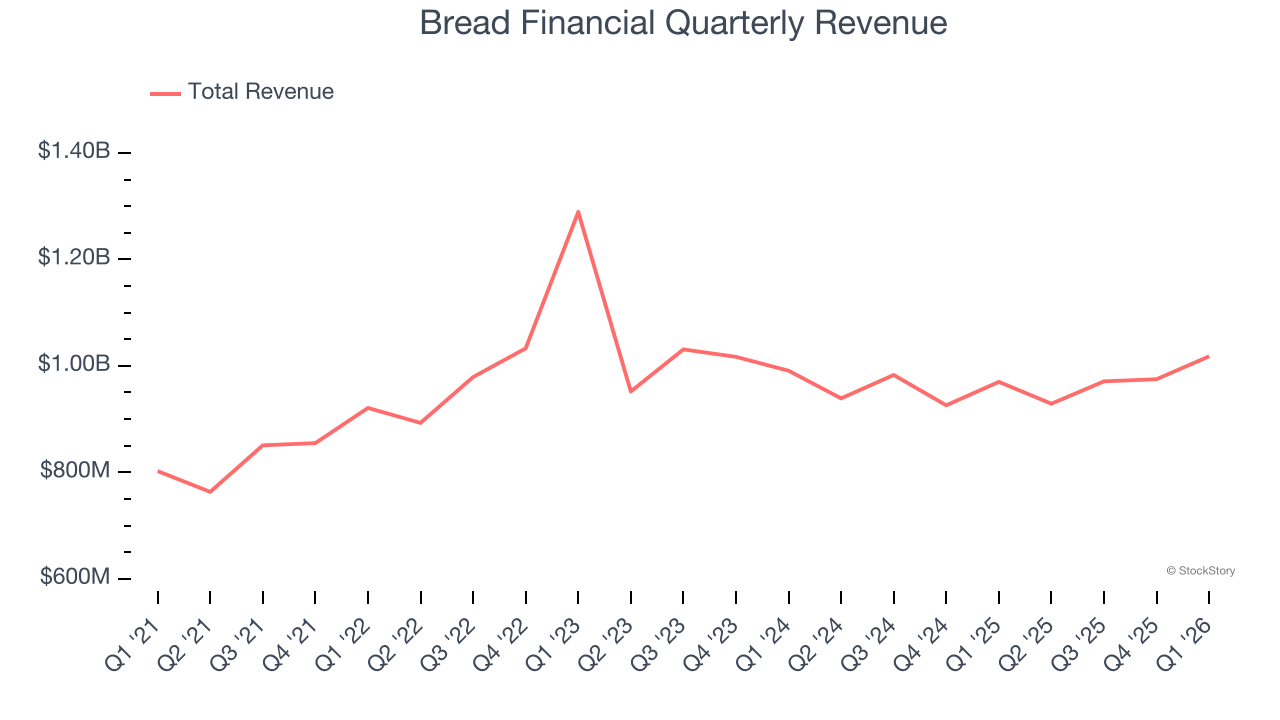
Long-term growth is the most important, but within financials, a half-decade historical view may miss recent interest rate changes and market returns. Bread Financial’s performance shows it grew in the past but relinquished its gains over the last two years, as its revenue fell by 1.2% annually. 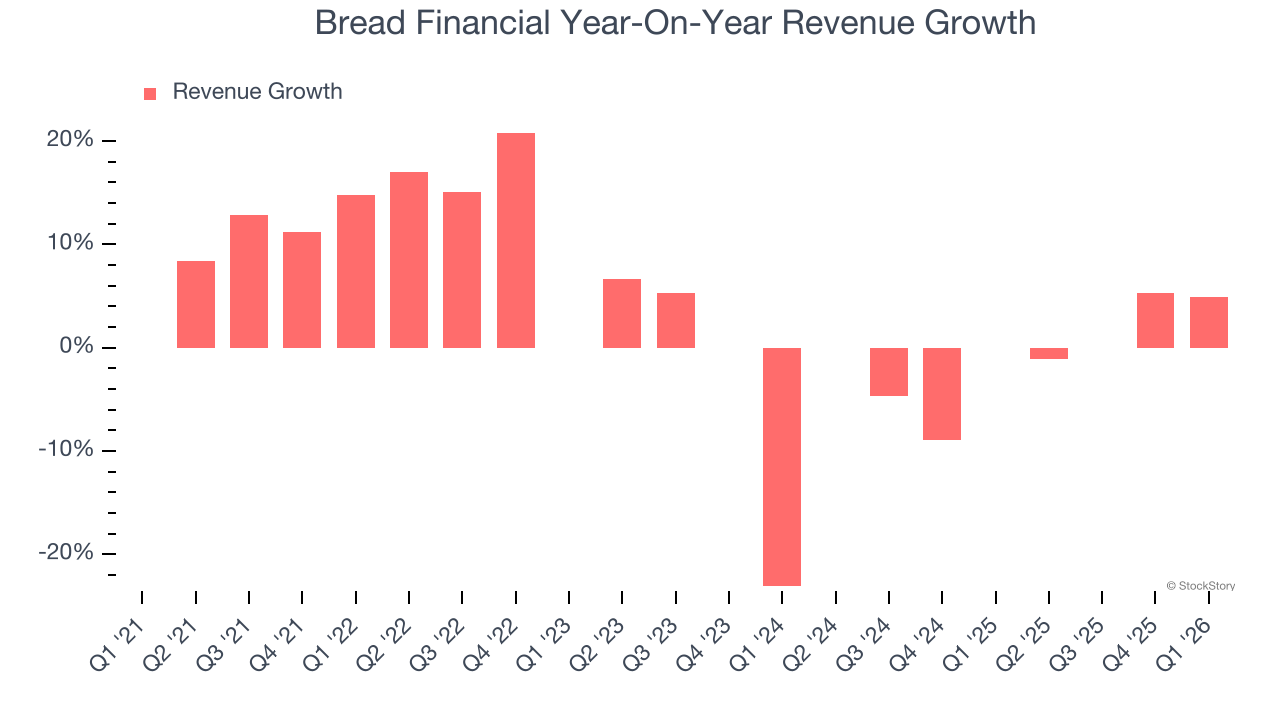 Note: Quarters not shown were determined to be outliers, impacted by outsized investment gains/losses that are not indicative of the recurring fundamentals of the business.
This quarter, Bread Financial reported modest year-on-year revenue growth of 4.9% but beat Wall Street’s estimates by 2.3%.
ONE MORE THING: The $21 AI Application Stock Wall Street Forgot. While Wall Street obsesses over who’s building AI, one company is already using it to print money. And nobody’s paying attention.
AI chip stocks trade at ridiculous valuations. This company processes a trillion consumer signals monthly using AI and trades at a third of the price. The gap won’t last. The institutions will figure it out. You need to see this first. Read the FREE Report Before They Notice.
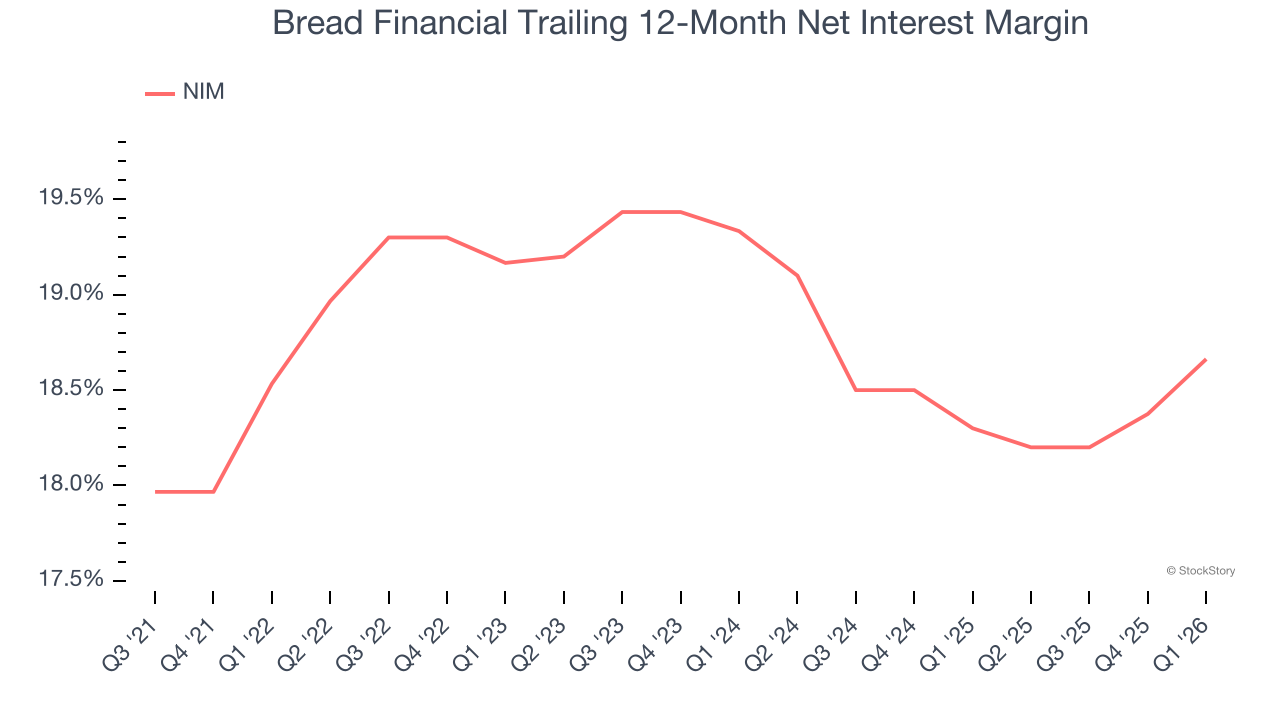
Net Interest Margin
Net interest margin (NIM) represents the unit economics of a financial institution by measuring the profitability of its interest-bearing assets relative to its interest-bearing liabilities. It's a fundamental metric that investors use to assess lending premiums and returns.
Bread Financial’s net interest margin has increased by 12.9 basis points (100 basis points = 1 percentage point) over the last four years but decreased by 67.1 basis points on a two-year basis. These rates of change were worse than the broader financials industry. The firm’s NIM for the trailing 12 months was 18.7%.
Key Takeaways from Bread Financial’s Q1 Results
It was good to see Bread Financial beat analysts’ EPS expectations this quarter. We were also excited its net interest margin outperformed Wall Street’s estimates by a wide margin. On the other hand, its efficiency ratio missed. Zooming out, we think this was a solid print. The stock remained flat at $91.60 immediately after reporting.
Should you buy the stock or not? We think that the latest quarter is only one piece of the longer-term business quality puzzle. Quality, when combined with valuation, can help determine if the stock is a buy. We cover that in our actionable full research report which you can read here (it’s free).