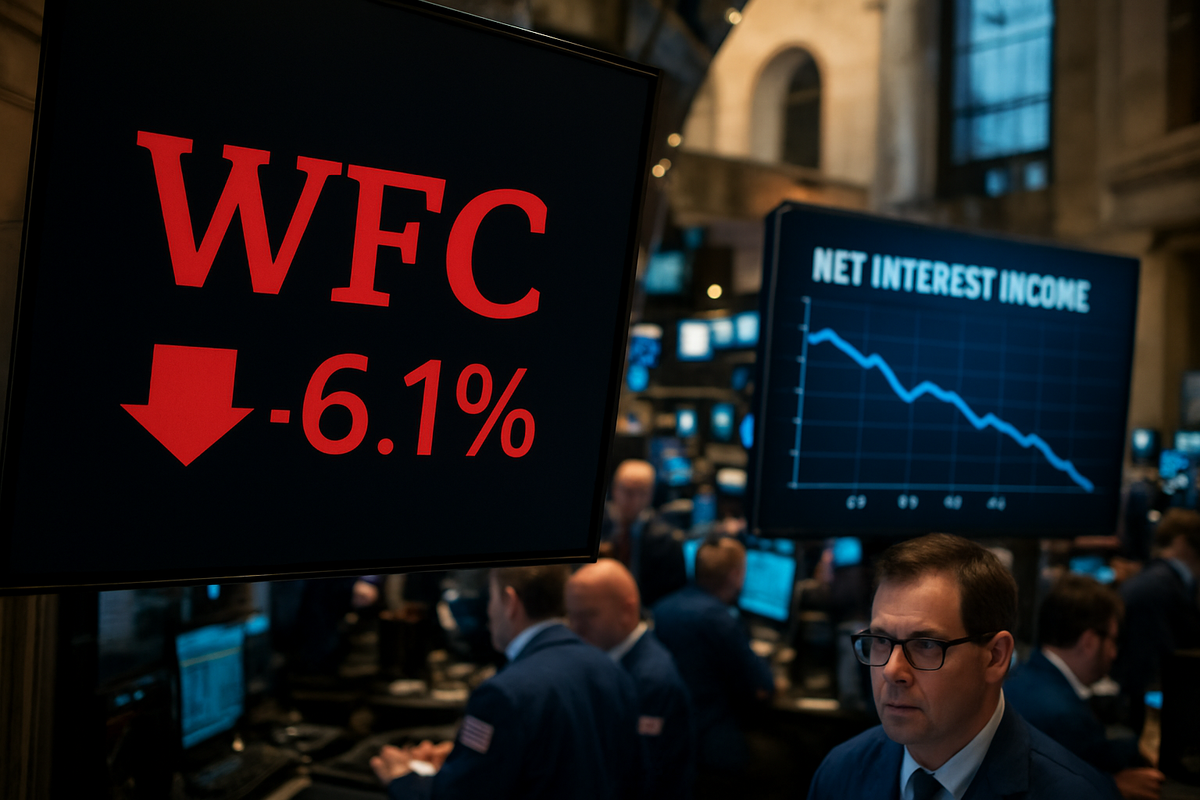
SAN FRANCISCO – Shares of Wells Fargo & Company (NYSE: WFC) experienced a sharp sell-off on Tuesday, falling 6.1% after the banking giant reported first-quarter revenue that missed Wall Street expectations. The decline reflects growing investor anxiety over the bank's ability to maintain profit margins as the era of aggressive interest rate hikes gives way to a more complex, stagnating rate environment.
The disappointing top-line performance has cast a shadow over the start of the 2026 banking earnings season, highlighting a critical pivot point for the industry. While Wells Fargo has spent the last year operating without the regulatory asset cap that long hampered its growth, the Q1 results suggest that internal operational hurdles and external macroeconomic pressures—specifically rising deposit costs and shifting interest rate outlooks—remain formidable obstacles to the bank’s full recovery.
Revenue Miss Rattles Investors as Lending Income Falters
The primary catalyst for Tuesday's slide was a notable shortfall in total revenue. Wells Fargo (NYSE: WFC) reported first-quarter revenue of $21.45 billion, failing to meet the consensus analyst estimate of $21.73 billion. While this represented a year-over-year increase from the $20.15 billion reported in Q1 2025, the pace of growth was insufficient to satisfy a market that had priced in a more robust post-asset-cap expansion.
The miss was driven largely by weaker-than-expected Net Interest Income (NII), which totaled $12.1 billion against a forecasted $12.3 billion. NII, the difference between what a bank earns on loans and what it pays out on deposits, has been under intense scrutiny as the Federal Reserve maintains a policy rate in the 3.50% to 3.75% range. Despite a yield curve that has finally uninverted, providing some relief to lending margins, Wells Fargo’s inability to capture that spread effectively caught many by surprise. CEO Charlie Scharf noted during the earnings call that while credit quality remains strong, the "normalization" of the balance sheet following the 2025 lifting of the asset cap is proving more gradual than anticipated.
Winners and Losers in a Volatile Financial Sector
The ripple effects of Wells Fargo’s results were felt across the sector, though the impact was not uniform. JPMorgan Chase & Co. (NYSE: JPM) saw its stock decline by a more modest 2.8%, as investors weighed its superior scale and diversified revenue streams against the broader industry headwinds. JPMorgan’s integration of assets acquired during the 2023-2024 banking tremors continues to provide a buffer that more retail-focused institutions like Wells Fargo lack.
Conversely, Bank of America Corporation (NYSE: BAC) found itself in a similar boat to Wells Fargo, with its shares sliding 4.2%. Bank of America remains burdened by a massive portfolio of low-yield, long-term bonds purchased during the low-rate era of 2020-2021. As these assets roll over slowly, the bank struggles to match the margin expansion seen by more nimble competitors. Meanwhile, Citigroup Inc. (NYSE: C) appeared to be a relative winner in the eyes of some analysts, as its recent corporate restructuring and heavy focus on investment banking fees provided a hedge against the NII volatility plaguing its peers.
The Broader Significance: The Death of the 'Easy Money' Margin
Wells Fargo’s Q1 miss is more than just a company-specific stumble; it represents the "new normal" for American banking in 2026. The "Goldilocks" period—where banks benefited from high lending rates while keeping deposit costs near zero—has officially ended. This phenomenon, known as "deposit beta," has seen consumers and corporations aggressively move funds into high-yield money market accounts and digital assets, forcing banks like Wells Fargo to pay more to retain their funding base.
This shift mirrors historical precedents from the late 1990s, where a plateauing interest rate environment led to a squeeze on regional and national banks alike. Furthermore, the 2026 regulatory landscape, influenced by the "Genius Act" of 2025 which increased transparency in digital banking, has accelerated the movement of capital. For Wells Fargo, the challenge is amplified by its historical reliance on a vast retail deposit base that is now demanding higher returns, effectively narrowing the Net Interest Margin (NIM) that was supposed to expand following the removal of the asset cap.
Strategic Pivots and the Path to Recovery
Looking ahead, the road to recovery for Wells Fargo will require a dual focus on cost discipline and aggressive expansion in non-interest-bearing sectors. Management has signaled an intention to deploy an additional $100 billion in capital over the next 18 months, focusing on its Wealth and Investment Management division, which was a rare bright spot in the Q1 report with 14% revenue growth.
In the short term, the market will be watching the Federal Reserve’s June meeting for any hints of a rate cut. If the Fed begins to ease, it could reduce the pressure on deposit costs, though it might also limit the yields Wells Fargo can earn on new loans. The long-term scenario hinges on the bank's ability to modernize its technology stack and improve its efficiency ratio, which currently lags behind top-tier competitors like JPMorgan.
Summary and Investor Outlook
The 6.1% drop in Wells Fargo shares serves as a stark reminder that the removal of regulatory shackles is not a panacea for macroeconomic challenges. The key takeaways for investors are clear: revenue growth is stalling as lending margins compress, and the "higher for longer" rate environment is finally taking its toll on the liability side of the balance sheet.
Moving forward, the market will likely reward banks that can prove their "stickiness" with depositors without sacrificing their margins. For Wells Fargo, the coming months will be a test of whether it can transform its increased balance sheet capacity into meaningful profit growth. Investors should keep a close eye on the bank’s loan demand figures and any shifts in its deposit mix, as these will be the primary drivers of stock performance in the second half of 2026.
This content is intended for informational purposes only and is not financial advice.