
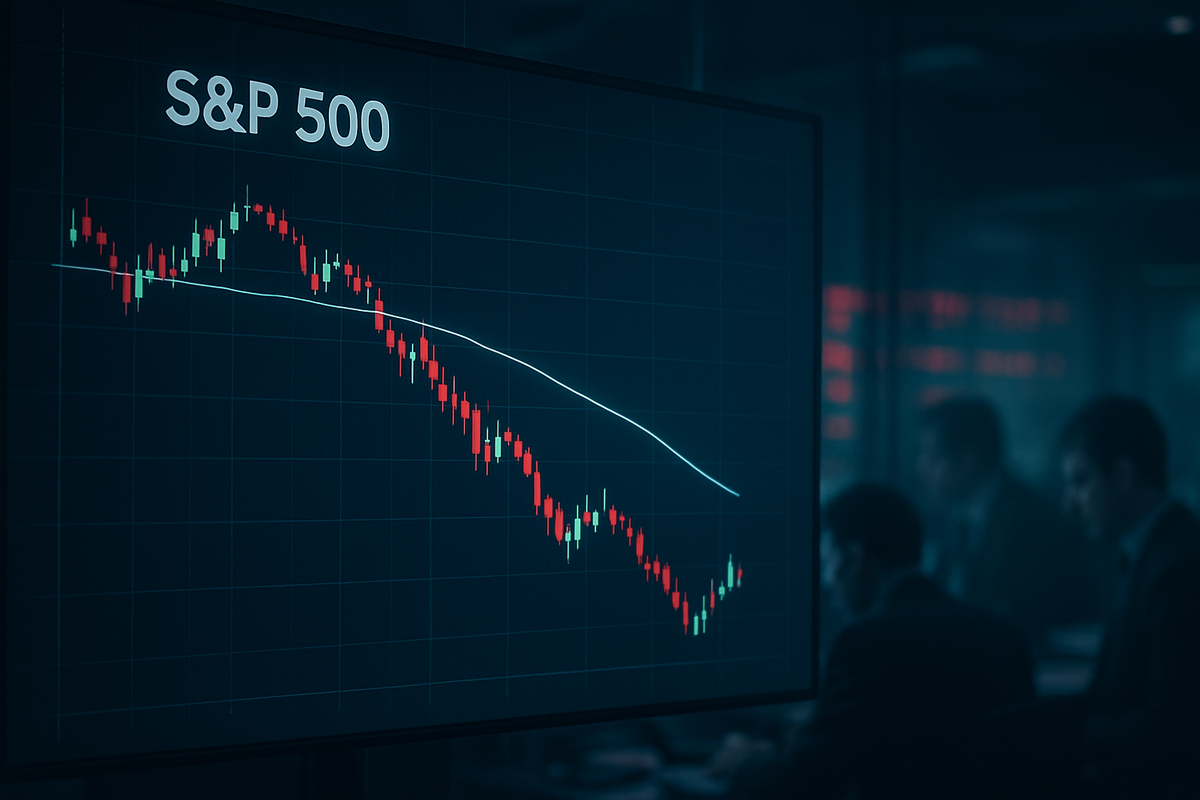
The S&P 500 index has entered a precarious technical phase after closing below its 200-day moving average of 6,621 for two consecutive trading sessions, a signal that historically heralds increased volatility and a potential shift into a bear market regime. While a relief rally on Monday, March 23, 2026, provided a temporary reprieve for bruised portfolios, technical analysts warn that the "two-day rule"—a confirmation of a breakdown—suggests the path of least resistance for the equity market may now be lower.
This breach represents the first time the index has sustained a close below this long-term trend line since the post-recession recovery began in late 2024. The immediate implications are significant: institutional "trend-following" models, which manage trillions in assets, often flip from buyers to sellers once this threshold is crossed. For the broader market, this technical failure at 6,621 could transform previous support levels into formidable resistance, potentially trapping investors who mistook Monday’s bounce for a durable bottom.
The Breach at 6,621: A Timeline of Technical Decay
The descent toward the 200-day moving average (DMA) began in late February, fueled by persistent inflation data and geopolitical tensions in the Middle East that spiked energy prices. The S&P 500 (NYSE Arca: SPY) first tested the 6,621 level during intraday trading on Thursday, March 19, but managed a desperate late-day recovery. However, the dam finally broke on Friday, March 20, when a wave of programmatic selling pushed the index to a close of 6,585, well below the critical average.
The "confirmation" came during the first half of trading on Monday, March 23. Despite an optimistic open, the index failed to reclaim the 6,621 level by the mid-day mark, marking the second consecutive close below the line. Although a late-afternoon "relief rally" saw the index claw back some losses, the technical damage was already done. Market participants, including major hedge funds and high-frequency trading desks, viewed the inability to hold the 200-DMA as a "regime shift" from a "buy-the-dip" environment to a "sell-the-rip" mentality.
The stakeholders currently in the crosshairs include retail investors heavily concentrated in passive index funds like the iShares Core S&P 500 ETF (NYSE Arca: IVV) and the Vanguard S&P 500 ETF (NYSE Arca: VOO). Initial market reactions have been characterized by a "flight to quality," with capital rotating out of speculative high-growth sectors and into short-term Treasury bills, reflecting a growing consensus that the 2025 bull run has hit a definitive ceiling.
Winners and Losers in a Below-200-Day World
The technical breakdown creates a stark divide between "defensive" survivors and "cyclical" victims. High-beta technology stocks, which drove the index to its 2025 peaks, are facing the most intense pressure. NVIDIA Corp. (NASDAQ: NVDA) and Microsoft Corp. (NASDAQ: MSFT), which together carry massive weight in the S&P 500, have seen their "valuation premiums" questioned as the index loses its upward momentum. If the breakdown persists, these former market leaders could see forced liquidations from "momentum-based" ETFs.
Conversely, some "value" and "defensive" players may emerge as relative winners. Consumer staple giants and healthcare firms often see inflows during periods of technical instability as investors seek "earnings certainty." Furthermore, the ProShares Short S&P 500 (NYSE Arca: SH) and other inverse ETFs are seeing a surge in volume as traders hedge against further downside. Financial institutions like JPMorgan Chase & Co. (NYSE: JPM) find themselves in a complex position; while higher volatility can boost trading desk revenue, a sustained market downturn typically leads to a slowdown in investment banking and IPO activity.
The biggest "losers" in this scenario are likely the mid-cap growth companies that rely on easy capital markets. With the S&P 500 below its 200-DMA, risk appetite shrinks, making it harder for pre-profit firms to raise secondary offerings or secure favorable debt terms. For companies like Tesla Inc. (NASDAQ: TSLA), which often trade more on sentiment and technical flow than traditional fundamentals, the loss of the 200-DMA support could trigger a cascade of "stop-loss" orders from retail and institutional desks alike.
Broader Significance: From "Noise" to "Trend Reversal"
In the world of technical analysis, the 200-day moving average is considered the "Mother of all Support Levels." Historical data suggests that when the S&P 500 trades above this line, it returns an annualized average of approximately 9.7%; however, when it falls below, annualized returns drop to 4.1% while volatility nearly doubles. The current event fits into a broader industry trend of "quantitative tightening" and the exhaustion of the AI-driven productivity trade that dominated 2024 and 2025.
The ripple effects extend far beyond the New York Stock Exchange. International markets often take their cues from the S&P 500; a confirmed breakdown in the U.S. can lead to sympathetic sell-offs in the Nikkei or the DAX. Policy-wise, a sustained stay below 6,621 often catches the attention of the Federal Reserve. Historically, significant breaches of the 200-DMA have preceded "dovish pivots" from the Fed, as the "wealth effect" of a declining stock market can quickly translate into reduced consumer spending and an economic slowdown.
Comparing this to historical precedents, the current setup mirrors the "head-and-shoulders" tops seen in 2000 and 2008. While those were extreme cases, even the 2022 bear market saw multiple "relief rallies" or "dead cat bounces" that lured investors back in, only to see the index make new lows weeks later. Analysts like Michael Hartnett at Bank of America (NYSE: BAC) have previously called the 6,600 level a "Policy Response Level," suggesting that if the market doesn't stabilize here, the "Fed Put" may finally be triggered.
What Comes Next: The Path to 6,000 or a Rapid Reclaim?
The short-term outlook depends entirely on the index's ability to reclaim the 6,621 level within the next 5 to 10 trading days. If the S&P 500 can stage a "V-shaped" recovery and close back above the 200-DMA, the recent breakdown will be dismissed as a "bear trap" or a "washout." In this scenario, the relief rally seen on Monday, March 23, would be the start of a robust recovery. Strategic pivots for investors would involve moving back into the high-growth names that were temporarily oversold.
However, a more ominous scenario involves a "test and reject" of the 6,621 level. If the index rallies up to 6,621 and fails to break through, it would confirm that the previous support has officially become "overhead resistance." This would likely lead to a test of the psychological 6,000 mark, representing a further 10% decline. Under such conditions, the market would require a significant catalyst—such as a surprise interest rate cut or a major cooling of geopolitical tensions—to reverse the technical damage.
Looking toward the mid-year, the market may enter a "trading range" between 6,200 and 6,600, requiring a more active management style. Investors may need to adapt by using "covered call" strategies or increasing their allocations to "all-weather" assets like gold or short-duration bonds. The emergence of a "lower low" below the March 20 closing price would be the ultimate signal that the multi-year bull market has officially concluded.
Market Outlook: The Importance of Technical Discipline
The takeaway for investors as of March 23, 2026, is one of extreme caution. The consecutive two-day close below the 200-day moving average is a rare and potent signal that the market's internal mechanics have weakened. While the relief rally on Monday offered some green on the screens, it did not change the underlying reality that the S&P 500 is currently trading in "hostile territory" below its long-term trend line.
Moving forward, the market is likely to remain in a high-volatility regime. Investors should watch the 6,621 level closely; any failed attempt to reclaim it should be viewed as a warning of further downside. The coming months will be a test of earnings resilience, as the "technical floor" has been removed, leaving the market to rely solely on fundamental valuations—which, at current levels, many strategists believe are still stretched.
In conclusion, the breach of 6,621 is more than just a number; it is a psychological shift for the investing public. Whether this is a temporary dip or the beginning of a prolonged downturn will be decided by the market's action in the final week of March. For now, the "wait-and-see" approach, coupled with a focus on risk management, appears to be the most prudent course of action for those navigating these turbulent financial waters.
This content is intended for informational purposes only and is not financial advice.