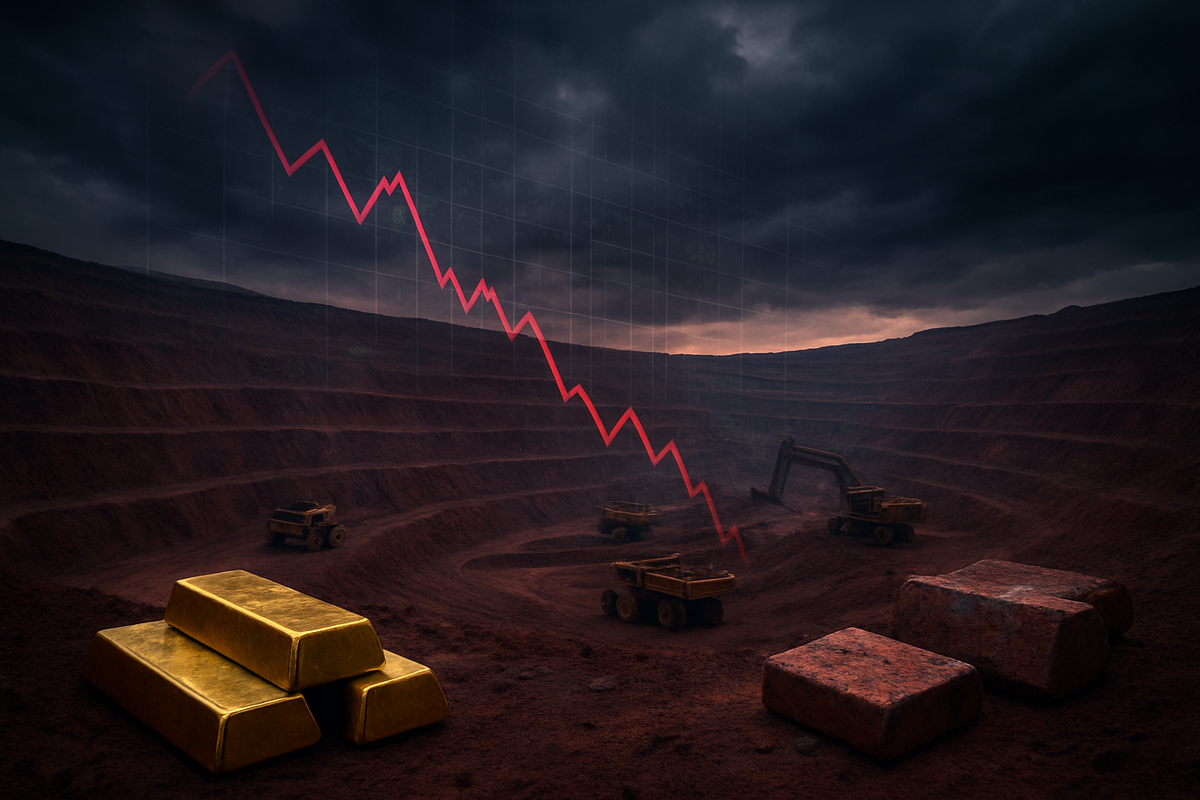
The global mining sector is reeling this week as a perfect storm of hawkish central bank policy and surging energy costs triggered a massive liquidation in precious and industrial metals. Major industry players, including Newmont Corporation (NYSE: NEM) and Freeport-McMoRan (NYSE: FCX), saw their valuations slashed as gold and copper prices retreated from historic highs, caught in the crosshairs of a Federal Reserve determined to keep interest rates restrictive.
The sudden reversal marks a stark departure from the record-breaking rally that defined the start of 2026. For investors, the 10% weekly plunge in gold and the corresponding double-digit declines in mining stocks serve as a jarring reminder of how quickly the "commodity supercycle" narrative can be derailed by shifts in monetary policy and a strengthening U.S. dollar.
The Mid-March Meltdown: A Timeline of the Sell-Off
The volatility began in earnest following the Federal Open Market Committee (FOMC) meeting on March 18, 2026. While the Fed maintained its benchmark interest rate at 3.50%–3.75%, the accompanying "dot plot" shattered market expectations for a series of rate cuts. Instead, officials signaled just one solitary reduction for the remainder of the year, citing persistent "cost-push" inflation driven by oil prices hovering above $100 per barrel. This "hawkish hold" sent shockwaves through the non-yielding asset classes, most notably gold.
By March 19, the sell-off intensified. Newmont Corporation (NYSE: NEM) shares plummeted 8.76% in a single session, extending a monthly decline that has now reached 18%. The pressure was compounded by the company’s own 2026 guidance, which characterized the current period as a "trough year" with a projected 10% drop in gold production and all-in sustaining costs (AISC) climbing to a staggering $1,680 per ounce. Similarly, Freeport-McMoRan (NYSE: FCX) faced a 14.4% slide over a ten-day window, as its primary revenue driver, copper, fell 5.8% to approximately $5.45 per pound.
The week ending March 23, 2026, has been described by institutional analysts as a "positioning flush." Spot gold (XAU), which had reached heights of $5,500 per ounce earlier in the year, saw its steepest weekly loss since 1983, dropping more than 10% to land near the $4,100 mark. Silver (XAG) fared even worse, enduring an 11% single-session tumble on March 23 as traders raced to liquidate positions in favor of the surging U.S. Dollar Index (DXY), which moved aggressively toward the 100.0 level.
Winners and Losers in the Commodities Correction
The primary losers in this environment are the large-cap miners with high operational leverage. Newmont’s struggle is particularly acute; the combination of falling metal prices and rising internal costs has squeezed margins from both ends. Institutional sentiment was further soured by reports of insider selling, with senior executives offloading shares just days before the March rout, signaling a lack of confidence in a near-term recovery. For Freeport-McMoRan (NYSE: FCX), the "macro squeeze" is twofold: while copper prices are falling, the cost of diesel—up 61% this year—is making the extraction and transport of ore significantly more expensive.
On the other side of the trade, the clear winner has been the U.S. dollar and short-duration Treasury instruments. As 10-year Treasury yields climbed to 4.25%, the opportunity cost of holding gold became too high for many institutional desks. Short-sellers and inverse commodity ETFs have also seen a windfall. Additionally, diversified industrial conglomerates that consume these metals as raw materials—such as those in the aerospace or traditional automotive sectors—may eventually see a reprieve in input costs, though these benefits are currently overshadowed by the same high energy prices hurting the miners.
Junior mining companies, often the most sensitive to price swings, are facing a liquidity crisis. With the "safe-haven" bid for gold evaporating despite ongoing geopolitical tensions in the Middle East, these smaller firms may struggle to secure the capital needed for exploration and development, potentially leading to a wave of consolidation or bankruptcies if prices do not stabilize quickly.
Broader Significance and Historical Precedents
The current retreat is a significant pivot in the 2026 market narrative. For months, the consensus was that gold would remain the ultimate hedge against a structural inflation shock and geopolitical instability. However, the Fed’s commitment to "vigilant neutrality" has proved that high interest rates remain the ultimate kryptonite for precious metals. This event mirrors the "volatility shakes" seen in the early 1980s, where aggressive Fed action eventually broke the back of a decade-long commodity boom.
The ripple effects extend beyond mining to the broader transition toward green energy. Copper is a critical component for electric vehicles and renewable grids; a sustained decline in its price could signal a cooling of the global manufacturing sector. Furthermore, the decoupling of gold from its safe-haven status suggests a shift in investor psychology: in a world of 4% yields and a strong dollar, "paper" assets are once again outshining "hard" assets.
Regulators and policy makers are watching closely, as the spike in energy costs that triggered the Fed's hawkish stance is a supply-side issue that higher interest rates can do little to fix. This creates a "stagflationary" shadow over the market, where the mining sector—traditionally an inflation hedge—is actually being crushed by the very inflation it was supposed to protect against.
What Comes Next: Strategic Pivots and Scenarios
In the short term, mining companies will likely focus on aggressive cost-cutting and high-grading—mining only the most profitable sections of their deposits—to preserve cash flow. Newmont Corporation (NYSE: NEM) may need to revise its 2026 capital expenditure plans if gold remains below $4,500/oz for an extended period. For Freeport-McMoRan (NYSE: FCX), the focus will be on managing energy hedges to mitigate the impact of $100+ oil on their bottom line.
There is a potential scenario where this "wash-out" creates a long-term floor for the market. Analysts suggest that the liquidation of crowded long positions was necessary to reset valuations. If the U.S. economy begins to show signs of a hard landing due to these high rates, the Fed might be forced to pivot back toward cuts sooner than the March "dot plot" suggests, which would reignite the rally in metals. However, for the next quarter, the "higher-for-longer" mantra is expected to keep a lid on any significant recovery.
Investors should also watch for a shift in M&A activity. With valuations depressed, larger miners with strong balance sheets may look to acquire distressed junior players at a discount. The "copper gap"—the long-term supply deficit expected by 2030—remains a structural reality, meaning that long-term investors may view this 20% correction as a generational entry point, provided they can stomach the near-term volatility.
Market Wrap-Up and Investor Outlook
The events of mid-March 2026 have fundamentally altered the trajectory of the mining sector. The 10% weekly drop in gold and the sharp retreat of stocks like Newmont Corporation (NYSE: NEM) and Freeport-McMoRan (NYSE: FCX) underscore the dominance of the Federal Reserve over the commodity markets. When the Fed chooses to combat energy-driven inflation with a hawkish stance, even the most traditional safe havens are not immune to the resulting liquidity drain.
Moving forward, the market remains in a state of "defensive recalibration." Investors should closely monitor the U.S. Dollar Index and the 10-year Treasury yield as the primary indicators for metal price movements. The era of easy gains in the commodity space has ended, replaced by a more selective environment where operational efficiency and cost management will be the primary drivers of stock performance.
As we look toward the second half of 2026, the key question will be whether the Fed can achieve a soft landing or if its "vigilant neutrality" will trigger a broader economic slowdown. Until that clarity emerges, the mining sector is likely to remain under pressure, making it a high-risk, high-reward frontier for those watching the charts.
This content is intended for informational purposes only and is not financial advice