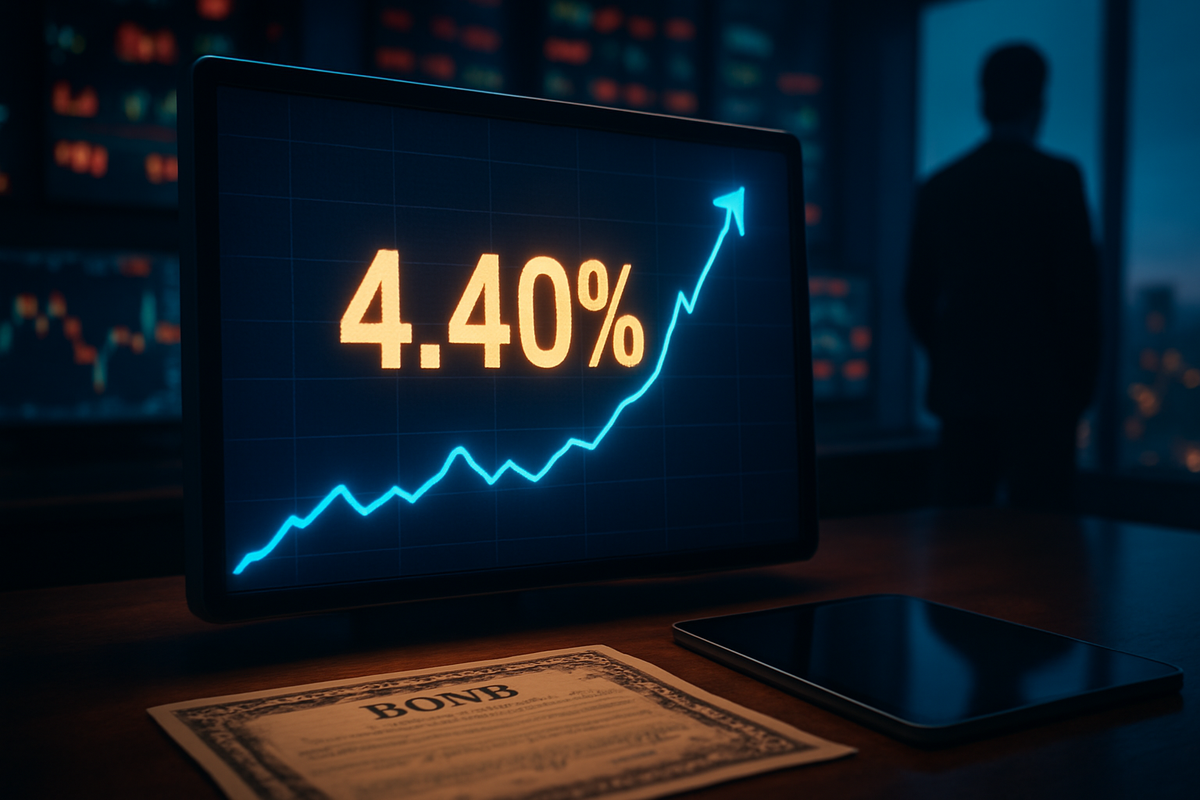
The US Treasury market experienced a seismic shift on Monday as the yield on the benchmark 10-year note surged to 4.40%, its highest level since July of last year. This rapid climb represents a dramatic repricing of risk across global financial markets, fueled by a growing realization among investors that the era of restrictive monetary policy is far from over. As inflation remains stubbornly above target and geopolitical tensions put upward pressure on energy prices, the "higher-for-longer" narrative has returned with a vengeance, shaking the foundations of the 2026 market outlook.
The implications of this yield spike are immediate and profound. With the 10-year Treasury serving as the "risk-free" benchmark for trillions of dollars in global debt, the move to 4.40% has triggered a sharp sell-off in interest-rate-sensitive assets. Most notably, the market has completely abandoned its expectations for multiple interest rate cuts in 2026. According to the latest data from the CME FedWatch Tool, traders are no longer just erasing cut projections; they are now pricing in a startling 40% probability of a rate hike by the Federal Open Market Committee (FOMC) before the year is out.
A Perfect Storm: How the 10-Year Reached a Nine-Month High
The journey to 4.40% began in earnest following the FOMC’s most recent policy meeting on March 18, 2026. While the Federal Reserve, led by Chair Jerome Powell, opted to maintain the federal funds rate at its current range of 3.50%–3.75%, the accompanying "dot plot" and hawkish rhetoric caught investors off guard. Powell’s warning that inflation progress had "plateaued" sent a clear signal that the central bank is prepared to remain restrictive for as long as necessary. This "hawkish pause" acted as the primary catalyst for the current bond rout, as the market began to digest the possibility that the Fed's next move could actually be upward.
Adding fuel to the fire is a volatile geopolitical landscape. Ongoing hostilities in the Middle East have pushed Brent crude oil prices above the $100 per barrel mark, raising the specter of a secondary inflation wave. For a market that had spent much of late 2025 betting on a "soft landing" and a return to 2% inflation, these developments have been a rude awakening. The timeline of this surge shows yields climbing nearly 50 basis points in just four weeks, a move that has caught many institutional desks positioned for a rally.
Furthermore, the domestic fiscal picture continues to weigh on the Treasury market. Persistent government spending, combined with the "One Big Beautiful Bill Act" passed earlier this year, has increased the supply of Treasury bonds at a time when demand from foreign central banks appears to be cooling. This supply-demand imbalance, coupled with sticky Personal Consumption Expenditures (PCE) data hovering between 2.4% and 2.7%, has left bond vigilantes with little choice but to demand higher yields to compensate for rising duration risk.
Winners and Losers: The Tech Exodus and the Financial Renaissance
The jump in yields has created a stark divide in the equity markets. High-growth technology companies, many of which are part of the "Magnificent Seven," have borne the brunt of the selling pressure. Companies like Nvidia (NASDAQ: NVDA), Apple Inc. (NASDAQ: AAPL), and Microsoft Corp. (NASDAQ: MSFT) have seen their valuations compressed as the discount rate used to value future earnings—heavily tied to the 10-year yield—moves higher. For these "long-duration" assets, every tick up in the Treasury yield makes their future cash flows less valuable in today’s dollars.
On the losing side, the real estate and utility sectors are also reeling. Realty Income Corp. (NYSE: O) and other high-dividend-yielding stocks are facing competition from "risk-free" government bonds that now offer comparable yields without the equity risk. Similarly, Tesla Inc. (NASDAQ: TSLA) has seen its share price pressured as higher borrowing costs threaten to dampen consumer demand for big-ticket purchases and increase the cost of capital for its ambitious expansion projects.
Conversely, the banking sector has emerged as a primary beneficiary of the steepening yield curve. Large-cap banks, including JPMorgan Chase & Co. (NYSE: JPM) and Bank of America Corp. (NYSE: BAC), have seen their stock prices rise as investors anticipate expanded Net Interest Margins (NIM). A higher 10-year yield allows these institutions to charge more for long-term loans while potentially keeping deposit rates relatively stable, directly boosting their bottom lines. Additionally, insurance giants such as MetLife Inc. (NYSE: MET) are seeing improved outlooks as they can reinvest their massive cash floats into higher-yielding government securities.
The End of the "Pivot" Fantasy and the New Macro Reality
This event marks a significant turning point in the post-pandemic economic cycle. For nearly two years, market participants have been obsessed with the "Fed pivot," repeatedly pricing in aggressive rate cuts that have failed to materialize. The current move to 4.40% and the 40% chance of a rate hike suggest that the market is finally surrendering to the reality that interest rates may remain structurally higher than they were during the "ZIRP" (Zero Interest Rate Policy) era.
Historically, a 10-year yield of 4.40% has often been a "tipping point" for equity markets. Comparisons are already being drawn to the autumn of 2023, when a similar surge in yields led to a double-digit correction in the S&P 500. However, the context in 2026 is different; while 2023 was characterized by a fear of a looming recession, the 2026 surge is driven by a resilient economy that refuses to cool down, despite the Fed’s best efforts. This "no landing" scenario creates a unique challenge for policymakers who must balance growth with price stability.
The ripple effects of higher US yields are also being felt globally. As the US dollar strengthens alongside yields, emerging market economies are facing increased pressure on their own currencies and debt servicing costs. This "dollar wrecking ball" effect could force foreign central banks to hike their own rates defensively, potentially slowing global growth and complicating the supply chain recovery that many industries had hoped for in 2026.
Looking Ahead: Tactical Shifts and Policy Deadlines
In the short term, all eyes will be on the April and May 2026 inflation prints. If Consumer Price Index (CPI) or PCE data shows any further acceleration, the 40% probability of a rate hike could quickly become the consensus view, potentially pushing the 10-year yield toward the 4.75% or 5.00% mark. Investors should brace for heightened volatility in the weeks leading up to the next FOMC meeting, as every data point—from non-farm payrolls to retail sales—will be scrutinized for its impact on the Fed's trajectory.
Strategic pivots are already underway in the asset management world. Portfolio managers are increasingly moving toward "short-duration" fixed income and "real assets" like gold and commodities to hedge against persistent inflation. For growth-oriented companies, the challenge will be to demonstrate "self-funding" capabilities. The era of relying on cheap debt to fund buybacks or speculative R&D is over; companies that can generate strong free cash flow in a high-rate environment will likely be the new market leaders.
Potential scenarios range from a continued "grind higher" in yields to a sharp "risk-off" event if the 10-year yield breaches the 4.50% technical level. A breach of that level could trigger algorithmic selling and a broader liquidation of equity positions. Conversely, if geopolitical tensions ease and oil prices retreat, we could see a rapid "relief rally" in bonds, though the structural floor for yields appears to have moved significantly higher than it was at the start of the decade.
Conclusion: Navigating the High-Yield Landscape
The surge in the 10-year Treasury yield to 4.40% is more than just a number; it is a signal that the market's long-held assumptions about the 2026 economic glide path were flawed. The vanishing hopes for rate cuts and the emergence of hike risks represent a fundamental shift in the financial landscape. While this environment poses significant challenges for high-growth sectors and debt-heavy industries, it also offers new opportunities for disciplined investors and the financial sector.
As we move forward, the key takeaway is that "higher-for-longer" is no longer a threat—it is the reality. The market's resilience will be tested as it adjusts to a higher cost of capital and a Fed that remains on high alert. For investors, the coming months will require a focus on quality, valuation, and a keen eye on the macroeconomic indicators that are now firmly in the driver's seat.
Watching the 10-year yield will be the most critical task for any market participant in the second quarter of 2026. Whether 4.40% serves as a peak or merely a pit stop on the way to higher levels will determine the direction of global markets for the remainder of the year.
This content is intended for informational purposes only and is not financial advice.