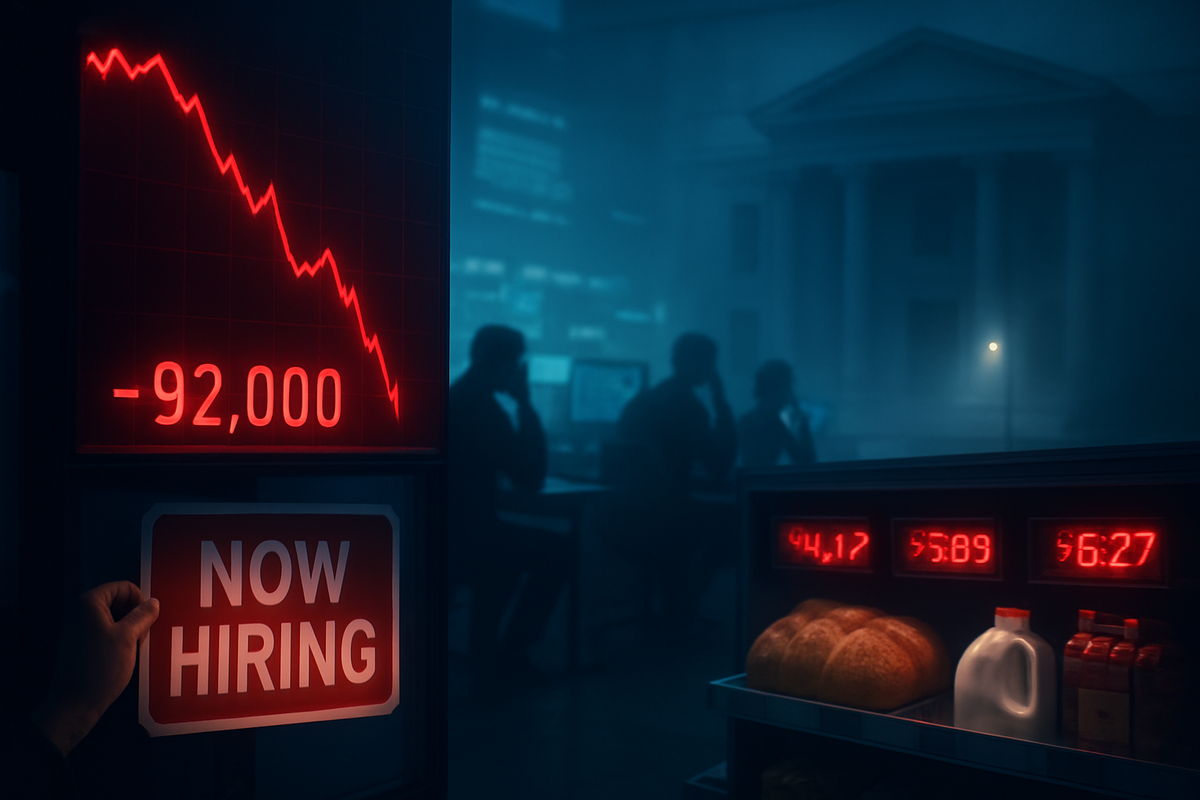
The U.S. labor market sent a seismic shock through global financial markets on Tuesday, March 10, 2026, as the Bureau of Labor Statistics reported a staggering contraction in non-farm payrolls for February. While economists had braced for a modest gain of roughly 70,000 jobs, the actual figure plummeted to a loss of 92,000 positions—the first contraction since the brief post-pandemic jitters. Simultaneously, the unemployment rate ticked up to 4.4%, signaling a sharp cooling in what had previously been a resilient, if slowing, employment landscape.
This "Friday morning surprise" (delayed by early-week data processing issues) has ignited a fierce debate among traders and policymakers. The sudden evaporation of job growth, occurring alongside a "tariff push" in consumer prices, has revived the dreaded "stagflation" narrative. Investors are now caught in a high-stakes tug-of-war: fears of an impending recession are clashing with desperate hopes that the Federal Reserve will be forced to accelerate rate cuts later this year to prevent a hard landing.
A Brutal Reversal: Inside the February Numbers
The contraction of 92,000 jobs represents a massive 162,000-job miss against consensus expectations. The decline was broad-based but hit the manufacturing and construction sectors particularly hard, as high borrowing costs and new trade barriers began to bite into industrial activity. This downturn follows a period of "low-hire, low-fire" equilibrium that characterized much of late 2025, where firms held onto workers despite slowing sales. That dam appears to have broken in February, as the "Magnificent Seven" and other tech giants began more aggressive structural realignments.
The timeline leading to this moment has been fraught with tension. Throughout January and February 2026, markets were already on edge following the implementation of a 15% global tariff surcharge, which many economists warned would act as a regressive tax on both consumers and businesses. While the Fed, led by outgoing Chair Jerome Powell, held rates steady at 3.50%–3.75% in January, the incoming hawkish shift signaled by the nomination of Kevin Warsh to the Fed chairmanship has left the market wondering if the "Fed Put"—the idea that the central bank will always step in to save the markets—is finally dead.
Initial market reactions were swift and volatile. The SPDR S&P 500 ETF Trust (NYSE: SPY) tumbled 2.1% in pre-market trading, while Treasury yields saw a "bull steepening" effect, where short-term yields fell on rate-cut bets while long-term yields remained sticky due to inflation concerns. Labor advocates and industrial stakeholders are already calling for emergency measures, while Wall Street analysts are frantically revising their year-end GDP targets downward.
Winners and Losers in a Cooling Economy
In this new "stagflation-lite" environment, the market is aggressively rotating out of growth and into defensive "real economy" plays. Procter & Gamble (NYSE: PG) and Walmart Inc. (NYSE: WMT) have emerged as primary beneficiaries of this flight to safety. As consumers trade down and prioritize essential goods over discretionary tech gadgets, these staples giants are proving their "AI immunity," with their stocks hitting near-term highs despite the broader market carnage.
Conversely, the technology sector is facing a "structural fracture." Companies like NVIDIA Corp (NASDAQ: NVDA) and Apple Inc. (NASDAQ: AAPL) are seeing their valuations questioned as the $500 billion-plus global investment in AI infrastructure has yet to produce the productivity miracles promised in 2024 and 2025. With job losses now hitting the white-collar sector, the demand for premium hardware and enterprise software is expected to take a significant hit in the coming quarters.
Financial institutions like JPMorgan Chase & Co. (NYSE: JPM) find themselves in a complex position. While a weakening economy increases the risk of loan defaults, the "steeper" yield curve—where the gap between short-term and long-term interest rates widens—allows them to maintain healthy net interest margins. However, if the contraction in payrolls translates into a full-blown recession, the banking sector's recent outperformance ("Boring Alpha") may quickly evaporate under the weight of credit losses.
The Stagflation Dilemma and Policy Ripple Effects
The current crisis fits into a broader trend of "Deglobalization 2.0," where trade barriers and domestic industrial policy are creating inflationary pressures even as the economy slows. This is a significant departure from the disinflationary environment of the 2010s. The 4.4% unemployment rate, while historically moderate, represents a rapid ascent from the 3.7% lows of 2024, echoing historical precedents where a 0.5% rise in unemployment often precedes a formal recession (the "Sahm Rule").
The regulatory and policy implications are profound. The Fed is now trapped: cutting rates to save the labor market could pour gasoline on the fire of tariff-induced inflation, which is currently projected to peak near 3.1% in early 2026. This creates a policy "pincer movement" that has not been seen with this intensity since the late 1970s. Global partners are also watching closely, as a U.S. slowdown combined with high tariffs could trigger a synchronized global downturn, forcing the European Central Bank and the Bank of Japan into defensive postures of their own.
Historically, periods of contracting payrolls and rising prices lead to extreme political pressure on the central bank. With Kevin Warsh’s nomination pending, the independence of the Fed is once again a central theme. Investors are questioning whether a "Warsh Fed" would prioritize fighting the "tariff push" inflation at the cost of even higher unemployment, a scenario that could lead to a deeper contraction in asset prices across the board.
What Comes Next: Strategic Pivots and Scenarios
In the short term, all eyes are on the upcoming CPI data release. If inflation remains hot despite the job losses, the "stagflation" narrative will be cemented, likely leading to further liquidations in equity markets. Conversely, if inflation shows signs of cooling alongside the labor market, the Fed may find the "green light" it needs to implement a 50-basis-point "jumbo" rate cut in May to stabilize the economy.
Market participants must now adapt to a "low-beta" world. Strategic pivots are already underway at major hedge funds, moving away from concentrated AI bets and toward "tangible alpha" in energy, healthcare, and infrastructure. The challenge for investors will be navigating the volatility as the market tries to price in a terminal interest rate that is high enough to satisfy the hawks but low enough to prevent a total labor market collapse.
Potential scenarios for the second half of 2026 range from a "soft-ish landing," where the job losses prove to be a one-month anomaly, to a "hard landing" recession if the Fed remains paralyzed by inflation fears. The most likely outcome currently priced in by the futures market is a series of "insurance cuts" starting in late Q2, though this assumes that the tariff-driven price shocks do not become embedded in consumer expectations.
Final Assessment: A Turning Point for the Cycle
The February labor report is more than just a bad data point; it is a signal that the post-pandemic expansion is entering its final, most volatile phase. The contraction of 92,000 payrolls serves as a stark reminder that even the most resilient economies have a breaking point when faced with the dual pressures of high interest rates and shifting trade dynamics.
Moving forward, the market will likely remain in a defensive crouch. The "Goldilocks" era of low inflation and steady growth is officially over, replaced by a period where "bad news is truly bad news." In previous years, a weak jobs report was cheered by investors because it meant the Fed would cut rates; today, that optimism is tempered by the fear that the Fed's hands may be tied by sticky inflation.
Investors should watch for three key indicators in the coming months: the stabilization (or further deterioration) of initial jobless claims, the rhetoric from the Fed regarding the "tariff push," and the Q1 earnings reports from retail giants for signs of a more permanent pullback in consumer spending. The road through 2026 just became significantly more treacherous.
This content is intended for informational purposes only and is not financial advice.