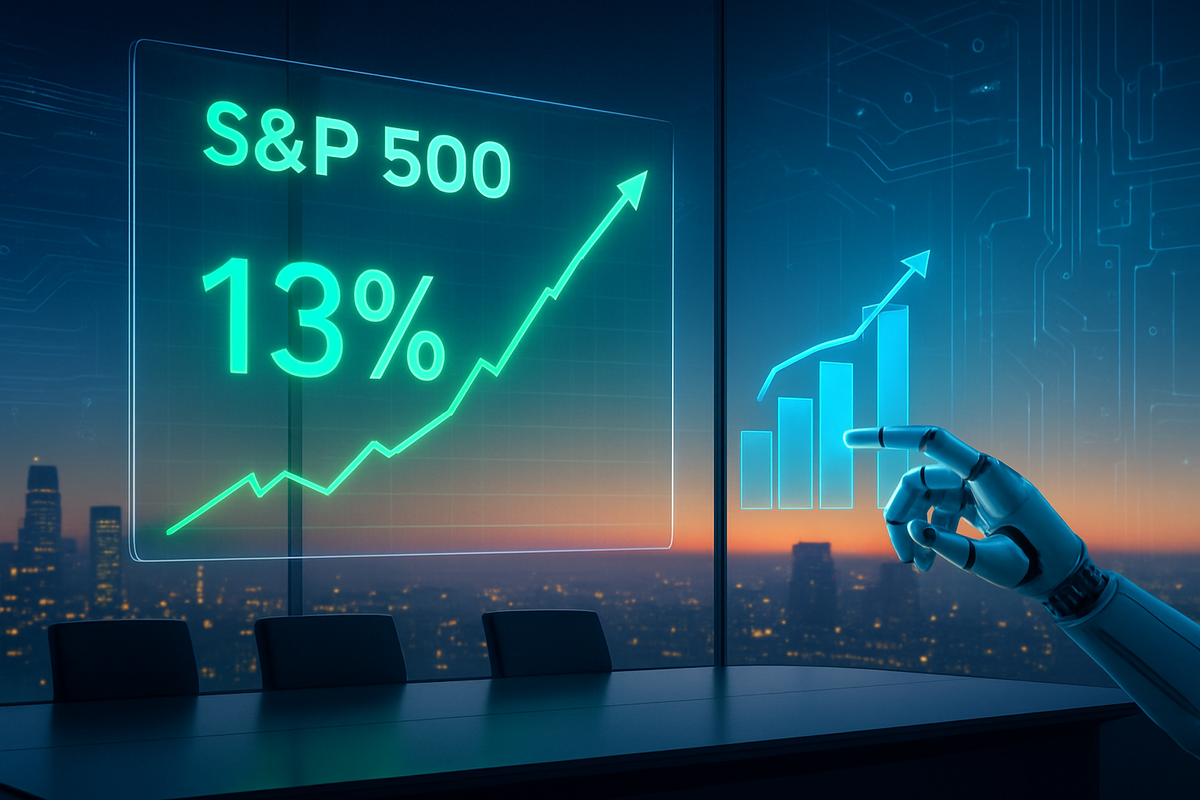
As of mid-January 2026, the American corporate landscape has reached a historic financial milestone. Net profit margins for the S&P 500 have surged past 13%, marking a record high that defies years of inflationary concerns and geopolitical volatility. This expansion, driven by a structural shift toward artificial intelligence (AI) integration and aggressive cost-management strategies, has redefined expectations for earnings growth in the mid-decades.
The immediate implications of this margin expansion are profound. Wall Street analysts are now projecting that annual net profit margins could climb as high as 13.9% by the end of the 2026 fiscal year. This surge has fueled a broader market rally, with major indices pushing toward new psychological ceilings as investors pivot their focus from top-line revenue growth to the sheer efficiency of the "bottom line."
The Roadmap to Record Profitability
The journey to these record margins began in earnest during the recovery of 2024, when corporate America first stabilized after the post-pandemic inflationary spike. By late 2025, data from FactSet and Goldman Sachs (NYSE: GS) began showing a decisive trend: revenue growth was consistently outstripping expense growth, a phenomenon known as "positive operating leverage." This trend hit its stride in the fourth quarter of 2025, with margins crossing the 13.1% mark, effectively shattering the 5-year average of 11.5%.
Central to this transformation has been the "emerging productivity boost" from generative and agentic AI. Financial giants like Morgan Stanley (NYSE: MS) have highlighted that the automation of administrative and operational roles has unlocked billions in labor cost savings. Furthermore, supportive fiscal measures, including the tax reliefs provided by the One Big Beautiful Act (OBBBA) passed in late 2024, have funneled nearly $200 billion back into corporate coffers, further insulating net margins from global economic headwinds.
Market reaction has been swift and decisive. While the "Magnificent 7" led the initial charge, the margin expansion has broadened across the index. Institutional investors have rewarded companies that demonstrate "AI-native" efficiency, while punishing those lagging in the transition. The revival of M&A activity in late 2025—which saw a 40% year-over-year increase—has also played a key role, as larger firms acquired smaller, leaner competitors to bolster their own operational efficiency.
The Great Divide: Winners and Losers of the 13% Era
The "Efficiency Era" has not distributed its rewards equally. The primary victors are concentrated in the Information Technology and Communication Services sectors. Companies like Nvidia (Nasdaq: NVDA), Microsoft (Nasdaq: MSFT), and Meta Platforms (Nasdaq: META) have maintained staggering margins, with the Tech sector as a whole averaging 28.5%. These firms have successfully transitioned from the "AI hype" phase of 2023-2024 to a phase of "AI monetization," where automated coding, customer service, and R&D have drastically lowered the cost of goods sold.
Conversely, legacy software providers and consumer staples are facing a harder reality. Salesforce (NYSE: CRM) and Adobe (Nasdaq: ADBE) have faced significant valuation pressure as the market questions the longevity of traditional per-seat licensing models in an age of autonomous AI agents. Meanwhile, the Consumer Staples sector has struggled. Giants such as PepsiCo (Nasdaq: PEP) and Procter & Gamble (NYSE: PG) are grappling with a "perfect storm": the widespread adoption of GLP-1 weight-loss drugs is permanently altering consumption patterns, while a consumer rotation toward private-label brands is eroding the pricing power that previously sustained their margins.
The Energy sector also presents a fractured front. While "Supermajors" like ExxonMobil (NYSE: XOM) are using AI to optimize reservoir recovery and keep break-evens low, smaller shale producers are being squeezed by a global supply glut and oil prices hovering in the $50-$60 range. Without the capital to automate, these smaller players are finding it impossible to keep pace with the S&P 500’s broader margin expansion.
Wider Significance and the Shift in Global Dynamics
This era of record profitability is more than just a balance sheet victory; it represents a fundamental shift in how corporations interact with labor and regulation. The rise in margins has been accompanied by a "no hiring, no firing" stasis in the labor market. While mass layoffs have slowed, the displacement caused by AI is creating a "K-shaped" recovery within the workforce, leading to localized but intense labor unrest. 2026 is poised to be a year of significant contract renewals, with unions like the CWA targeting AT&T (NYSE: T) and Verizon (NYSE: VZ) over AI-driven job protections.
Regulatorily, the landscape is becoming increasingly complex. The enforcement of the EU AI Act in August 2025 has introduced massive compliance overheads, estimated to cost high-risk AI projects upwards of 17% in additional expenses. Companies failing to navigate these waters risk fines of up to 7% of their global annual turnover. Furthermore, the mandatory 2026 review of the USMCA trade agreement is expected to introduce tighter "rules of origin" for the automotive and industrial sectors, potentially inflating production costs for companies like U.S. Steel (NYSE: X) and Cleveland-Cliffs (NYSE: CLF).
Historically, such high profit margins have often invited anti-trust scrutiny or "windfall" tax proposals. As S&P 500 margins stay above 13%, the debate over "AI Washing"—where firms mask labor cuts as technological progress—is gaining traction in Washington. The comparison to the high-margin periods of the late 1990s is inevitable, though analysts argue that today’s margins are supported by real-world productivity gains rather than the speculative fervor of the dot-com era.
Looking Ahead: The 14% Horizon
The trajectory for the remainder of 2026 appears bullish but fragile. FactSet projects a 15% earnings growth for the year, supported by a continued climb in margins toward 13.9%. Goldman Sachs has set an ambitious end-of-year target of 7,500 for the S&P 500, while Morgan Stanley has pushed their target even higher to 7,800, citing "better volumes and pricing" as the efficiency gains of the last two years finally reach the broader market beyond Big Tech.
However, strategic pivots will be required. Firms can no longer rely solely on "cost-cutting" to maintain these levels; they must now focus on revenue scaling. The upcoming USMCA review and the potential for a "TrumpRx" drug-pricing initiative pose specific challenges to the Manufacturing and Biopharma sectors, respectively. Companies that can maintain their margins in the face of these regulatory hurdles will likely be the market leaders of the late 2020s.
Summary and Investor Outlook
The S&P 500’s ascent to record profit margins above 13% is a testament to the transformative power of AI and disciplined fiscal management. While the "Efficiency Era" has provided a massive boost to stock valuations and corporate health, it has also created a stark divide between sectors. Investors should watch for the following in the coming months:
- Labor Tensions: Watch for potential strikes in the Retail and Manufacturing sectors as unions push back against AI displacement.
- Regulatory Penalties: The first major fines under the EU AI Act could serve as a wake-up call for the Tech and Financial sectors.
- Consumption Shifts: Monitor the ongoing impact of GLP-1 drugs on the Consumer Staples sector to see if the margin compression there is permanent.
Moving forward, the focus for investors should shift from "who is using AI" to "who is converting AI into sustainable margin expansion." As we navigate 2026, the S&P 500 remains on a path of unprecedented profitability, but the risks of labor unrest and regulatory friction suggest that the journey to 14% will be anything but a straight line.
This content is intended for informational purposes only and is not financial advice