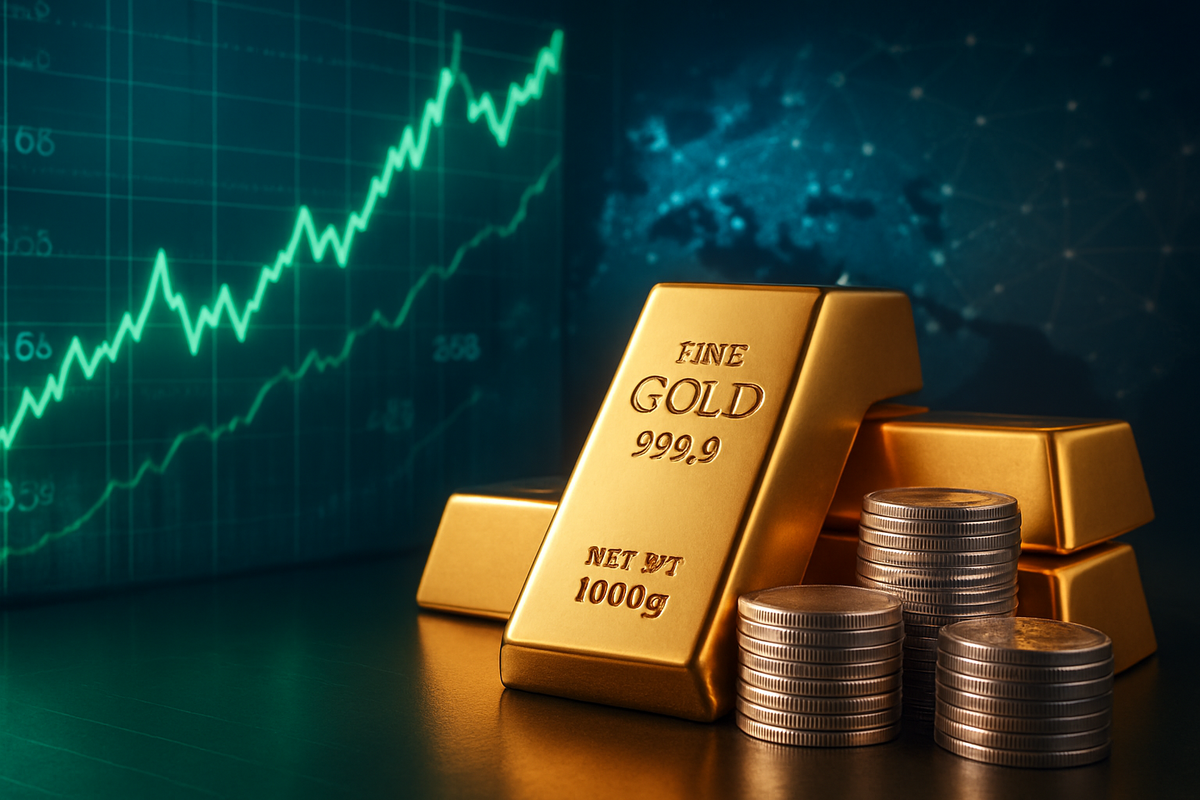
As the global markets close for the Christmas holiday on December 24, 2025, investors are witnessing a financial phenomenon rarely seen in history: the "Everything Rally." The S&P 500 has surged to a fresh all-time high of 6,927 points, fueled by a relentless artificial intelligence boom and robust U.S. GDP growth of 4.3%. Yet, in a startling departure from traditional inverse correlations, precious metals are not just participating in the rally—they are leading it. Gold has shattered the $4,500 per ounce barrier, while silver has nearly tripled in value over the past year to trade at $72.70.
This synchronized surge signals a fundamental shift in investor psychology. While record-high equity valuations suggest confidence in corporate earnings, the aggressive rotation into "hard assets" reveals a deep-seated anxiety regarding geopolitical stability and the long-term health of fiat currencies. Despite the bullish environment for stocks, capital is flooding into gold and silver as a strategic hedge against a weakening U.S. Dollar and a global financial system increasingly defined by "fiscal dominance" and de-dollarization.
A Perfect Storm: The 2025 Path to Parallel Records
The road to this dual-peak environment began in early 2025, as the Federal Reserve struggled to balance "sticky" inflation with a desire to ease monetary policy. While tech giants like Nvidia (NASDAQ: NVDA) and Broadcom (NASDAQ: AVGO) propelled the S&P 500 upward with massive AI-driven earnings, the underlying macro environment became increasingly fractured. Geopolitical tensions reached a boiling point in late 2025, marked by U.S. naval blockades of Venezuelan oil tankers and protracted conflicts in Eastern Europe, driving a renewed "fear trade" into tangible assets.
Simultaneously, the U.S. Dollar Index (DXY) suffered its worst performance in nearly a decade, falling 10% as global central banks accelerated their pivot away from dollar-denominated reserves. Central banks in Poland, China, and India emerged as the primary "whales" in the gold market, treating the metal as the ultimate neutral reserve asset. This institutional floor, combined with a "Santa Claus rally" in equities, created a feedback loop where investors used stock market profits to fund defensive positions in precious metals. By December 2025, gold had recorded its 50th record-breaking session of the year, a feat not seen since the late 1970s.
Mining Giants and Industrial Victims: The Winners and Losers
The primary beneficiaries of this price explosion are the major mining and royalty firms, which have seen their margins expand to historic levels. Newmont Corporation (NYSE: NEM), the world’s largest gold producer, has seen its stock price climb over 150% in 2025, trading near $102. With an All-In Sustaining Cost (AISC) anchored around $1,375 per ounce, Newmont’s profit spread at $4,500 gold has resulted in a "margin explosion," allowing for record dividends and stock buybacks. Similarly, Barrick Gold (NYSE: GOLD) has leveraged its dual exposure to gold and copper to double its market capitalization, as institutional investors re-rate the sector as a primary source of portfolio alpha.
On the silver front, Hecla Mining (NYSE: HL) and First Majestic Silver (NYSE: AG) have outperformed even the most optimistic forecasts, with Hecla seeing a nearly 300% gain year-to-date. These companies are benefiting from a massive industrial supply deficit, as silver becomes a critical bottleneck for the "green transition." However, this same price surge has created significant "losers" in the industrial sector. Tesla, Inc. (NASDAQ: TSLA) has faced mounting pressure on its automotive margins, as the cost of silver—essential for EV electronics and solar integration—jumped from roughly $25 to over $100 per vehicle. Other casualties include solar manufacturers like JinkoSolar (NYSE: JKS), which have struggled to pass on the rising costs of "greenflation" to consumers.
Historical Precedents and the Paradigm of "Fiscal Dominance"
The 2025 market environment bears a striking resemblance to the early 1970s. In 1972, shortly after the collapse of the Bretton Woods system, both the S&P 500 and gold rose to record highs as the world grappled with the end of the gold standard and the onset of inflationary pressures. Much like today, that era was defined by massive deficit spending and geopolitical shifts. Today’s rally suggests that the market is pricing in a "Hard Asset Super-Cycle," where the value of tangible commodities is prioritized over sovereign debt, which many now view as increasingly risky given the rising interest payments on the U.S. national debt.
This trend fits into a broader industry shift toward "de-dollarization." As the BRICS nations move to settle trade in local currencies or gold-backed instruments, the demand for gold has transitioned from a niche speculative play to a core component of global financial architecture. The ripple effects are being felt across the banking sector, as traditional firms like JPMorgan Chase & Co. (NYSE: JPM) and Goldman Sachs (NYSE: GS) revise their long-term gold targets upward, with some analysts now forecasting $5,000 gold by the end of 2026.
The Road Ahead: Short-Term Gains vs. Long-Term Shifts
In the short term, the momentum in both stocks and metals appears likely to persist into the first quarter of 2026. With the Federal Reserve signaling at least two interest rate cuts in the coming year, the opportunity cost of holding non-yielding assets like gold and silver will continue to fall, potentially driving another leg higher for the metals. However, the "Everything Rally" also presents a challenge: if inflation remains high due to soaring commodity prices, the Fed may be forced to pivot back to a hawkish stance, which could eventually trigger a sharp correction in equity valuations while leaving metals as the only standing "safe haven."
Investors should watch for strategic pivots from industrial companies as they attempt to mitigate silver and copper costs through thrifting or alternative materials. Furthermore, any cooling of geopolitical tensions in Eastern Europe or South America could lead to a temporary pullback in the "fear trade," providing a buying opportunity for those who missed the 2025 surge. The long-term outlook remains dominated by the "debasement trade," as the world’s largest economies continue to grapple with high debt-to-GDP ratios.
A New Market Reality
The 2025 diversification trend into precious metals is not a sign of a "bear market" in stocks, but rather a sophisticated evolution of risk management. Investors are no longer choosing between growth and safety; they are aggressively pursuing both. The simultaneous records in the S&P 500 and gold represent a market that is optimistic about technological progress (AI) but deeply skeptical about the long-term stability of the global monetary order.
As we move into 2026, the key takeaway for investors is that the old "60/40" portfolio model is being replaced by a more commodity-heavy allocation. The performance of companies like Wheaton Precious Metals (NYSE: WPM)—which provides exposure to metal prices without the direct inflationary risks of mining operations—will be a critical barometer for the health of this new paradigm. For now, the "Everything Rally" remains the dominant story on Wall Street, a festive end to a year that has redefined the boundaries of the financial markets.
This content is intended for informational purposes only and is not financial advice