
Earth imaging satellite company Planet Labs (NYSE: PL) reported Q2 CY2026 results beating Wall Street’s revenue expectations, with sales up 58.1% year on year to $116.1 million. On the other hand, next quarter’s revenue guidance of $103 million was less impressive, coming in 10.5% below analysts’ estimates. Its non-GAAP profit of $0.02 per share was significantly above analysts’ consensus estimates.
Is now the time to buy Planet Labs? Find out by accessing our full research report, it’s free.
Planet Labs (PL) Q2 CY2026 Highlights:
- Revenue: $116.1 million vs analyst estimates of $105.1 million (58.1% year-on-year growth, 10.4% beat)
- Adjusted EPS: $0.02 vs analyst estimates of -$0.02 (significant beat)
- Adjusted EBITDA: $13.93 million vs analyst estimates of $2.05 million (12% margin, significant beat)
- The company slightly lifted its revenue guidance for the full year to $435.5 million at the midpoint from $433 million
- EBITDA guidance for the full year is $6.5 million at the midpoint, below analyst estimates of $9.79 million
- Operating Margin: -11.6%, up from -24.5% in the same quarter last year
- Free Cash Flow Margin: 1.6%, down from 64.7% in the same quarter last year
- Backlog: $814.9 million at quarter end, up 10.7% year on year
- Market Capitalization: $7.12 billion
“Planet delivered an outstanding second quarter, with record revenue of $116.1 million, representing 58% year-over-year growth and our fourth consecutive quarter of meeting or exceeding the Rule of 40,” said Will Marshall, Planet’s Co-Founder, Chief Executive Officer and Chairperson. “The team continues to demonstrate strong execution, highlighted by our satellite handover for the Swedish Armed Forces and landmark contract wins in August with the NGA and the German government. We’ve seen incredible traction in satellite services and our pipeline has continued to expand. To capture this momentum, our strategy pairs AI-enabled analytics with sovereign satellite services, merging our core growth vectors into an even more powerful offering.”
Company Overview
Pioneering the concept of "agile aerospace" with hundreds of small but powerful satellites, Planet Labs (NYSE: PL) operates the world's largest fleet of Earth observation satellites, capturing daily images of our planet to provide insights on deforestation, agriculture, and climate change.
Revenue Growth
Examining a company’s long-term performance can provide clues about its quality. Any business can have short-term success, but a top-tier one grows for years.
With $378.3 million in revenue over the past 12 months, Planet Labs is a small player in the business services space, which sometimes brings disadvantages compared to larger competitors benefiting from economies of scale and numerous distribution channels. On the bright side, it can grow faster because it has more room to expand.
As you can see below, Planet Labs grew its sales at an incredible 25.8% compounded annual growth rate over the last five years. This is a great starting point for our analysis because it shows Planet Labs’s demand was higher than many business services companies.
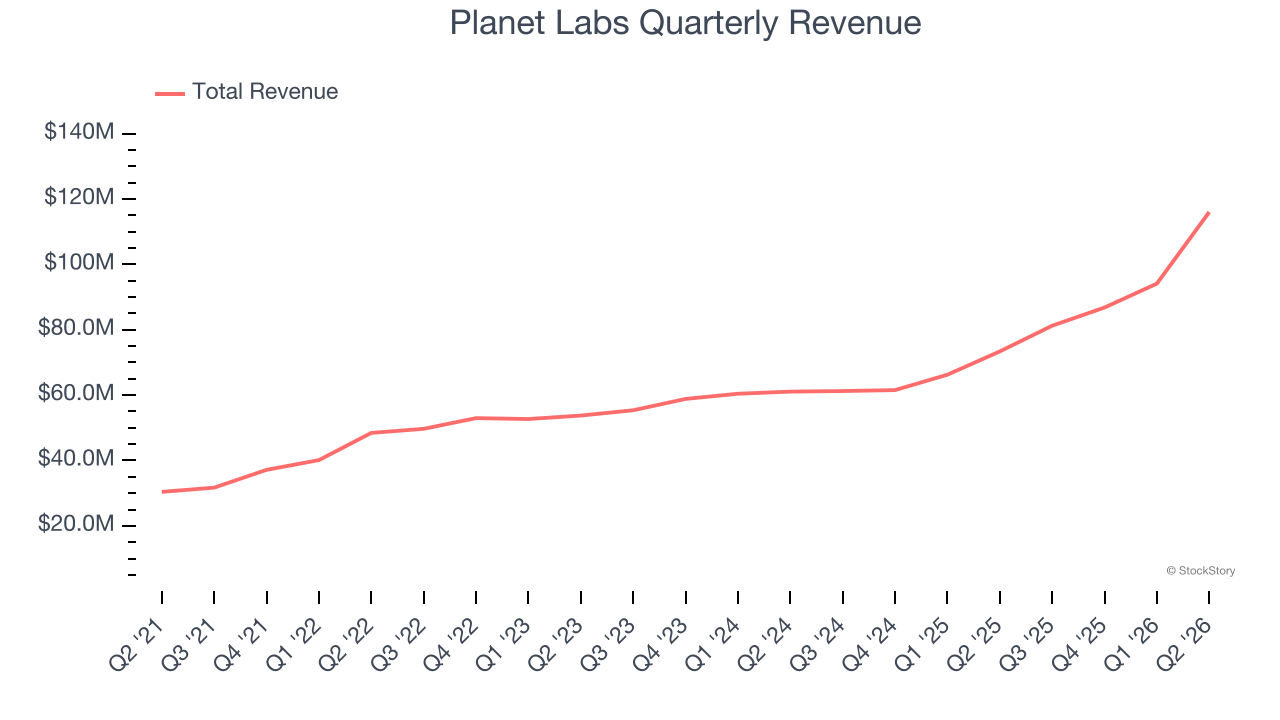
We at StockStory place the most emphasis on long-term growth, but within business services, a half-decade historical view may miss recent innovations or disruptive industry trends. Planet Labs’s annualized revenue growth of 26.7% over the last two years aligns with its five-year trend, suggesting its demand was predictably strong. 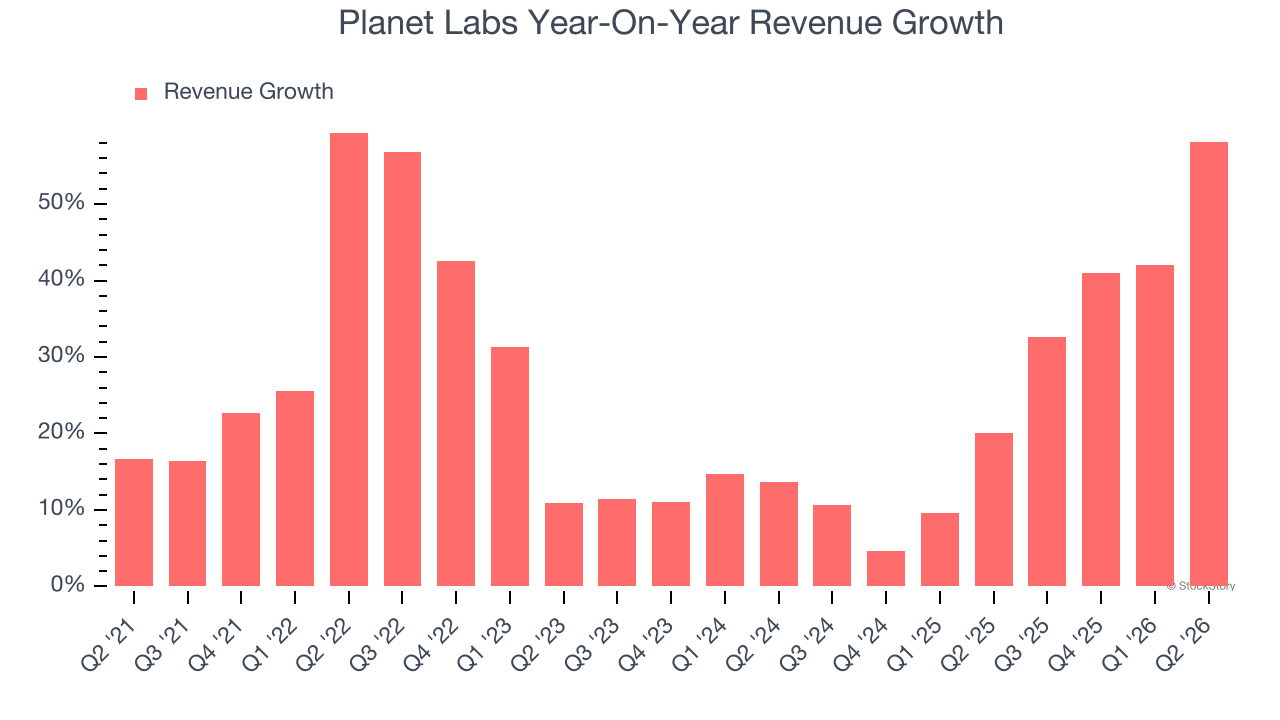
We can dig further into the company’s revenue dynamics by analyzing its backlog, or the value of its outstanding orders that have not yet been executed or delivered. Planet Labs’s backlog reached $814.9 million in the latest quarter and averaged 124% year-on-year growth over the last two years. Because this number is better than its revenue growth, we can see the company accumulated more orders than it could fulfill and deferred revenue to the future. This could imply elevated demand for Planet Labs’s products and services but raises concerns about capacity constraints. 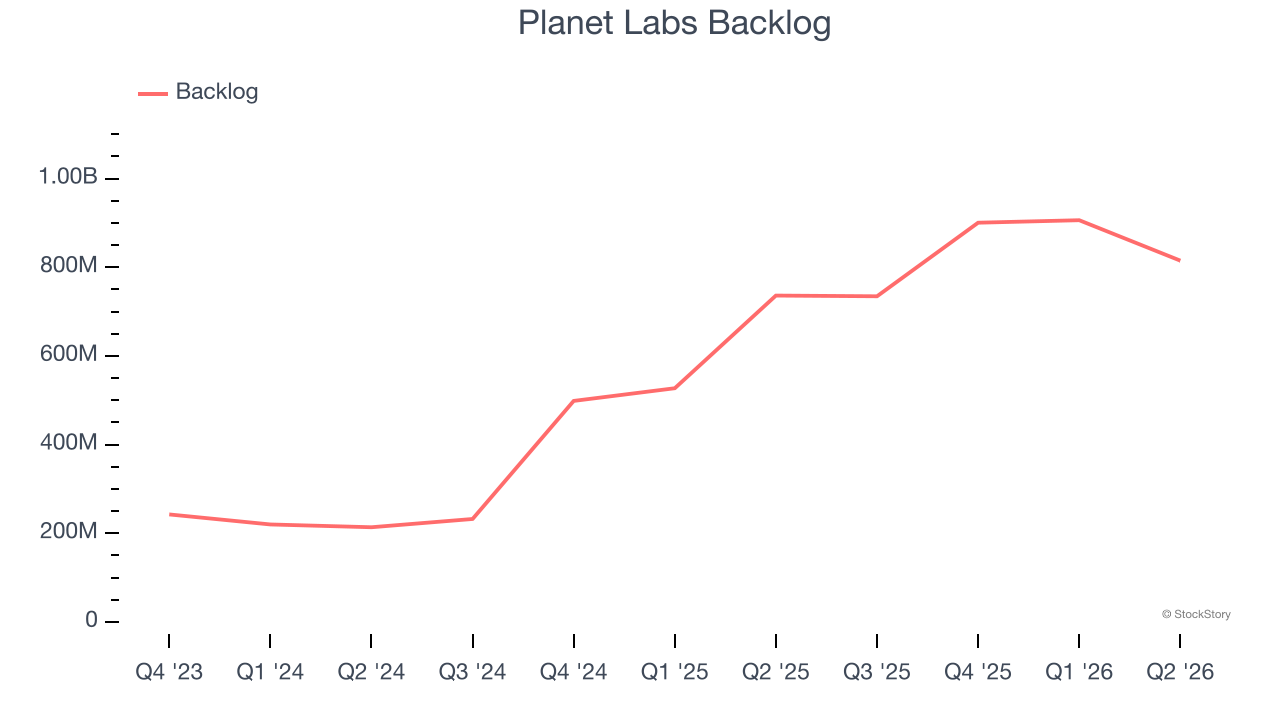
This quarter, Planet Labs reported magnificent year-on-year revenue growth of 58.1%, and its $116.1 million of revenue beat Wall Street’s estimates by 10.4%. Company management is currently guiding for a 26.8% year-on-year increase in sales next quarter.
Looking further ahead, sell-side analysts expect revenue to grow 32.7% over the next 12 months, an improvement versus the last two years. This projection is eye-popping and indicates its newer products and services will spur better top-line performance.
ONE MORE THING: 3 Hidden Platforms Growing 3X Faster than Amazon, Google, and PayPal. Amazon, Google, and Meta all followed the same playbook: Dominate an ignored market. Build an unbeatable moat. Scale until you’re unstoppable.
These three platforms are running that exact playbook right now. The early investors in Amazon made fortunes. The early investors in these could do the same. Get All 3 Stocks Here for FREE.
Adjusted Operating Margin
Adjusted operating margin is an important measure of profitability as it shows the portion of revenue left after accounting for all core expenses — everything from the cost of goods sold to advertising and wages. It’s also useful for comparing profitability across companies because it excludes non-recurring expenses, interest on debt, and taxes.
Planet Labs’s high expenses have contributed to an average adjusted operating margin of negative 29.3% over the last five years. Unprofitable business services companies require extra attention because they could get caught swimming naked when the tide goes out.
On the plus side, Planet Labs’s adjusted operating margin rose by 49.5 percentage points over the last five years, as its sales growth gave it operating leverage. Still, it will take much more for the company to reach long-term profitability.
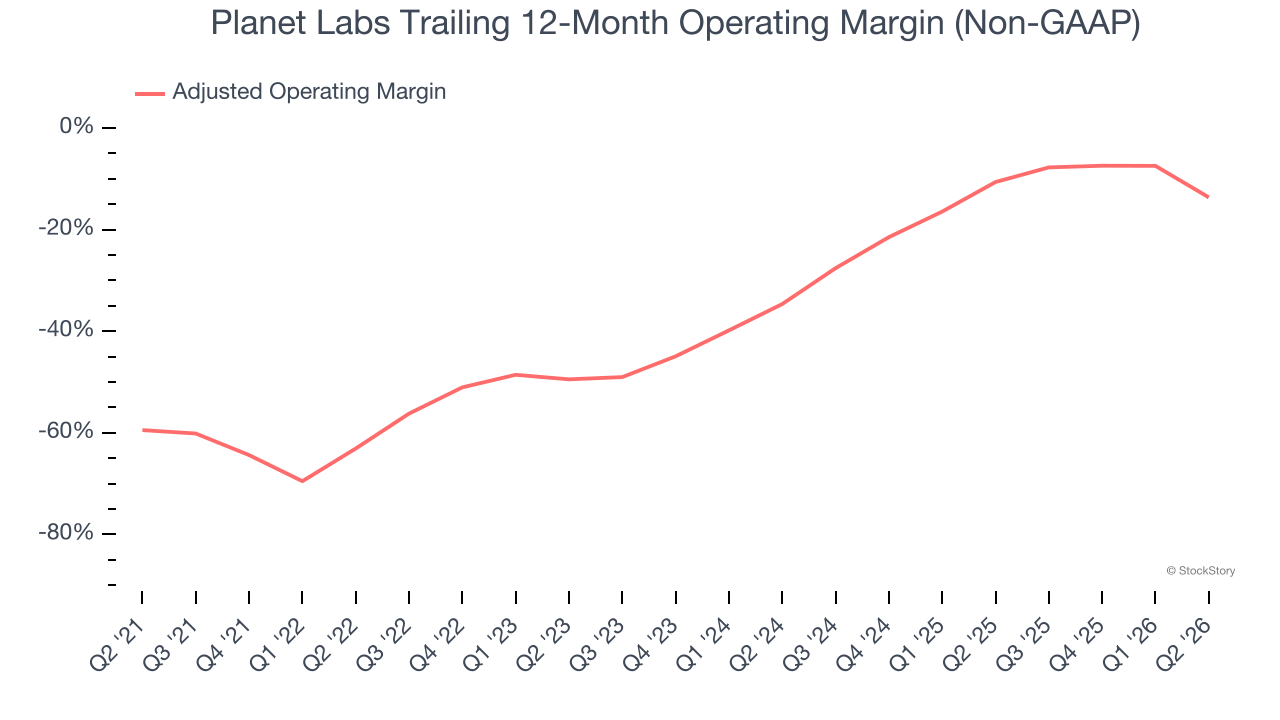
In Q2, Planet Labs generated a negative 25.8% adjusted operating margin.
Earnings Per Share
We track the long-term change in earnings per share (EPS) for the same reason as long-term revenue growth. Compared to revenue, however, EPS highlights whether a company’s growth is profitable.
Although Planet Labs’s full-year earnings are still negative, it reduced its losses and improved its EPS by 63.6% annually over the last four years. The next few quarters will be critical for assessing its long-term profitability. We hope to see an inflection point soon.
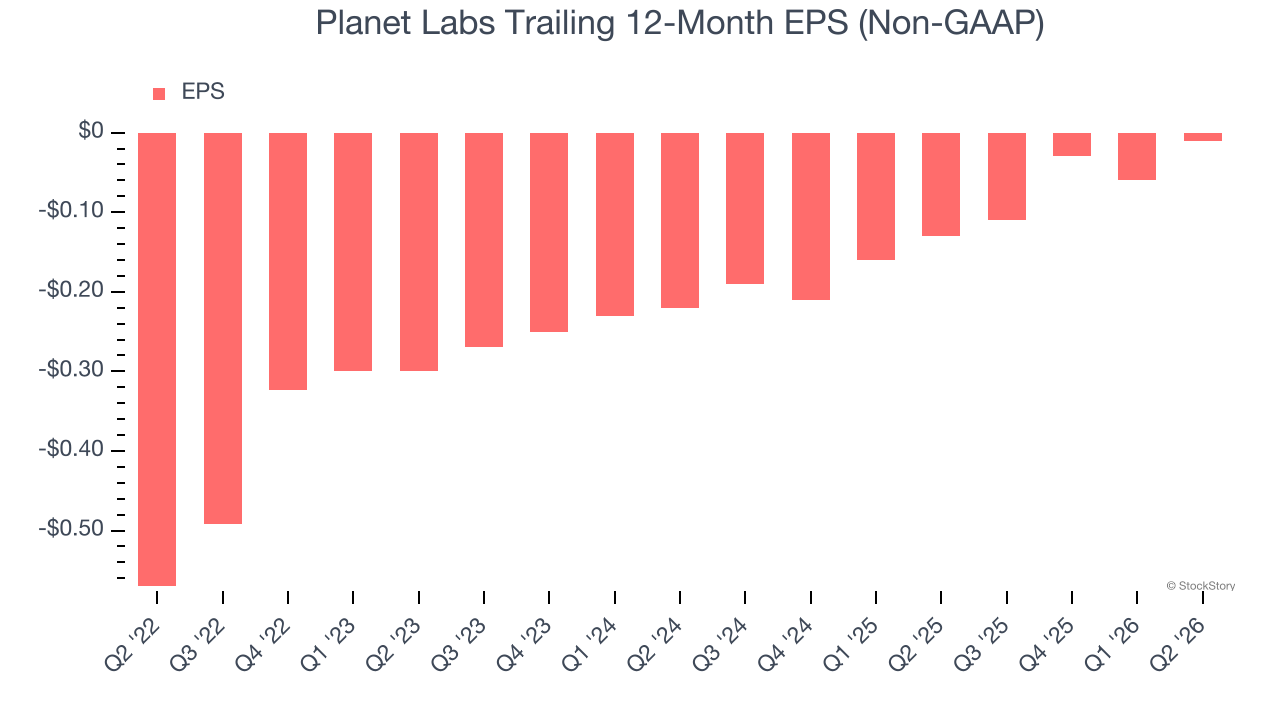
Like with revenue, we analyze EPS over a more recent period because it can provide insight into an emerging theme or development for the business.
For Planet Labs, its two-year annual EPS growth of 78.7% was higher than its four-year trend. We love it when earnings improve, but a caveat is that its EPS is still in the red.
In Q2, Planet Labs reported adjusted EPS of $0.02, up from negative $0.03 in the same quarter last year. This print easily cleared analysts’ estimates, and shareholders should be content with the results. Over the next 12 months, Wall Street expects Planet Labs to perform poorly. Analysts forecast its full-year EPS will tumble from negative $0.01 to negative $0.05. This is unusual as its revenue and operating margin are anticipated to increase, signaling the fall likely stems from “below-the-line” items such as taxes.
Key Takeaways from Planet Labs’s Q2 Results
It was good to see Planet Labs beat analysts’ EPS expectations this quarter. We were also excited its revenue outperformed Wall Street’s estimates by a wide margin. On the other hand, its revenue guidance for next quarter missed. Overall, this print had some key positives. The stock traded up 6.1% to $19.75 immediately after reporting.
So should you invest in Planet Labs right now? If you’re making that decision, you should consider the bigger picture of valuation, business qualities, as well as the latest earnings. We cover that in our actionable full research report which you can read here (it’s free).