Renewable fuels producer Gevo (NASDAQ: GEVO) reported Q2 CY2026 results beating Wall Street’s revenue expectations, with sales up 7.1% year on year to $46.5 million. Its GAAP loss of $0.75 per share was significantly below analysts’ consensus estimates.
Is now the time to buy Gevo? Find out by accessing our full research report, it’s free.
Gevo (GEVO) Q2 CY2026 Highlights:
- Revenue: $46.5 million vs analyst estimates of $44.62 million (7.1% year-on-year growth, 4.2% beat)
- EPS (GAAP): -$0.75 vs analyst estimates of -$0.02 (significant miss)
- Adjusted EBITDA: $11.08 million vs analyst estimates of $9.05 million (23.8% margin, 22.4% beat)
- Operating Margin: -369%, down from 13.4% in the same quarter last year
- Market Capitalization: $363.4 million
“Gevo delivered strong second quarter operational results and unlocked significant carbon business revenue that is expected to begin in the third quarter, which supports increased expectations of full-year non-GAAP Adjusted EBITDA1 outlook of more than $60 million,” said Gevo Chief Executive Officer Paul Bloom.
Company Overview
Operating one of the largest dairy-based renewable natural gas facilities in the United States, Gevo (NASDAQ: GEVO) produces sustainable aviation fuel and other renewable hydrocarbon fuels from plant-based feedstocks like corn.
Revenue Growth
Cyclical sectors like Energy often flatter weaker operators during favorable price environments, but a longer-term lens separates those from businesses that can consistently perform across market cycles. Thankfully, Gevo’s 176% annualized revenue growth over the last five years was incredible. Its growth beat the average energy upstream and integrated energy company and shows its offerings resonate with customers, a helpful starting point for our analysis.
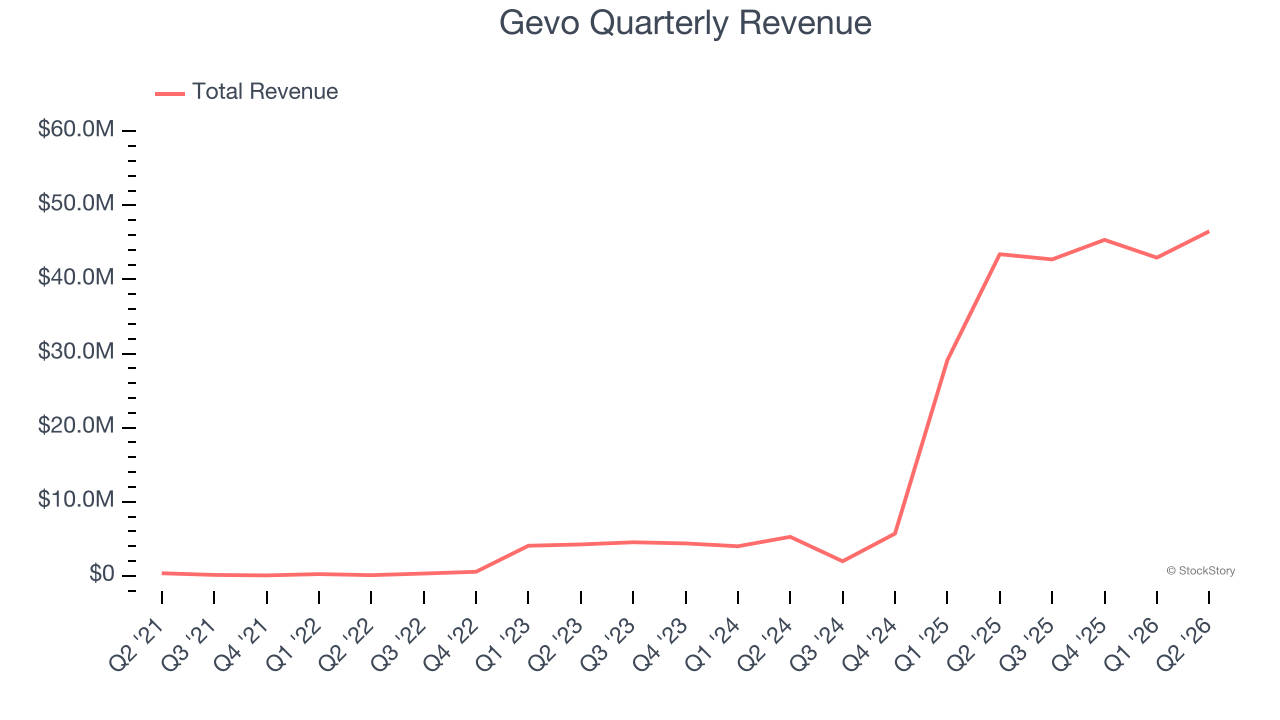
Energy cycles can be long enough that a single five-year period can still reflect one price environment, which is why an additional, decade-long view can help capture through-cycle performance. Gevo’s annualized revenue growth of 19.6% over the last ten years is below its five-year trend, but we still think the results suggest decent demand.
This quarter, Gevo reported year-on-year revenue growth of 7.1%, and its $46.5 million of revenue exceeded Wall Street’s estimates by 4.2%.
ONE MORE THING: The $21 AI Application Stock Wall Street Forgot. While Wall Street obsesses over who’s building AI, one company is already using it to print money. And nobody’s paying attention.
AI chip stocks trade at ridiculous valuations. This company processes a trillion consumer signals monthly using AI and trades at a third of the price. The gap won’t last. The institutions will figure it out. You need to see this first. Read the FREE Report Before They Notice.
Adjusted EBITDA Margin
Although Gevo was profitable this quarter from an operational perspective, it’s generally struggled over a longer time period. Its expensive cost structure has contributed to an average EBITDA margin of negative 58.2% over the last five years.
On the plus side, Gevo’s EBITDA margin rose over the last year, as its sales growth gave it operating leverage. Still, it will take much more for the company to reach long-term profitability.
This quarter, Gevo generated an EBITDA margin profit margin of 23.8%, down 16.1 percentage points year on year. This contraction shows it was less efficient because its expenses grew faster than its revenue. This adjusted EBITDA beat Wall Street’s estimates by 22.4%.
Cash Is King
As mentioned above, adjusted EBITDA ignores capital structure and drilling expenditure decisions. These are two huge aspects of an Energy producer, so in order to understand a comprehensive picture of business quality, an investor needs to account for these. Said differently, adjusted EBITDA margins could be solid but free cash flow is abysmal because decline rates of the asset are extreme and the drilling is expensive. Free cash flow tells you about not only the economics of the production that has happened but how much it costs to stay in business as well (further drilling or extraction).
Gevo’s demanding reinvestments have drained its resources over the last five years, putting it in a pinch and limiting its ability to return capital to investors. Its free cash flow margin averaged negative 205%, meaning it lit $205.01 of cash on fire for every $100 in revenue.
The level of free cash flow is important, but its durability across cycles is just as critical. Consistent margins are far more valuable than volatile swings driven by commodity prices.
Gevo’s ratio of quarterly free cash flow volatility to WTI crude price volatility over the past five years was 3.4 (lower is better), indicating excellent insulation from commodity swings. This stability supports superior capital access in downturns and positions Gevo to act as a consolidator when weaker peers are forced to retrench.
You may be asking why we wait until the free cash flow line to perform this stability analysis versus commodity prices. Why not compare revenue or EBITDA to WTI Crude prices in the case of Gevo? Because what ultimately matters is not how much revenue or profit you earn when prices are high but how much cash you can generate when prices are low. Free cash flow is the superior metric because it includes everything from hedging prowess to growth and maintenance capex to management behavior during good times and bad.
Key Takeaways from Gevo’s Q2 Results
We were impressed by how significantly Gevo blew past analysts’ EBITDA expectations this quarter. We were also excited its revenue outperformed Wall Street’s estimates by a wide margin. On the other hand, its EPS missed. Overall, we think this was a decent quarter with some key metrics above expectations. The stock traded up 9.7% to $1.59 immediately after reporting.
Sure, Gevo had a solid quarter, but if we look at the bigger picture, is this stock a buy? We think that the latest quarter is only one piece of the longer-term business quality puzzle. Quality, when combined with valuation, can help determine if the stock is a buy. We cover that in our actionable full research report which you can read here (it’s free).