Biotechnology company United Therapeutics (NASDAQ: UTHR) reported revenue ahead of Wall Street’s expectations in Q2 CY2026, but sales fell by 1.9% year on year to $783.3 million. Its GAAP profit of $7.27 per share was 5.9% above analysts’ consensus estimates.
Is now the time to buy United Therapeutics? Find out by accessing our full research report, it’s free.
United Therapeutics (UTHR) Q2 CY2026 Highlights:
- Revenue: $783.3 million vs analyst estimates of $765.9 million (1.9% year-on-year decline, 2.3% beat)
- EPS (GAAP): $7.27 vs analyst estimates of $6.86 (5.9% beat)
- Operating Margin: 42.2%, down from 45.6% in the same quarter last year
- Market Capitalization: $22.02 billion
“We just submitted what we believe are two of the most important NDAs in rare pulmonary disease history: ralinepag tablets in PAH and Nebulized Tyvaso in IPF,” said Martine Rothblatt, Ph.D., Chairperson and Chief Executive Officer of United Therapeutics.
Company Overview
Founded by a mother seeking treatment for her daughter's pulmonary arterial hypertension, United Therapeutics (NASDAQ: UTHR) develops and commercializes medications for chronic lung diseases and other life-threatening conditions, with a focus on pulmonary hypertension treatments.
Revenue Growth
Reviewing a company’s long-term sales performance reveals insights into its quality. Any business can experience short-term success, but top-performing ones enjoy sustained growth for years. Thankfully, United Therapeutics’s 14.7% annualized revenue growth over the last five years was solid. Its growth beat the average healthcare company and shows its offerings resonate with customers.
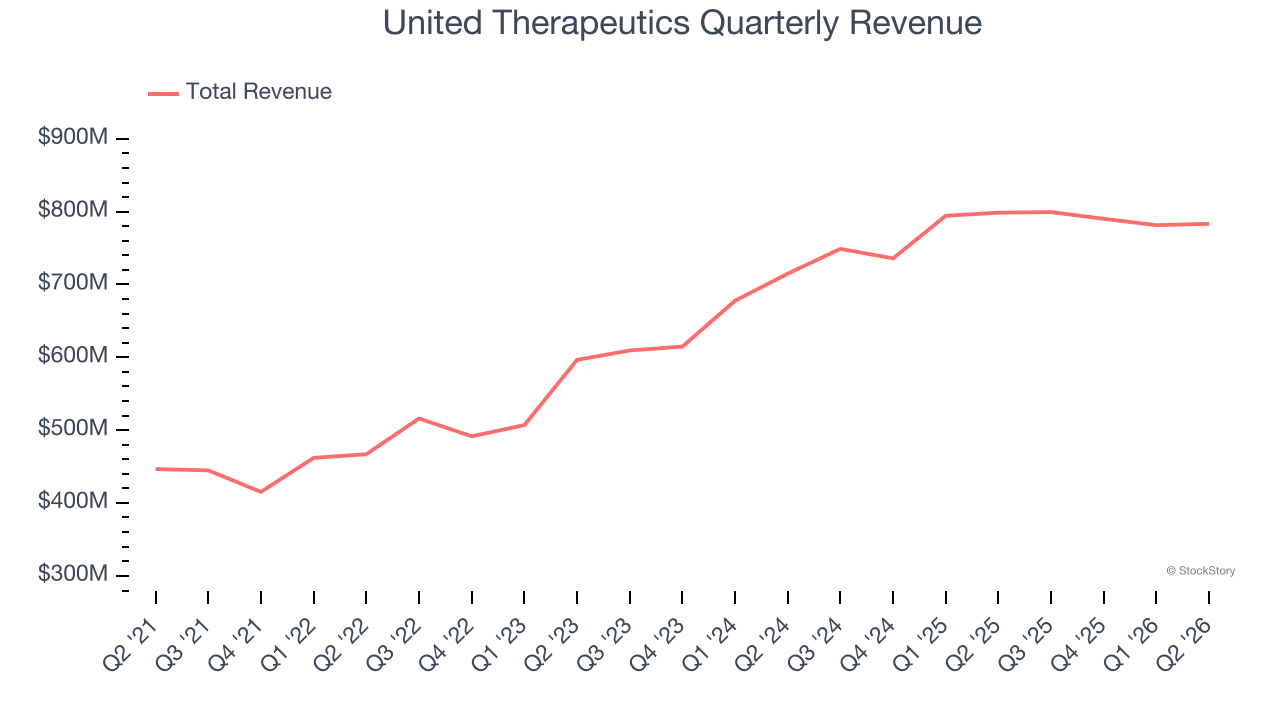
Long-term growth is the most important, but within healthcare, a half-decade historical view may miss new innovations or demand cycles. United Therapeutics’s annualized revenue growth of 9.8% over the last two years is below its five-year trend, but we still think the results were respectable. 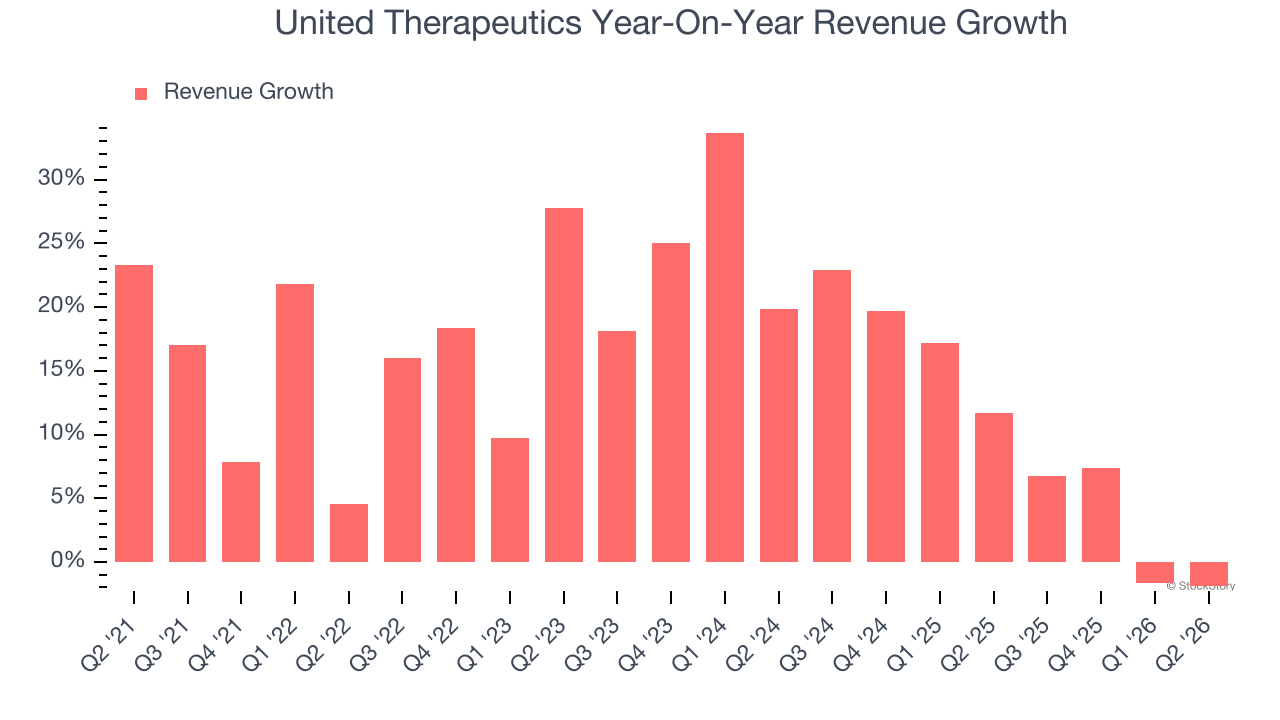
This quarter, United Therapeutics’s revenue fell by 1.9% year on year to $783.3 million but beat Wall Street’s estimates by 2.3%.
Looking ahead, sell-side analysts expect revenue to decline by 20.9% over the next 12 months, a deceleration versus the last two years. This projection doesn’t excite us and suggests its products and services will see some demand headwinds.
ONE MORE THING: The $21 AI Application Stock Wall Street Forgot. While Wall Street obsesses over who’s building AI, one company is already using it to print money. And nobody’s paying attention.
AI chip stocks trade at ridiculous valuations. This company processes a trillion consumer signals monthly using AI and trades at a third of the price. The gap won’t last. The institutions will figure it out. You need to see this first. Read the FREE Report Before They Notice.
Adjusted Operating Margin
United Therapeutics has been a well-oiled machine over the last five years. It demonstrated elite profitability for a healthcare business, boasting an average adjusted operating margin of 53.1%.
Analyzing the trend in its profitability, United Therapeutics’s adjusted operating margin decreased by 6.6 percentage points over the last five years. The company’s two-year trajectory also shows it failed to get its profitability back to the peak as its margin fell by 3.2 percentage points. This performance was poor no matter how you look at it - it shows its expenses were rising and it couldn’t pass those costs onto its customers.
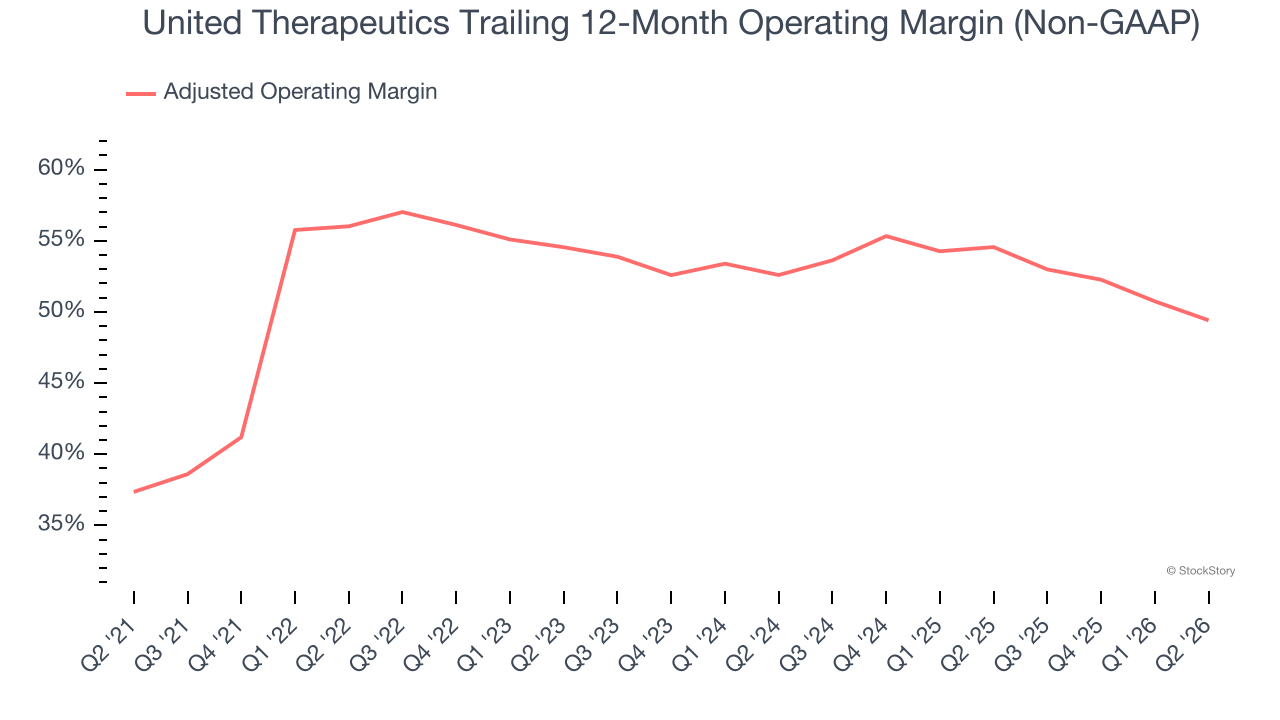
This quarter, United Therapeutics generated an adjusted operating margin profit margin of 47.8%, down 5.3 percentage points year on year. This contraction shows it was less efficient because its expenses increased relative to its revenue.
Earnings Per Share
Revenue trends explain a company’s historical growth, but the long-term change in earnings per share (EPS) points to the profitability of that growth — for example, a company could inflate its sales through excessive spending on advertising and promotions.
United Therapeutics’s EPS grew at 22.1% compounded annual growth rate over the last five years, higher than its 14.7% annualized revenue growth. However, this alone doesn’t tell us much about its business quality because its adjusted operating margin didn’t improve.
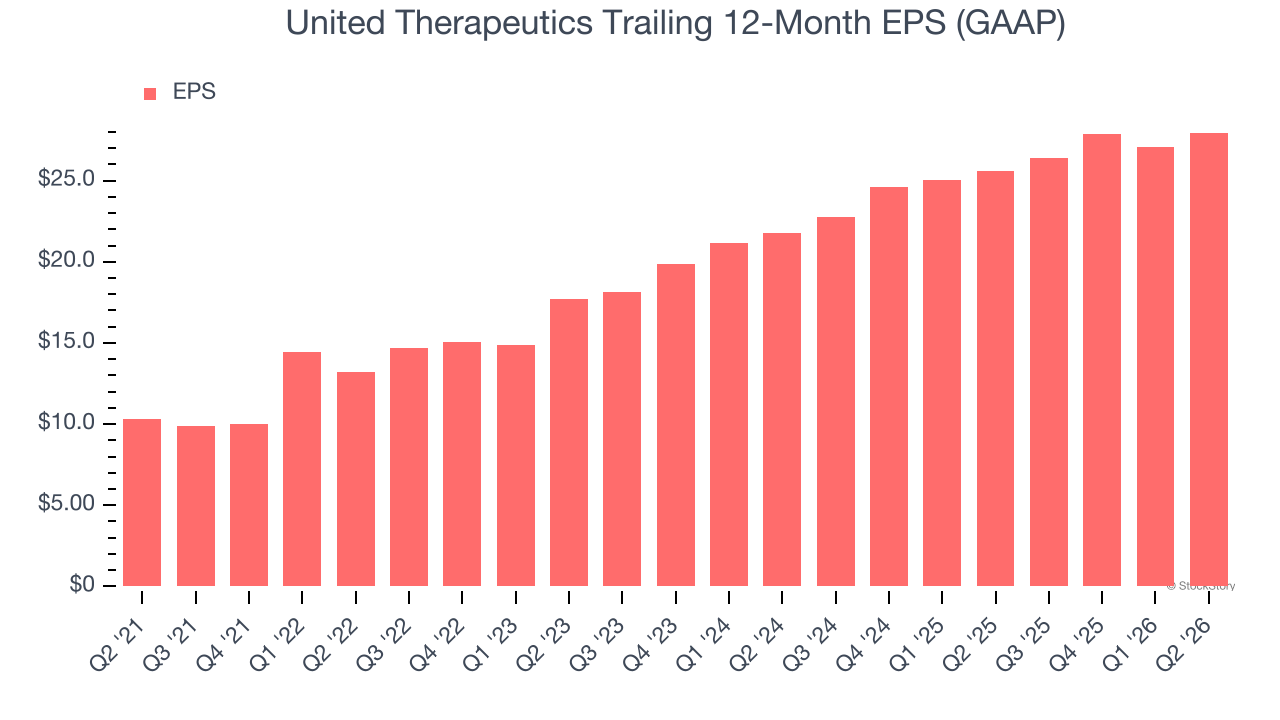
We can take a deeper look into United Therapeutics’s earnings to better understand the drivers of its performance. A five-year view shows that United Therapeutics has repurchased its stock, shrinking its share count by 3.2%. This tells us its EPS outperformed its revenue not because of increased operational efficiency but financial engineering, as buybacks boost per share earnings. 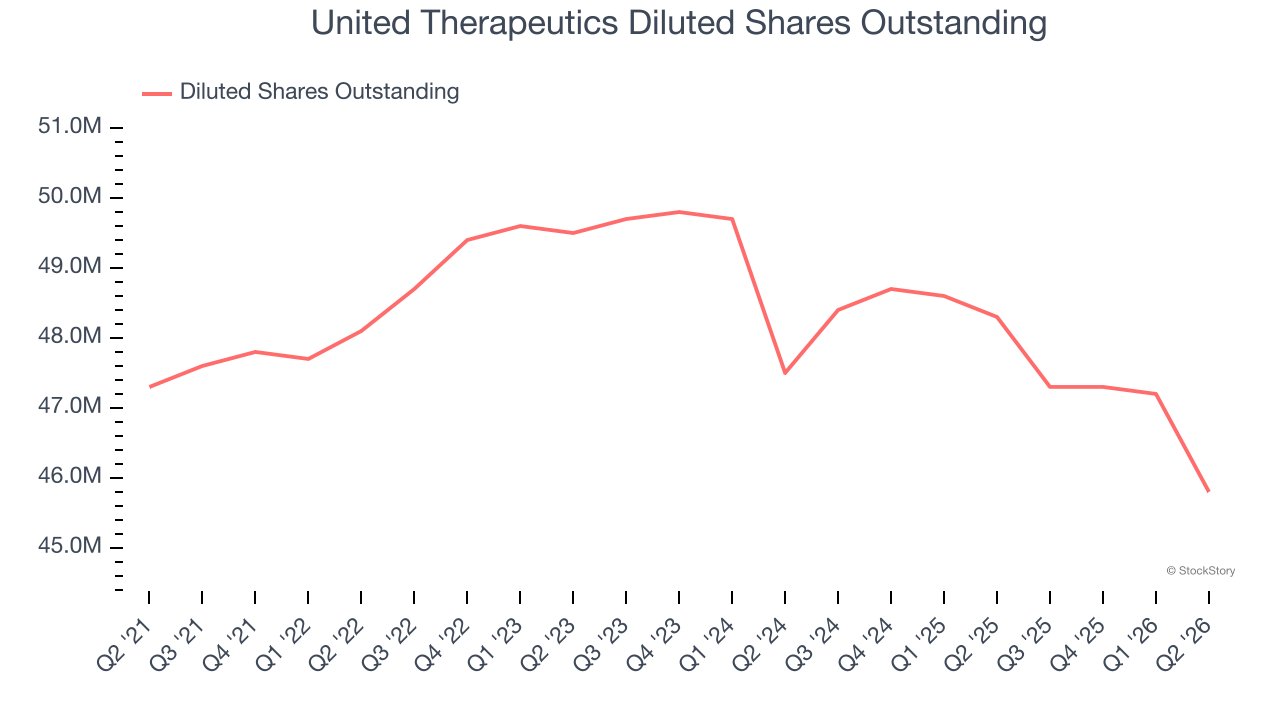
In Q2, United Therapeutics reported EPS of $7.27, up from $6.41 in the same quarter last year. This print beat analysts’ estimates by 5.9%. Over the next 12 months, Wall Street expects United Therapeutics’s full-year EPS to grow 3.1% from $27.96 to $28.83.
Key Takeaways from United Therapeutics’s Q2 Results
It was encouraging to see United Therapeutics beat analysts’ revenue expectations this quarter. We were also glad its EPS outperformed Wall Street’s estimates. Overall, we think this was a solid quarter with some key areas of upside. The market seemed to be hoping for more, and the stock traded down 4.3% to $496.57 immediately after reporting.
Should you buy the stock or not? We think that the latest quarter is only one piece of the longer-term business quality puzzle. Quality, when combined with valuation, can help determine if the stock is a buy. We cover that in our actionable full research report which you can read here (it’s free).