


Data protection software company Commvault (NASDAQ: CVLT) announced better-than-expected revenue in Q2 CY2026, with sales up 11.4% year on year to $314.1 million. On the other hand, next quarter’s revenue guidance of $266 million was less impressive, coming in 13.7% below analysts’ estimates. Its non-GAAP profit of $1.42 per share was 22.2% above analysts’ consensus estimates.
Is now the time to buy Commvault? Find out by accessing our full research report, it’s free.
Commvault (CVLT) Q2 CY2026 Highlights:
- Revenue: $314.1 million vs analyst estimates of $310.5 million (11.4% year-on-year growth, 1.2% beat)
- Adjusted EPS: $1.42 vs analyst estimates of $1.16 (22.2% beat)
- Adjusted Operating Income: $71.47 million vs analyst estimates of $59.41 million (22.8% margin, 20.3% beat)
- Subscription revenue Guidance for Q3 CY2026 is $266 million at the midpoint, above analyst estimates of $261.4 million
- Operating Margin: 8.2%, in line with the same quarter last year
- Free Cash Flow Margin: 16.3%, down from 42.3% in the previous quarter
- Annual Recurring Revenue: $1.05 billion vs analyst estimates of $1.15 billion (5.8% year-on-year growth, miss)
- Billings: $301.8 million at quarter end, down 5.9% year on year
- Market Capitalization: $6.19 billion
"Our results reflect what we're hearing from customers every day – they are embracing our AI-enabled platform to protect data, govern access, and make clean, trusted recoveries," said Sanjay Mirchandani, President and CEO, Commvault.
Company Overview
Born from the need to create ironclad protection in an increasingly dangerous digital world, Commvault (NASDAQ: CVLT) provides data protection and cyber resilience software that helps organizations secure, back up, and recover their data across on-premises, hybrid, and multi-cloud environments.
Revenue Growth
A company’s long-term sales performance is one signal of its overall quality. Any business can experience short-term success, but top-performing ones enjoy sustained growth for years. Over the last five years, Commvault grew its sales at a 10.6% compounded annual growth rate. Though this growth is acceptable on an absolute basis, we need to see more than just topline growth for the software sector, which can display significant earnings volatility. This means our bar for the sector is particularly high, reflecting the non-essential and hit-driven nature of the products and services offered. Additionally, five-year CAGR starts around Covid, when revenue was depressed then rebounded.
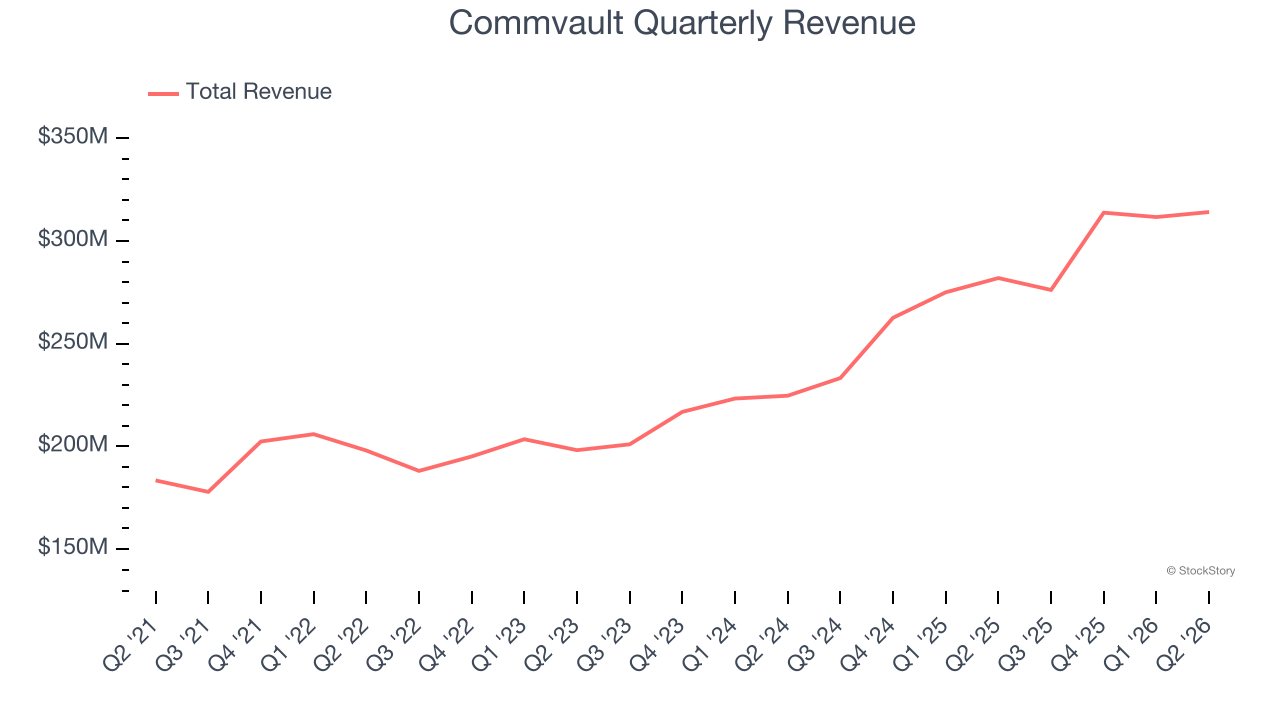
We at StockStory place the most emphasis on long-term growth, but within software, a half-decade historical view may miss recent innovations or disruptive industry trends. Commvault’s annualized revenue growth of 18.5% over the last two years is above its five-year trend, suggesting its demand recently accelerated. 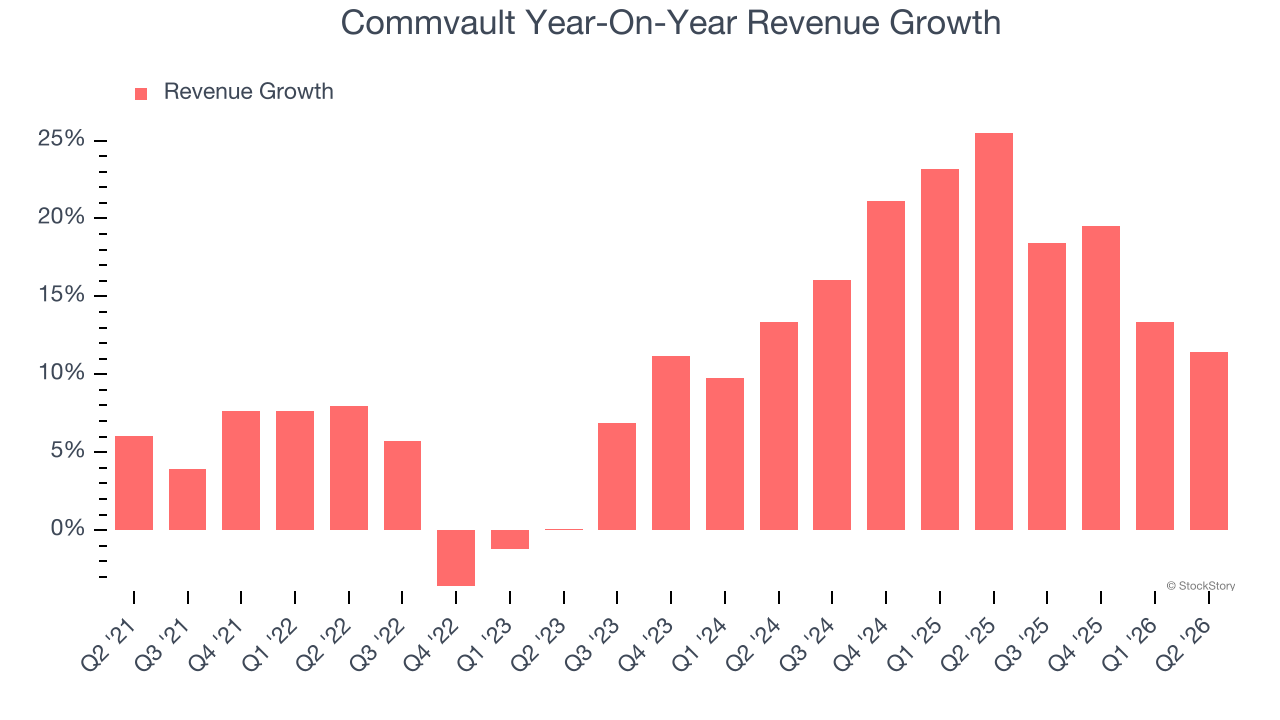
This quarter, Commvault reported year-on-year revenue growth of 11.4%, and its $314.1 million of revenue exceeded Wall Street’s estimates by 1.2%. Company management is currently guiding for a 3.7% year-on-year decline in sales next quarter.
Looking further ahead, sell-side analysts expect revenue to grow 10% over the next 12 months, a deceleration versus the last two years. This projection doesn’t excite us and implies its products and services will face some demand challenges.
ALSO WORTH WATCHING: Nvidia’s Quiet Partner. Nvidia’s chips cost a hundred grand. The connectors that make them work cost even more. One company makes them all.
Every AI server needs specialized infrastructure the chip companies don’t make. High-speed cables. Power connectors. Thermal sensors. This 90-year-old company built a monopoly on it. The AI boom just started. This stock is still flying under the radar. Claim The Stock Ticker Here for FREE.
Annual Recurring Revenue
While reported revenue for a software company can include low-margin items like implementation fees, annual recurring revenue (ARR) is a sum of the next 12 months of contracted revenue purely from software subscriptions, or the high-margin, predictable revenue streams that make SaaS businesses so valuable.
Commvault’s ARR punched in at $1.05 billion in Q2, and over the last four quarters, its growth was solid as it averaged 17.7% year-on-year increases. This alternate topline metric grew faster than total sales, which likely means that the recurring portions of the business are growing faster than less predictable, choppier ones such as implementation fees. That could be a good sign for future revenue growth. 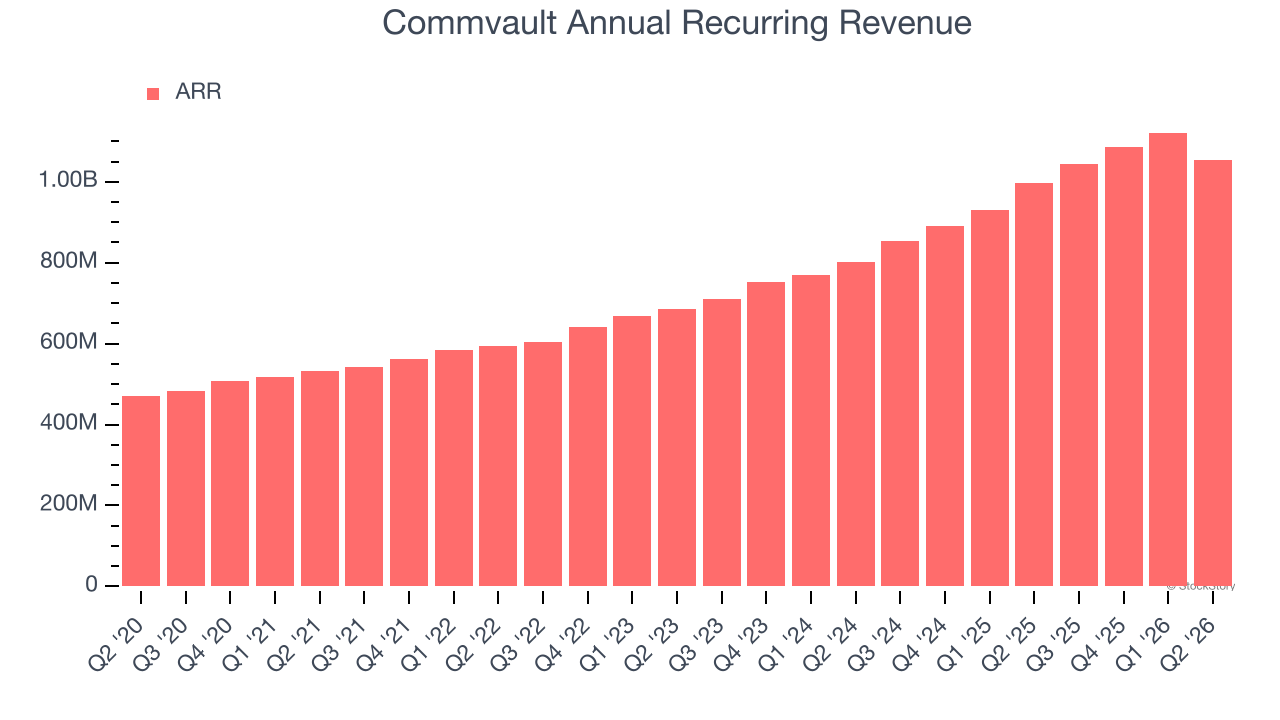
Customer Acquisition Efficiency
The customer acquisition cost (CAC) payback period measures the months a company needs to recoup the money spent on acquiring a new customer. This metric helps assess how quickly a business can break even on its sales and marketing investments.
Commvault’s recent customer acquisition efforts haven’t yielded returns as its CAC payback period was negative this quarter, meaning its incremental sales and marketing investments outpaced its revenue. The company’s inefficiency indicates it operates in a competitive market and must continue investing to grow.
Key Takeaways from Commvault’s Q2 Results
We liked that revenue narrowly outperformed Wall Street’s estimates. On the other hand, its ARR missed and its billings both declined year-on-year and fell short of Wall Street’s estimates. Overall, this was a softer quarter. The stock traded down 7.7% to $137.93 immediately after reporting.
Commvault’s latest earnings report disappointed. One quarter doesn’t define a company’s quality, so let’s explore whether the stock is a buy at the current price. We think that the latest quarter is only one piece of the longer-term business quality puzzle. Quality, when combined with valuation, can help determine if the stock is a buy. We cover that in our actionable full research report which you can read here (it’s free).