Wrapping up Q1 earnings, we look at the numbers and key takeaways for the non-discretionary retail stocks, including Sprouts (NASDAQ: SFM) and its peers.
Food is non-discretionary because it's essential for life (maybe not those Oreos?), so consumers naturally need a place to buy it. Selling food is a notoriously tough business, however, as the costs of procuring and transporting oftentimes perishable products and operating stores fit to sell those products can be high. Competition is also fierce because the alternatives are numerous. While online competition threatens all of retail, grocery is one of the least penetrated because of the nature of the product. Still, we could be one startup or innovation away from a paradigm shift.
The 9 non-discretionary retail stocks we track reported a satisfactory Q1. As a group, revenues beat analysts’ consensus estimates by 1.5% while next quarter’s revenue guidance was in line.
In light of this news, share prices of the companies have held steady as they are up 2.8% on average since the latest earnings results.
Sprouts (NASDAQ: SFM)
Playing on the secular trend of healthier living, Sprouts Farmers Market (NASDAQ: SFM) is a grocery store chain emphasizing natural and organic products.
Sprouts reported revenues of $2.33 billion, up 4.1% year on year. This print was in line with analysts’ expectations, but overall, it was a mixed quarter for the company with a narrow beat of analysts’ EBITDA estimates but full-year EPS guidance missing analysts’ expectations.
“The first quarter played out largely as we expected,” said Jack Sinclair, chief executive officer of Sprouts Farmers Market.
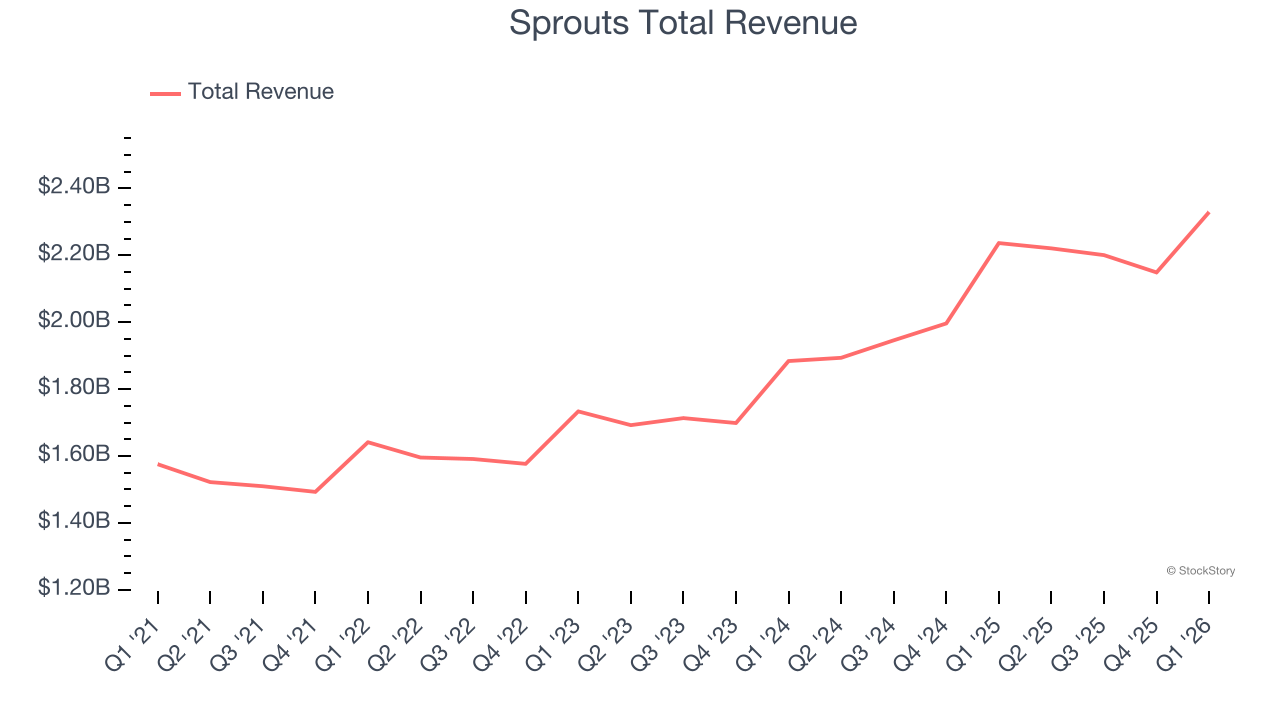
Interestingly, the stock is up 13.6% since reporting and currently trades at $80.80.
Is now the time to buy Sprouts? Access our full analysis of the earnings results here, it’s free.
Best Q1: Target (NYSE: TGT)
With a higher focus on style and aesthetics compared to other large general merchandise retailers, Target (NYSE: TGT) serves the suburban consumer who is looking for a wide range of products under one roof.
Target reported revenues of $25.44 billion, up 6.7% year on year, outperforming analysts’ expectations by 3.4%. The business had an exceptional quarter with a beat of analysts’ EPS and EBITDA estimates.
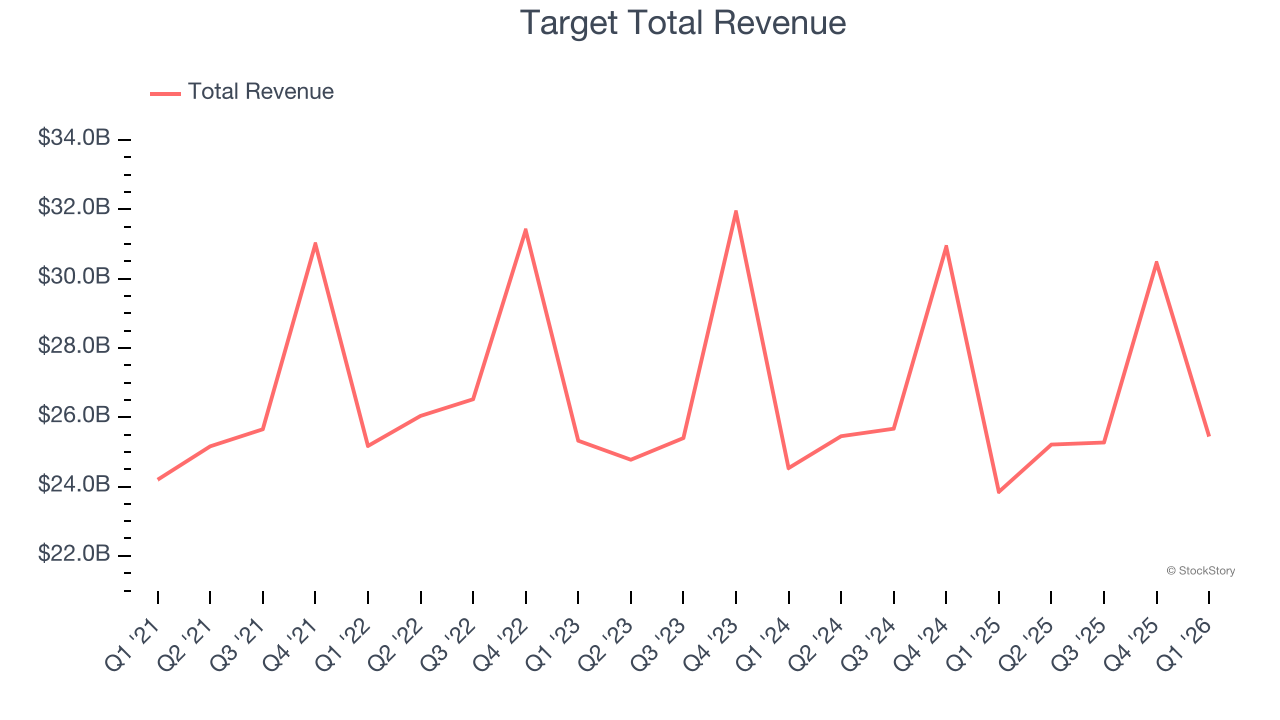
The market seems content with the results as the stock is up 2.2% since reporting. It currently trades at $130.04.
Is now the time to buy Target? Access our full analysis of the earnings results here, it’s free.
Weakest Q1: Walmart (NASDAQ: WMT)
Known for its large-format Supercenters, Walmart (NASDAQ: WMT) is a retail pioneer that serves a budget-conscious consumer who is looking for a wide range of products under one roof.
Walmart reported revenues of $177.8 billion, up 7.3% year on year, exceeding analysts’ expectations by 1.6%. Still, it was a slower quarter as it posted full-year EPS guidance missing analysts’ expectations.
Walmart delivered the weakest guidance update in the group. As expected, the stock is down 10.5% since the results and currently trades at $117.06.
Read our full analysis of Walmart’s results here.
BJ's (NYSE: BJ)
Appealing to the budget-conscious individual shopping for a household, BJ’s Wholesale Club (NYSE: BJ) is a membership-only retail chain that sells groceries, appliances, electronics, and household items, often in bulk quantities.
BJ's reported revenues of $5.66 billion, up 9.9% year on year. This print surpassed analysts’ expectations by 4.2%. It was a strong quarter as it also produced a beat of analysts’ EPS and EBITDA estimates.
BJ's delivered the biggest analyst estimate beat among its peers. The stock is down 10.3% since reporting and currently trades at $84.69.
Read our full, actionable report on BJ's here, it’s free.
Dollar General (NYSE: DG)
Appealing to the budget-conscious consumer, Dollar General (NYSE: DG) is a discount retailer that sells a wide range of household essentials, groceries, apparel/beauty products, and seasonal merchandise.
Dollar General reported revenues of $10.79 billion, up 3.4% year on year. This result was in line with analysts’ expectations. Overall, it was a satisfactory quarter as it also recorded a decent beat of analysts’ EBITDA estimates.
Dollar General had the weakest performance against analyst estimates among its peers. The stock is up 4.2% since reporting and currently trades at $114.50.
Read our full, actionable report on Dollar General here, it’s free.
Market Update
Late in 2025 into early 2026, there was hand-wringing around artificial intelligence. For software companies, the fear was that AI would erode pricing power and compress margins as new tools made it easier to replicate what once required expensive enterprise platforms. Crypto investors had their own version of the same anxiety: if AI agents could trade, allocate capital, and manage wallets autonomously, what exactly was the long-term value of today’s crypto infrastructure?
These concerns triggered a noticeable rotation away from these sectors and into safer havens. But markets rarely dwell on one narrative for long. Spring 2026 came, and the focus shifted abruptly from technological disruption to geopolitical risk. The US’ conflict with Iran became the dominant driver of market psychology, and when geopolitics takes center stage, the script changes quickly. Investors stop debating growth rates and start worrying about oil supply, inflation, and global stability.
Want to invest in winners with rock-solid fundamentals? Check out our 9 Best Market-Beating Stocks and add them to your watchlist. These companies are poised for growth regardless of the political or macroeconomic climate.
StockStory’s analyst team — all seasoned professional investors — uses quantitative analysis and automation to deliver market-beating insights faster and with higher quality.