Financial services giant Wells Fargo (NYSE: WFC) missed Wall Street’s revenue expectations in Q1 CY2026, but sales rose 6% year on year to $21.45 billion. Its GAAP profit of $1.60 per share was 1.1% above analysts’ consensus estimates.
Is now the time to buy Wells Fargo? Find out by accessing our full research report, it’s free.
Wells Fargo (WFC) Q1 CY2026 Highlights:
- Net Interest Income: $12.1 billion vs analyst estimates of $12.3 billion (953% year-on-year growth, 1.6% miss)
- Net Interest Margin: 2.5% vs analyst estimates of 2.6% (11.2 basis point miss)
- Revenue: $21.45 billion vs analyst estimates of $21.77 billion (6% year-on-year growth, 1.5% miss)
- Efficiency Ratio: 67% vs analyst estimates of 65.4% (160.2 basis point miss)
- EPS (GAAP): $1.60 vs analyst estimates of $1.58 (1.1% beat)
- Tangible Book Value per Share: $44.98 vs analyst estimates of $45.76 (6.8% year-on-year growth, 1.7% miss)
- Market Capitalization: $267.3 billion
Company Overview
Founded during the California Gold Rush in 1852 to provide banking and express delivery services to miners and merchants, Wells Fargo (NYSE: WFC) is a diversified financial services company that provides banking, lending, investment, and wealth management services to individuals and businesses.
Sales Growth
From lending activities to service fees, most banks build their revenue model around two income sources. Interest rate spreads between loans and deposits create the first stream, with the second coming from charges on everything from basic bank accounts to complex investment banking transactions. Unfortunately, Wells Fargo’s 2.6% annualized revenue growth over the last five years was sluggish. This fell short of our benchmarks and is a tough starting point for our analysis.
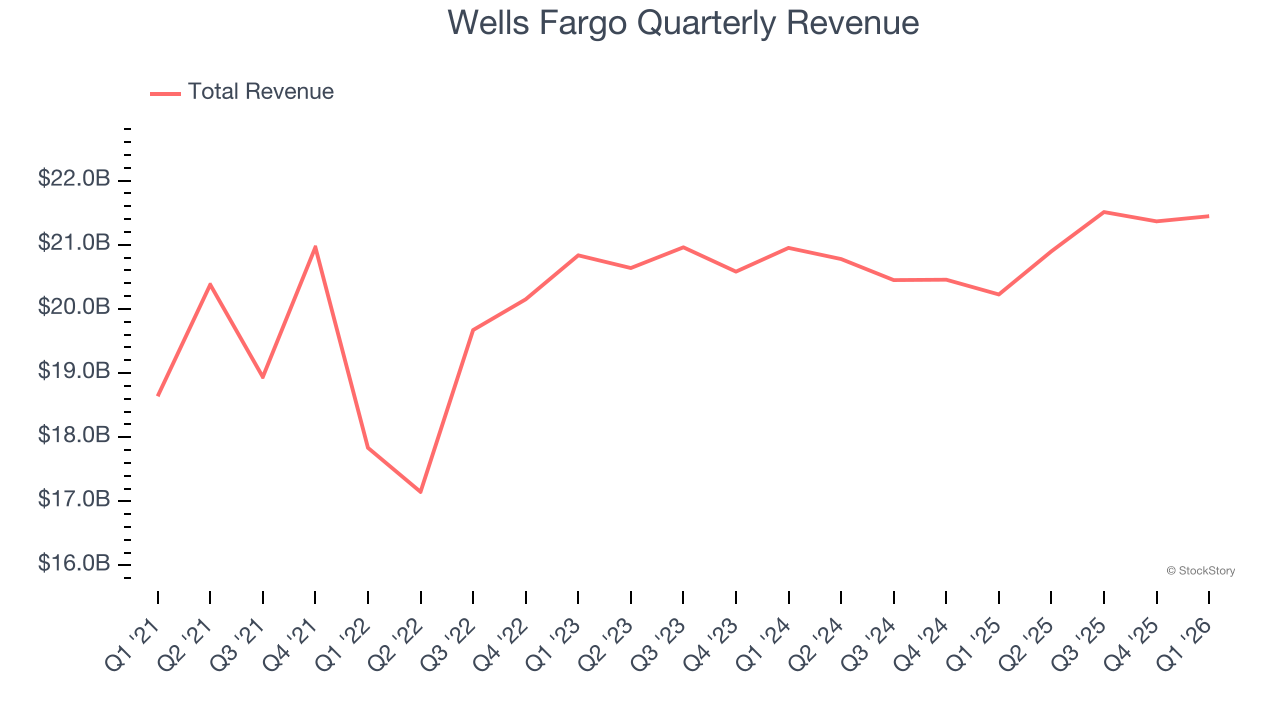
Long-term growth is the most important, but within financials, a half-decade historical view may miss recent interest rate changes and market returns. Wells Fargo’s recent performance shows its demand has slowed as its annualized revenue growth of 1.2% over the last two years was below its five-year trend. We’re wary when companies in the sector see decelerations in revenue growth, as it could signal changing consumer tastes aided by low switching costs. 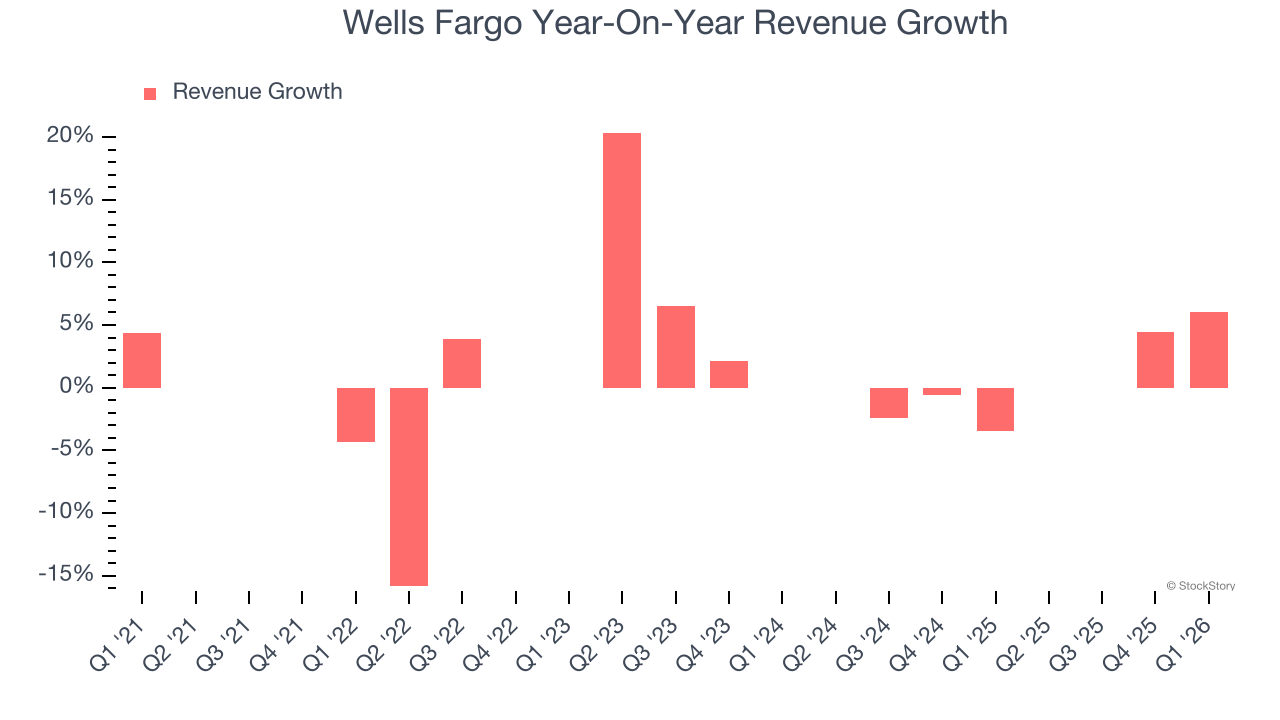 Note: Quarters not shown were determined to be outliers, impacted by outsized investment gains/losses that are not indicative of the recurring fundamentals of the business.
This quarter, Wells Fargo’s revenue grew by 6% year on year to $21.45 billion, missing Wall Street’s estimates.
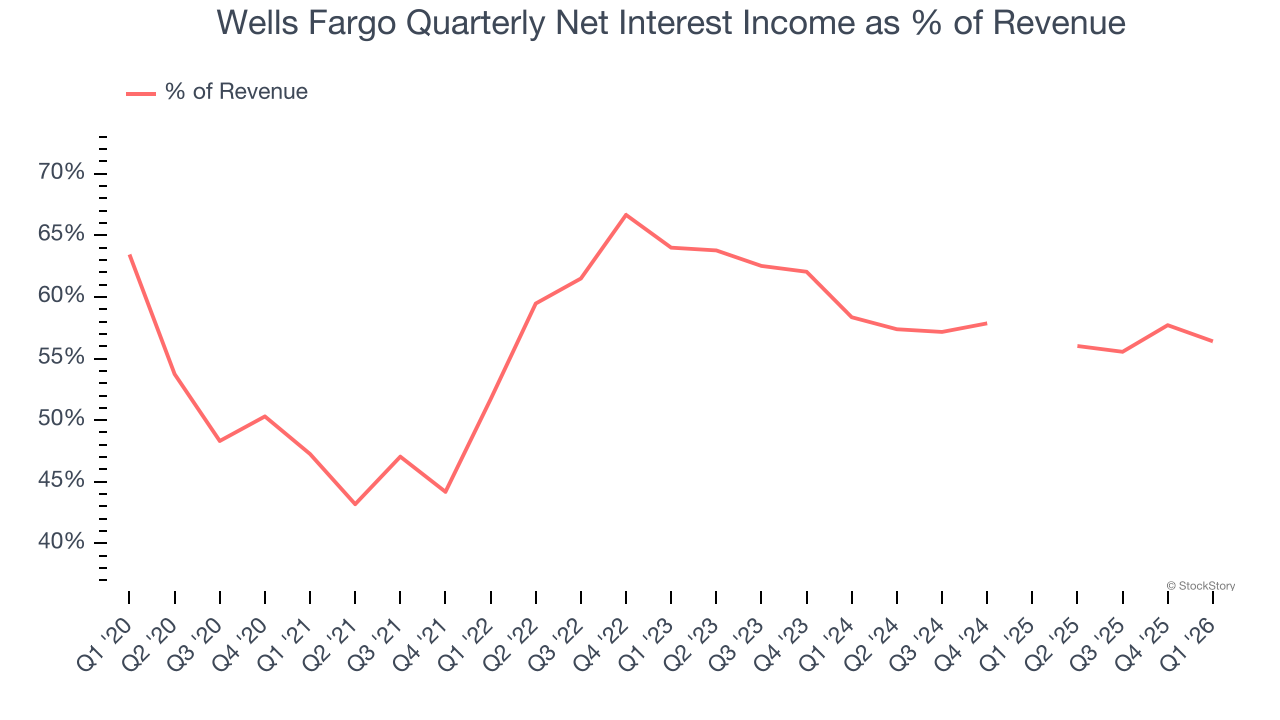
Net interest income made up 54.4% of the company’s total revenue during the last five years, meaning Wells Fargo’s growth drivers strike a balance between lending and non-lending activities.
 Note: Quarters not shown were determined to be outliers, impacted by outsized investment gains/losses that are not indicative of the recurring fundamentals of the business.
While banks generate revenue from multiple sources, investors view net interest income as the cornerstone - its predictable, recurring characteristics stand in sharp contrast to the volatility of non-interest income.
WHILE YOU’RE HERE: The Next Palantir? One satellite company captures images of every point on Earth. Every single day. The Pentagon wants it. Hedge funds are using it to beat earnings. You’ve probably never heard of it.
This is what the early days of Palantir looked like before it became a $437 billion giant. Same playbook. Different technology. If you missed Palantir, you need to see this. Claim The Stock Ticker for Free HERE.
Tangible Book Value Per Share (TBVPS)
The balance sheet drives banking profitability since earnings flow from the spread between borrowing and lending rates. As such, valuations for these companies concentrate on capital strength and sustainable equity accumulation potential.
When analyzing banks, tangible book value per share (TBVPS) takes precedence over many other metrics. This measure isolates genuine per-share value by removing intangible assets of debatable liquidation worth. On the other hand, EPS is often distorted by mergers and flexible loan loss accounting. TBVPS provides clearer performance insights.
Wells Fargo’s TBVPS grew at a decent 5.8% annual clip over the last five years. TBVPS growth has accelerated recently, growing by 7.2% annually over the last two years from $39.17 to $44.98 per share.
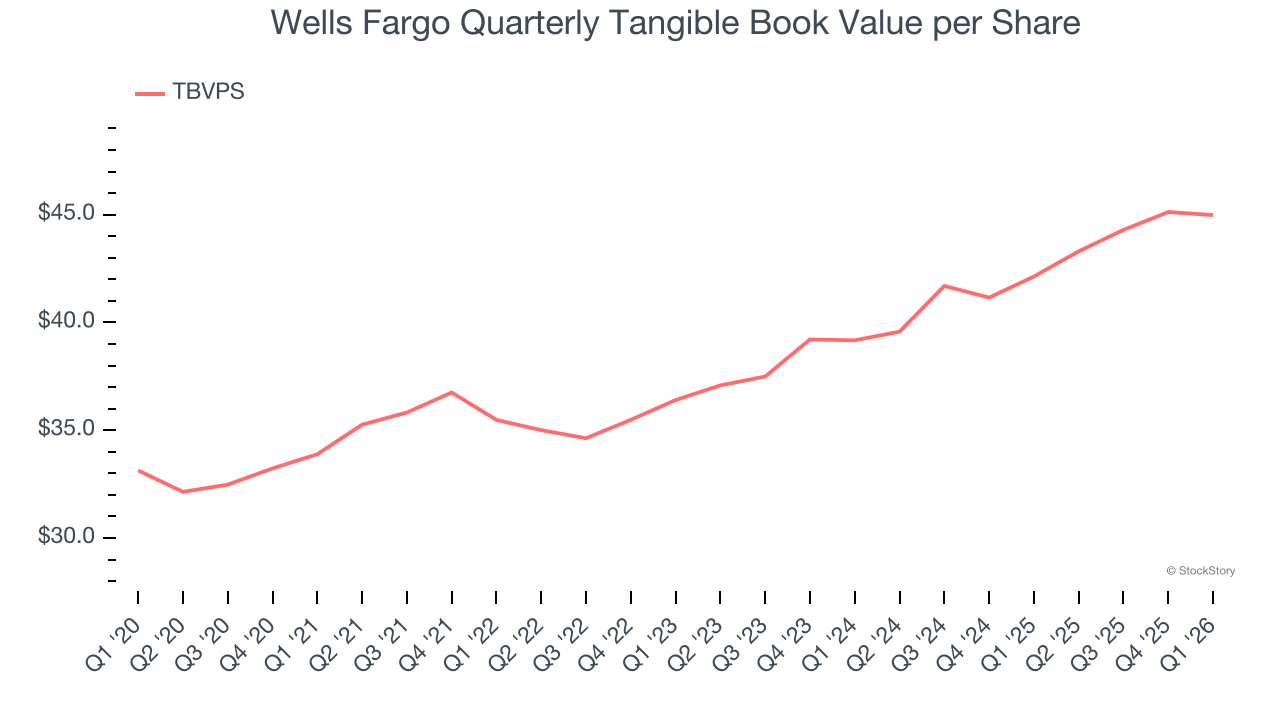
Over the next 12 months, Consensus estimates call for Wells Fargo’s TBVPS to grow by 7.4% to $48.32, lousy growth rate.
Key Takeaways from Wells Fargo’s Q1 Results
We struggled to find many positives in these results. Its net interest income missed and its revenue fell short of Wall Street’s estimates. Efficiency ratio was also worse-than-expected. Overall, this quarter could have been better. The stock traded down 2.3% to $84.68 immediately following the results.
Wells Fargo didn’t show it’s best hand this quarter, but does that create an opportunity to buy the stock right now? We think that the latest quarter is only one piece of the longer-term business quality puzzle. Quality, when combined with valuation, can help determine if the stock is a buy. We cover that in our actionable full research report which you can read here (it’s free).