Medical professional network Doximity (NYSE: DOCS) reported Q4 CY2025 results beating Wall Street’s revenue expectations, with sales up 9.8% year on year to $185.1 million. On the other hand, next quarter’s revenue guidance of $143.5 million was less impressive, coming in 5.2% below analysts’ estimates. Its non-GAAP profit of $0.46 per share was 2.9% above analysts’ consensus estimates.
Is now the time to buy Doximity? Find out by accessing our full research report, it’s free.
Doximity (DOCS) Q4 CY2025 Highlights:
- Revenue: $185.1 million vs analyst estimates of $181.5 million (9.8% year-on-year growth, 2% beat)
- Adjusted EPS: $0.46 vs analyst estimates of $0.45 (2.9% beat)
- Adjusted Operating Income: $109.3 million vs analyst estimates of $102.1 million (59.1% margin, 7.1% beat)
- Revenue Guidance for Q1 CY2026 is $143.5 million at the midpoint, below analyst estimates of $151.3 million
- EBITDA guidance for the full year is $356 million at the midpoint, in line with analyst expectations
- Operating Margin: 38.9%, down from 47.4% in the same quarter last year
- Free Cash Flow Margin: 31.6%, down from 54.3% in the previous quarter
- Market Capitalization: $6.64 billion
Company Overview
With over 80% of U.S. physicians as members of its digital community, Doximity (NYSE: DOCS) operates a digital platform that enables physicians and other healthcare professionals to collaborate, stay current with medical news, manage their careers, and conduct virtual patient visits.
Revenue Growth
A company’s long-term performance is an indicator of its overall quality. Any business can experience short-term success, but top-performing ones enjoy sustained growth for years. Luckily, Doximity’s sales grew at an impressive 29.3% compounded annual growth rate over the last five years. Its growth surpassed the average software company and shows its offerings resonate with customers, a great starting point for our analysis.
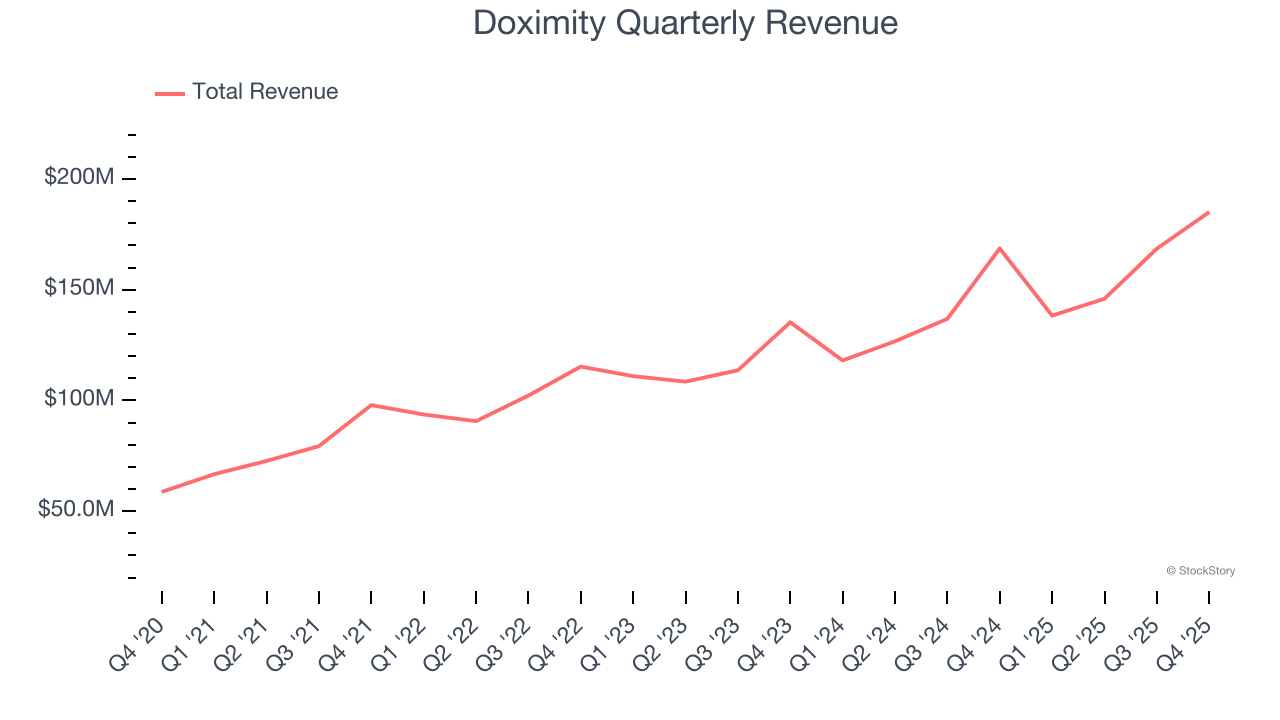
We at StockStory place the most emphasis on long-term growth, but within software, a half-decade historical view may miss recent innovations or disruptive industry trends. Doximity’s annualized revenue growth of 16.7% over the last two years is below its five-year trend, but we still think the results were respectable. 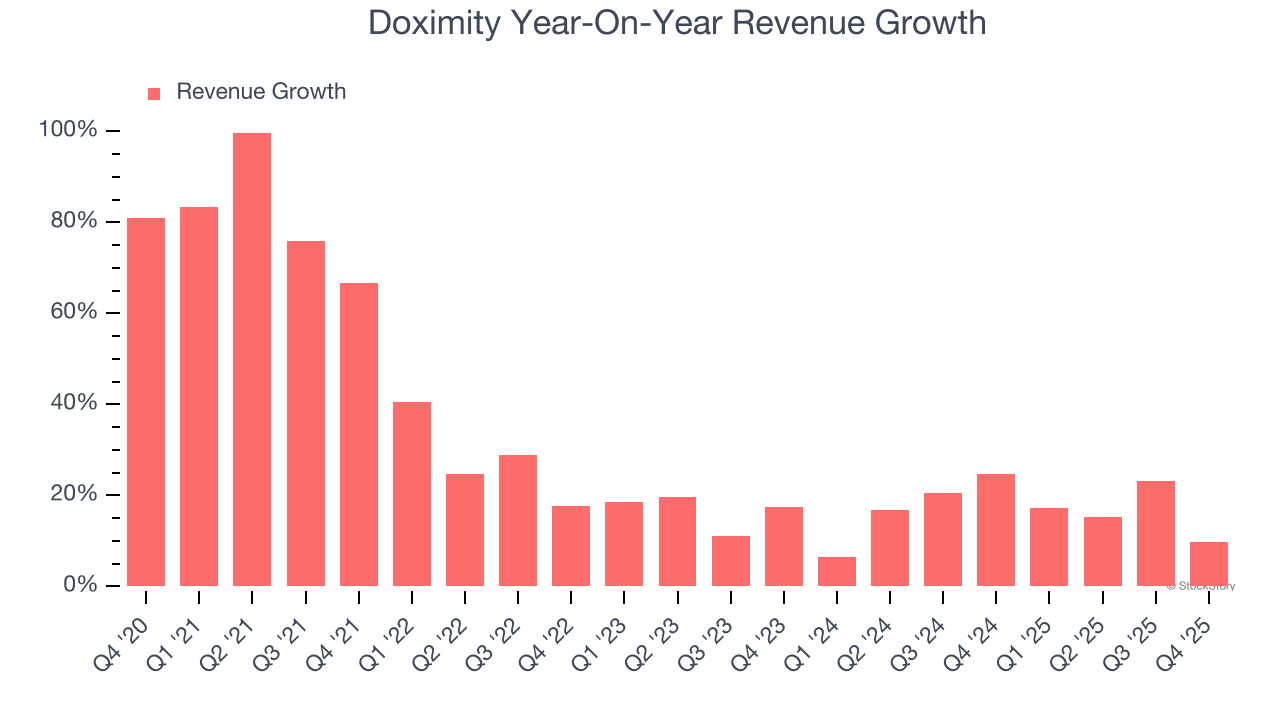
This quarter, Doximity reported year-on-year revenue growth of 9.8%, and its $185.1 million of revenue exceeded Wall Street’s estimates by 2%. Company management is currently guiding for a 3.8% year-on-year increase in sales next quarter.
Looking further ahead, sell-side analysts expect revenue to grow 9% over the next 12 months, a deceleration versus the last two years. This projection doesn't excite us and indicates its products and services will face some demand challenges. At least the company is tracking well in other measures of financial health.
The 1999 book Gorilla Game predicted Microsoft and Apple would dominate tech before it happened. Its thesis? Identify the platform winners early. Today, enterprise software companies embedding generative AI are becoming the new gorillas. a profitable, fast-growing enterprise software stock that is already riding the automation wave and looking to catch the generative AI next.
Customer Acquisition Efficiency
The customer acquisition cost (CAC) payback period measures the months a company needs to recoup the money spent on acquiring a new customer. This metric helps assess how quickly a business can break even on its sales and marketing investments.
Doximity is extremely efficient at acquiring new customers, and its CAC payback period checked in at 6.4 months this quarter. The company’s rapid recovery of its customer acquisition costs indicates it has a highly differentiated product offering and a strong brand reputation. These dynamics give Doximity more resources to pursue new product initiatives while maintaining the flexibility to increase its sales and marketing investments.
Key Takeaways from Doximity’s Q4 Results
We enjoyed seeing Doximity beat analysts’ EBITDA expectations this quarter. We were also happy its revenue outperformed Wall Street’s estimates. On the other hand, its revenue guidance for next quarter missed and its EBITDA guidance for next quarter fell short of Wall Street’s estimates. Overall, this was a softer quarter. The stock traded down 32.5% to $22.50 immediately after reporting.
Doximity may have had a tough quarter, but does that actually create an opportunity to invest right now? What happened in the latest quarter matters, but not as much as longer-term business quality and valuation, when deciding whether to invest in this stock. We cover that in our actionable full research report which you can read here (it’s free).