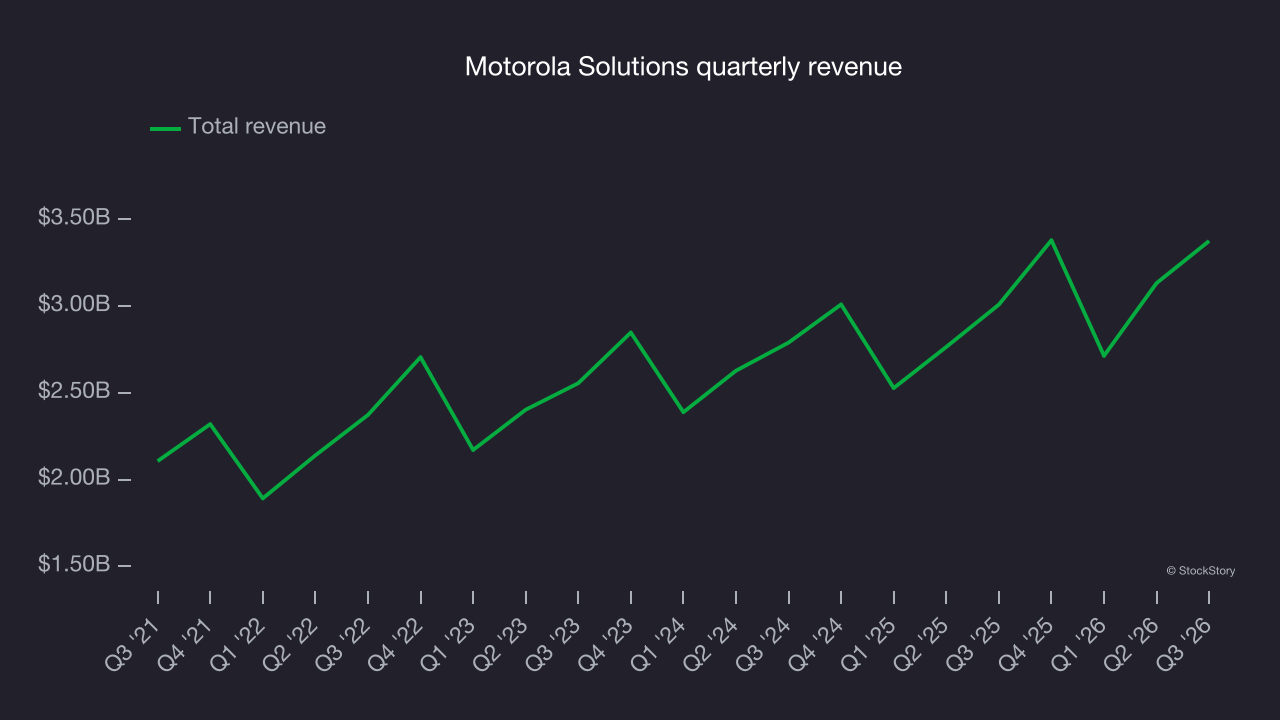
Public safety technology company Motorola Solutions (NYSE: MSI) beat Wall Street’s revenue expectations in Q3 2026, with revenue rising 12.2% year on year to $3.38 billion. On the other hand, next quarter’s revenue guidance of $3.82 billion was less impressive, coming in 1.3% below analysts’ consensus estimates. Its non-GAAP profit of $4.69 per share was 5.8% above analysts’ consensus estimates.
For more on Motorola Solutions, read our free full research report.
Motorola Solutions (MSI) Q3 2026 highlights:
- Revenue $3.38 billion vs S&P analysts’ consensus estimates of $3.28 billion (12.2% year-on-year growth, 3.1% beat)
- Adjusted EPS $4.69 vs S&P analysts’ consensus estimates of $4.43 (5.8% beat)
- Revenue guidance $3.82 billion at the midpoint for Q4 2026, below analysts’ consensus estimates of $3.87 billion
- Adjusted EPS guidance Management raised its full-year adjusted EPS guidance to $17.97 at the midpoint, a 1.7% increase
- Operating margin 23%, down from 25.6% in the same quarter last year
- Free cash flow margin 17.4%, down from 24.4% in the same quarter last year
- Market capitalization $81.26 billion
“Q3 was another outstanding quarter, with double-digit revenue growth across both segments and all three technologies,” said Greg Brown, chairman and CEO, Motorola Solutions. “We continue to see exceptionally strong demand across our safety and security solutions, driving record Q3 orders and an all-time record ending backlog. As a result, we’re raising our revenue and earnings outlook again and increasing our cash flow expectations for the full year.”
Revenue growth
A company’s long-term revenue performance can indicate its overall quality. Any business can have short-term success, but a top-tier one grows for years.
With $12.6 billion in revenue over the past 12 months, Motorola Solutions is a large company in the business services sector and benefits from economies of scale, giving it an edge in distribution. Its scale also gives it more leverage on fixed costs than smaller competitors and the flexibility to offer lower prices.
Motorola Solutions grew its revenue at a strong 9.2% compounded annual growth rate over the last five years, showing that its demand was higher than that of many business services companies.
Long-term growth is the most important, but within business services, a half-decade historical view may miss new innovations or demand cycles. Motorola Solutions’s annualized revenue growth of 8.8% over the last two years aligns with its five-year trend, suggesting its demand was predictably strong. 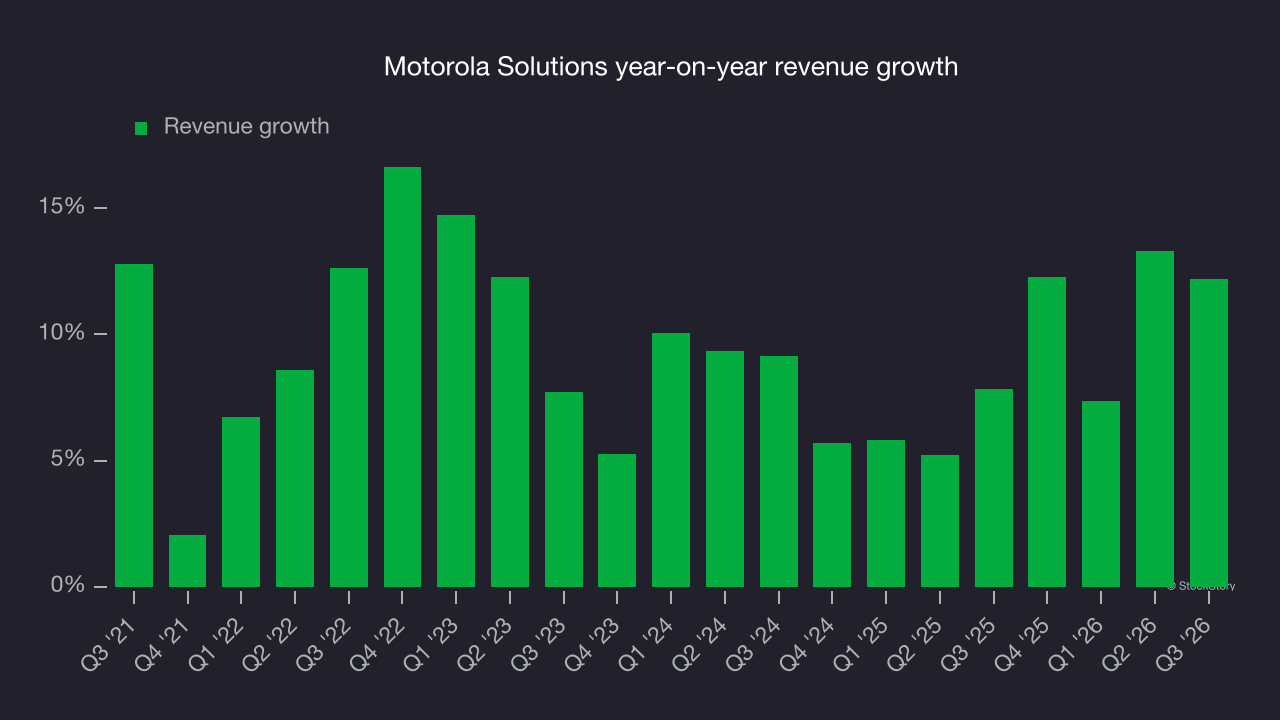
Motorola Solutions also breaks out the revenue for its most important segment, Software and services. Over the last two years, Motorola Solutions’s Software and services revenue averaged 17.8% year-on-year growth. This segment has outperformed its total revenue during the same period, lifting the company’s performance. 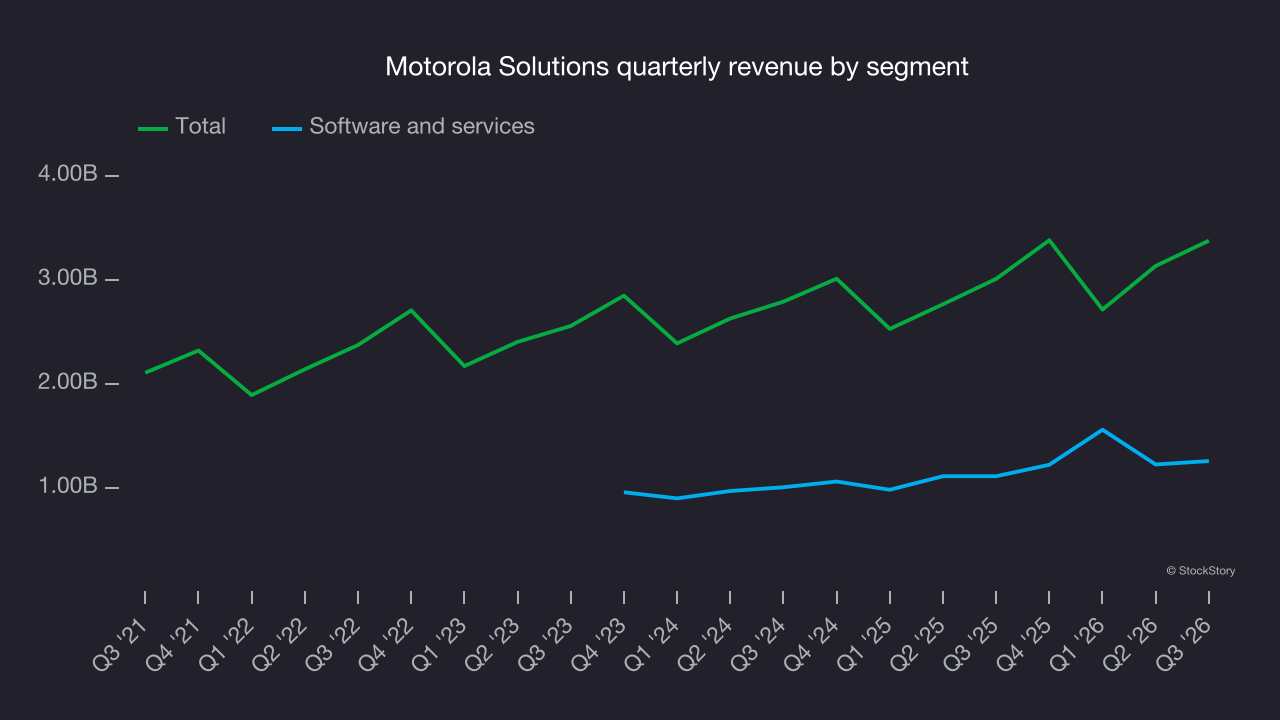
This quarter, Motorola Solutions reported year-on-year revenue growth of 12.2%, and its $3.38 billion in revenue exceeded Wall Street’s consensus estimates by 3.1%. Management is guiding for a 13% year-on-year increase in revenue next quarter.
Looking further ahead, sell-side analysts expect revenue to grow 8.9% over the next 12 months, according to S&P, similar to its two-year rate. This projection is particularly noteworthy for a company of its scale and indicates the market is forecasting success for its products and services.
Adjusted operating margin
Adjusted operating margin is an important measure of profitability as it shows the portion of revenue left after accounting for all core expenses, from the cost of goods sold to advertising and wages. It’s also useful for comparing profitability across companies because it excludes non-recurring expenses, interest on debt and taxes.
Motorola Solutions has performed well over the last five years. It demonstrated high profitability for a business services company, with an average adjusted operating margin of 29%.
Looking at the trend in its profitability, Motorola Solutions’s adjusted operating margin rose by 6.3 percentage points over the last five years, as its revenue growth provided substantial operating leverage.
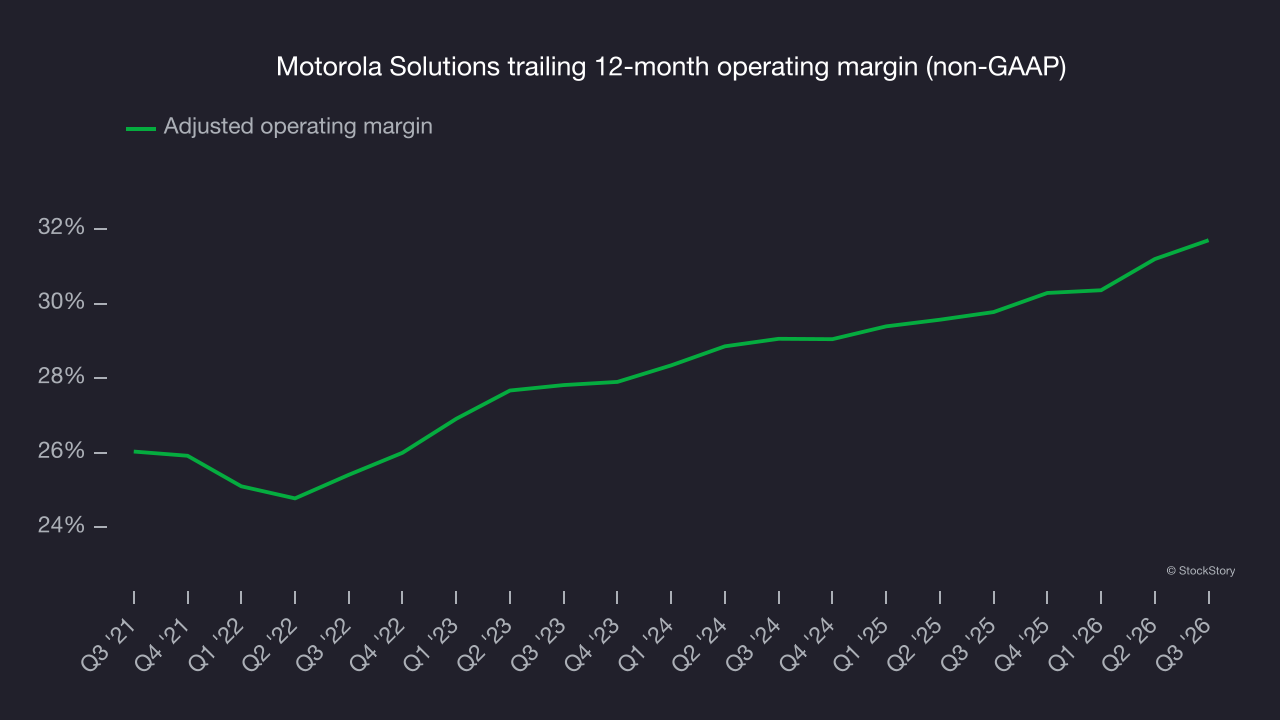
In Q3, Motorola Solutions generated an adjusted operating margin of 32.5%, up 2 percentage points year on year. This increase was a positive development and shows it was more efficient.
Earnings per share
We track the long-term change in earnings per share (EPS) for the same reason as long-term revenue growth. Compared to revenue, however, EPS highlights whether a company’s growth is profitable.
Motorola Solutions’s EPS grew at a 13.3% compounded annual growth rate over the last five years, higher than its 9.2% annualized revenue growth. This indicates the company became more profitable on a per-share basis as it expanded.
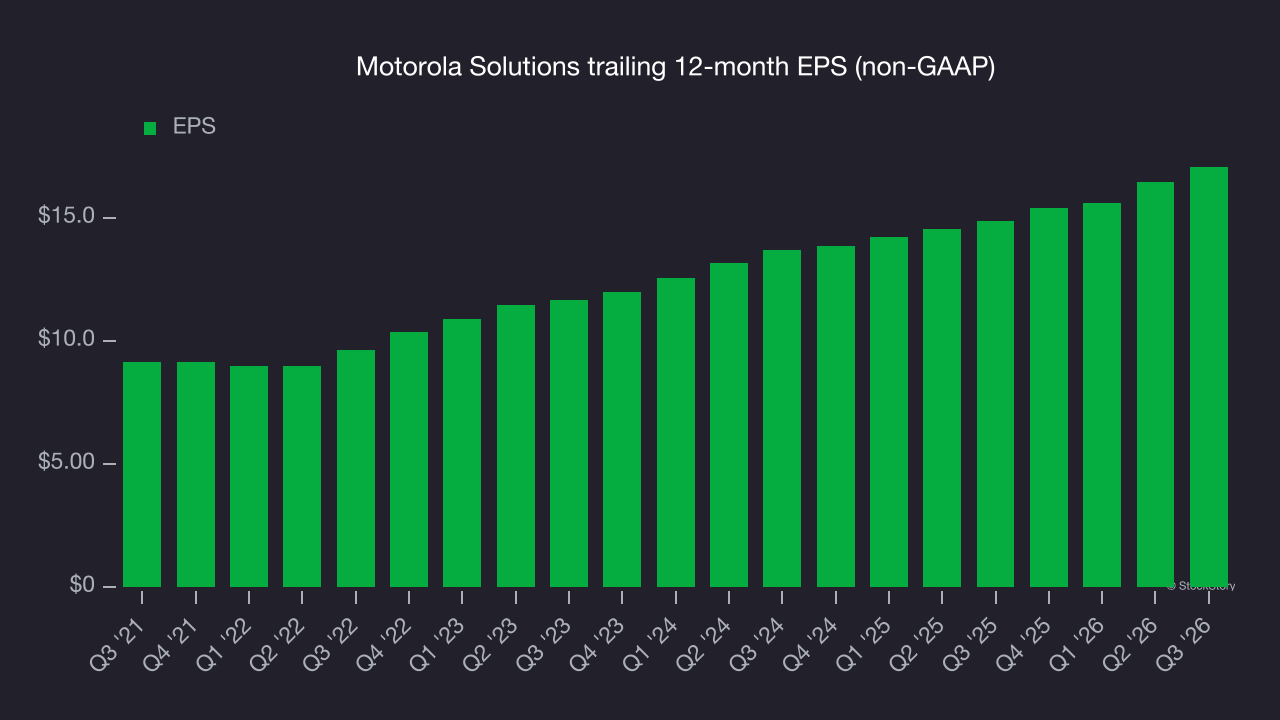
A closer look at Motorola Solutions’s earnings helps explain its performance. As noted earlier, Motorola Solutions’s adjusted operating margin expanded by 6.3 percentage points over the last five years. In addition, its share count shrank by 3.8%. These are positive signs for shareholders because improving profitability and share buybacks boost EPS growth relative to revenue growth. 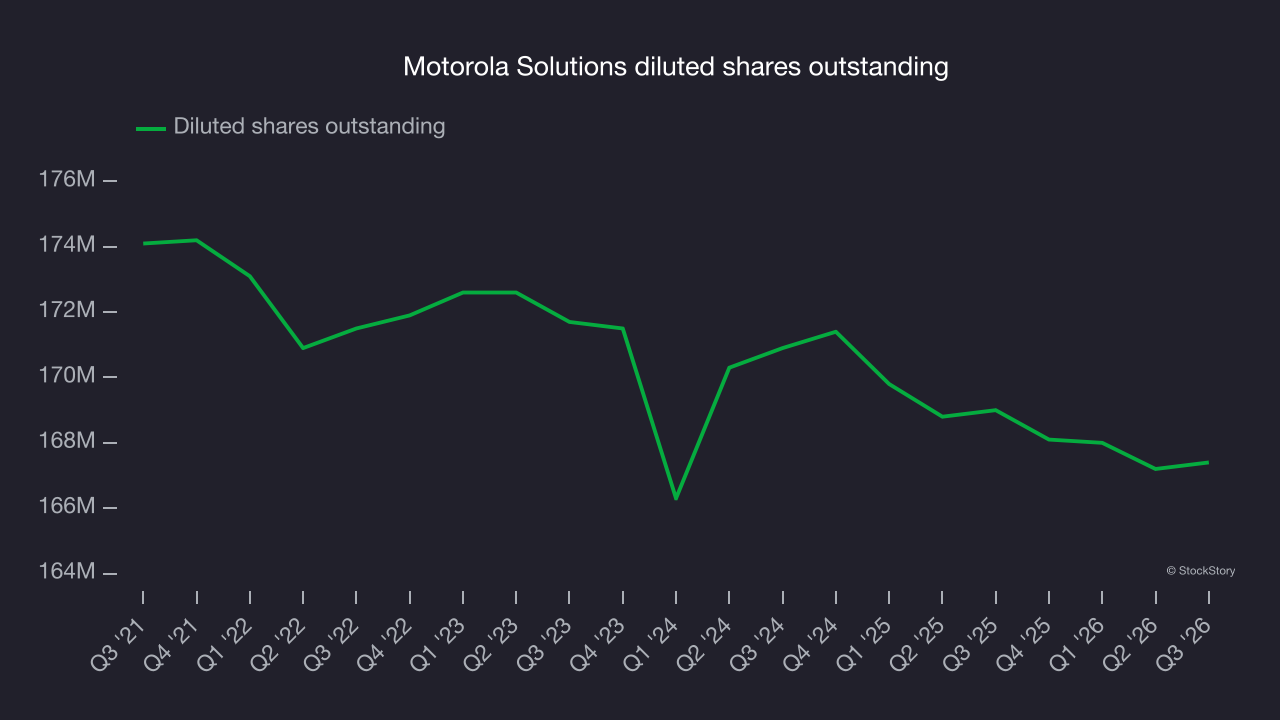
As with revenue, examining EPS over a shorter period helps identify changes in the business.
Motorola Solutions’s two-year annual EPS growth of 11.6% was lower than its five-year trend. This was underwhelming, but the company performed well on other measures of financial health.
In Q3, Motorola Solutions reported adjusted EPS of $4.69, up from $4.06 in the same quarter last year. This result beat analysts’ consensus estimates by 5.8%. Over the next 12 months, Wall Street expects Motorola Solutions’s full-year EPS to grow 10.4% from $17.06 to $18.83, according to S&P.
Key takeaways from Motorola Solutions’s Q3 results
Revenue and EPS beat Wall Street’s consensus estimates, but Motorola Solutions’ revenue guidance for next quarter fell slightly short, leaving a mixed picture for the quarter. The market appeared to be hoping for more, with shares edging lower 1.2% to $491.00 immediately after the release.
When deciding whether to invest in Motorola Solutions, the latest quarter matters, but not as much as longer-term business quality and valuation. For more on these factors, read the full research report here (it’s free).