Earnings results often indicate what direction a company will take in the months ahead. With Q2 behind us, let’s have a look at TETRA Technologies (NYSE: TTI) and its peers.
Oilfield services companies provide equipment, technology, and services enabling exploration and production activities, including drilling, completion, well intervention, and reservoir evaluation. Their fortunes closely track upstream capital spending cycles. Tailwinds include increased drilling activity during favorable commodity environments, demand for efficiency-enhancing technologies, and growing offshore and unconventional resource development. Headwinds include significant revenue volatility tied to oil and gas price swings and producer spending discipline. Intense competition pressures pricing and margins, while the energy transition may structurally reduce long-term demand. Workforce availability and technological disruption require continuous adaptation.
The 25 oilfield services stocks we track reported a strong Q2. As a group, revenues beat analysts’ consensus estimates by 4.6%.
In light of this news, share prices of the companies have held steady as they are up 1.2% on average since the latest earnings results.
TETRA Technologies (NYSE: TTI)
Operating across six continents with approximately 40,000 acres of mineral-rich brine leases in Arkansas, TETRA Technologies (NYSE: TTI) provides well completion fluids and water management services to oil and gas operators.
TETRA Technologies reported revenues of $185.7 million, up 6.8% year on year. This print exceeded analysts’ expectations by 4.9%. Overall, it was a very strong quarter for the company with a solid beat of analysts’ EBITDA estimates and EPS in line with analysts’ estimates.
Brady Murphy, TETRA's President and Chief Executive Officer, stated, "We delivered one of our strongest second-quarter and first-half financial performances in the past decade, reflecting the strength of our base business and our ability to grow in deepwater and international markets. Internationally and globally offshore, our revenues for the second-quarter and first six months of the year were a ten-year high, with our first-half 2026 international revenue 24% higher than any first six months over the past decade. Second-quarter consolidated revenue of $186 million increased 19% sequentially and 7% year over year. Income from continuing operations was $10.2 million for the quarter. Adjusted EBITDA for the quarter increased 24% sequentially to $31.9 million. Our performance also benefited from growing demand for the proprietary zinc-bromide electrolyte solution manufactured at our facility, reflecting expanding market interest in long-duration energy storage applications."
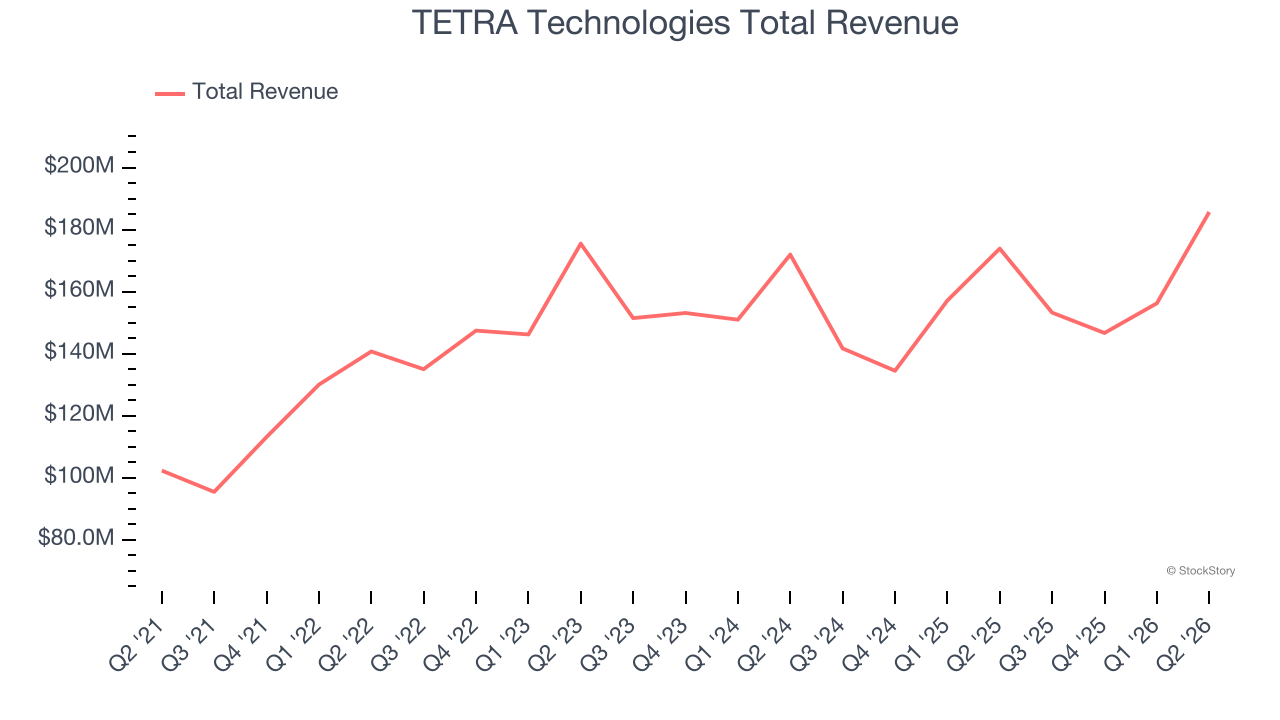
Investor expectations, however, were likely higher than Wall Street’s published projections, leaving some wishing for even better results (analysts’ consensus estimates are those published by big banks and advisory firms, not the investors who make buy and sell decisions). The stock is down 20.9% since reporting and currently trades at $6.17.
Is now the time to buy TETRA Technologies? Access our full analysis of the earnings results here, it’s free.
Best Q2: NESR (NASDAQ: NESR)
Operating across 16 countries from Algeria to Indonesia, NESR (NASDAQ: NESR) provides oilfield services like hydraulic fracturing, cementing, and drilling to oil and gas companies.
NESR reported revenues of $520.8 million, up 59.1% year on year, outperforming analysts’ expectations by 17.8%. The business had an incredible quarter with a beat of analysts’ EPS estimates and a solid beat of analysts’ EBITDA estimates.
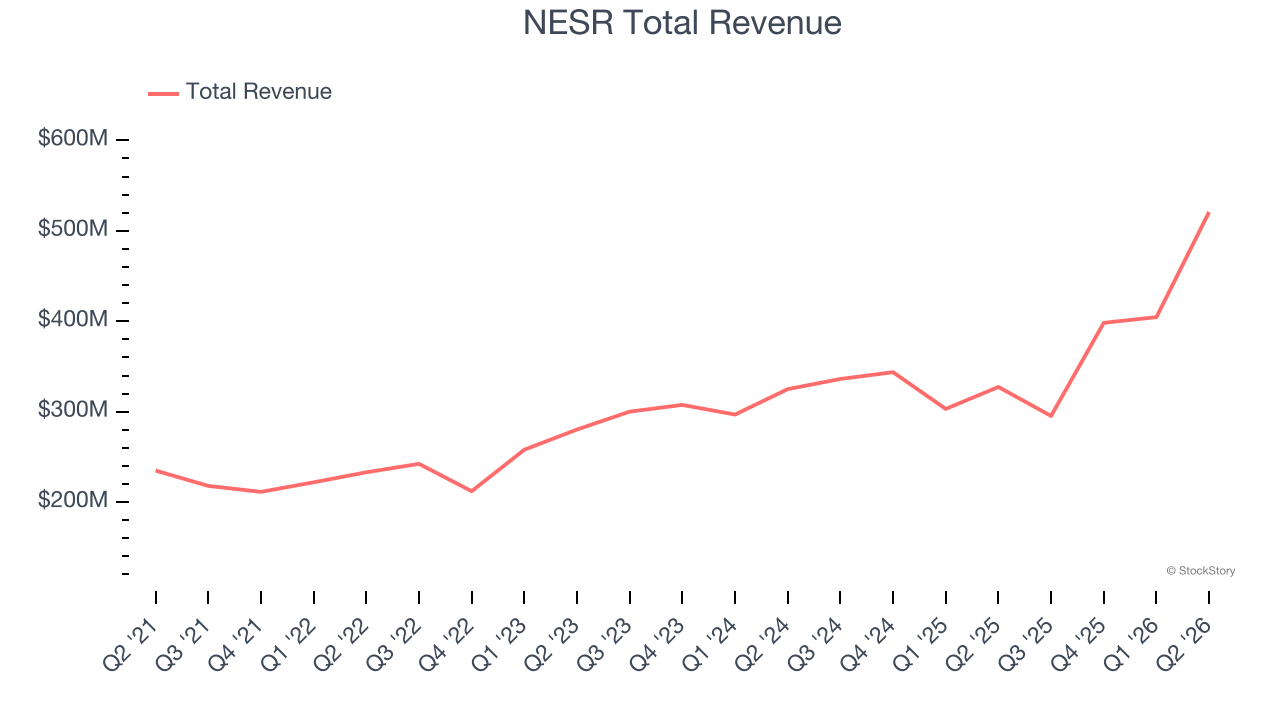
NESR achieved the fastest revenue growth in the group. Although it had a fine quarter compared to its peers, the market seems unhappy with the results as the stock is down 15.5% since reporting. It currently trades at $24.52.
Is now the time to buy NESR? Access our full analysis of the earnings results here, it’s free.
Weakest Q2: ProPetro (NYSE: PUMP)
Operating exclusively in the Permian Basin—one of America's most prolific oil-producing regions—ProPetro (NYSE: PUMP) provides hydraulic fracturing services that pump high-pressure fluid and sand into oil wells to release trapped hydrocarbons.
ProPetro reported revenues of $305.8 million, down 6.2% year on year, falling short of analysts’ expectations by 1.6%. It was a disappointing quarter as it posted a significant miss of analysts’ EBITDA estimates and a significant miss of analysts’ EPS estimates.
As expected, the stock is down 10.1% since the results and currently trades at $9.59.
Read our full analysis of ProPetro’s results here.
Oceaneering (NYSE: OII)
Deploying a fleet of 250 tethered underwater robots around the globe, Oceaneering International (NYSE: OII) provides remotely operated underwater vehicles and subsea equipment for offshore energy exploration.
Oceaneering reported revenues of $768.2 million, up 10% year on year. This print beat analysts’ expectations by 4.3%. Overall, it was an exceptional quarter as it also recorded a beat of analysts’ EPS estimates and an impressive beat of analysts’ EBITDA estimates.
The stock is flat since reporting and currently trades at $44.97.
Read our full, actionable report on Oceaneering here, it’s free.
Valaris (NYSE: VAL)
Operating the world's largest fleet of offshore drilling rigs across six continents, Valaris (NYSE: VAL) provides offshore drilling rigs and crews to oil and gas companies exploring and producing in deep waters and shallow seas.
Valaris reported revenues of $539.2 million, down 12.4% year on year. This number topped analysts’ expectations by 8%. Overall, it was a very strong quarter as it also put up a beat of analysts’ EPS estimates.
The stock is up 6.5% since reporting and currently trades at $82.00.
Read our full, actionable report on Valaris here, it’s free.
Market Update
Over the past year, investors have been forced to repeatedly answer the same question: what is the market’s biggest risk? The answer has changed several times, and each shift has reshaped market leadership.
Late in 2025 and early 2026, artificial intelligence became the market’s primary uncertainty. Investors questioned whether AI would erode software pricing power and weaken competitive moats as AI made it easier to replicate once-differentiated products.
By the spring, technology took a back seat to geopolitics. The U.S. conflict with Iran briefly became the market’s dominant narrative, raising concerns about oil prices, inflation, and global growth. But as energy markets remained orderly and fears of a prolonged supply disruption faded, investors quickly turned their focus back to fundamentals.
Want to invest in winners with rock-solid fundamentals? Check out our Top 5 Growth Stocks and add them to your watchlist. These companies are poised for growth regardless of the political or macroeconomic climate.