Asset management firm WisdomTree (NYSE: WT) fell short of the market’s revenue expectations in Q3 2026, but revenue rose 42.8% year on year to $179.4 million. Its non-GAAP profit of $0.32 per share was 6.7% above analysts’ consensus estimates.
For more on WisdomTree, read our free full research report.
WisdomTree (WT) Q3 2026 highlights:
- Assets under management $171 billion vs analysts’ consensus estimates of $170.8 billion (24.7% year-on-year growth, in line)
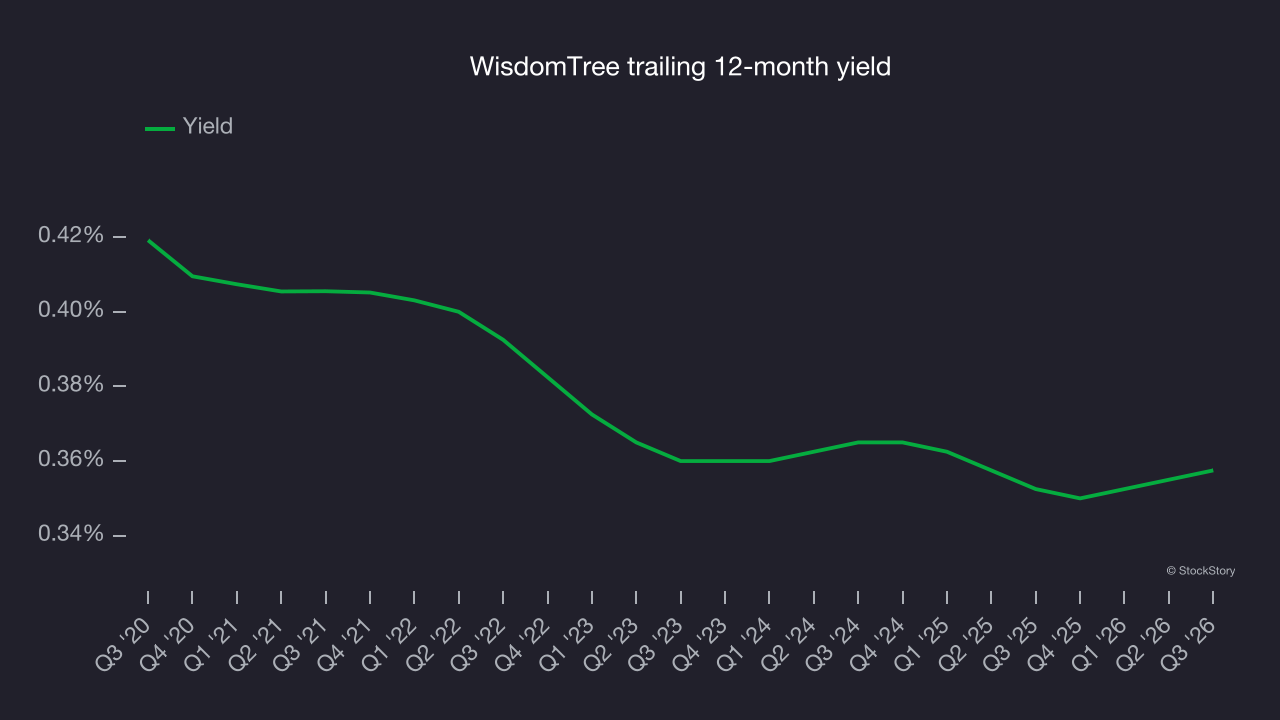
- Yield 0.4% vs analysts’ consensus estimates of 0.4% (in line)
- Revenue $179.4 million vs S&P analysts’ consensus estimates of $181.2 million (42.8% year-on-year growth, 1% miss)
- Pre-tax profit $64.48 million (35.9% margin)
- Adjusted EPS $0.32 vs S&P analysts’ consensus estimates of $0.30 (6.7% beat)
- Market capitalization $3.18 billion
“Our third quarter results reflect the continued strength and scalability of WisdomTree’s business, with record AUM of $171 billion, $4.6 billion of net inflows and meaningful contributions across our global platform. The breadth and consistency of our organic growth, coupled with expanding distribution capabilities and continued operating discipline, are driving significant operating leverage and margin expansion. As we deepen our presence in existing markets and capitalize on new opportunities across liquid alternatives, private markets and tokenization, we remain focused on executing our proven playbook: generating high-quality organic growth, scaling efficiently and translating that momentum into greater earnings power.”
Revenue growth
A company’s long-term revenue performance can indicate its overall quality. Even a bad business can perform well for one or two quarters, but a top-tier one grows for years. WisdomTree’s 17.9% annualized revenue growth over the last five years was impressive. Its growth surpassed that of the average financials company and shows its offerings resonate with customers.
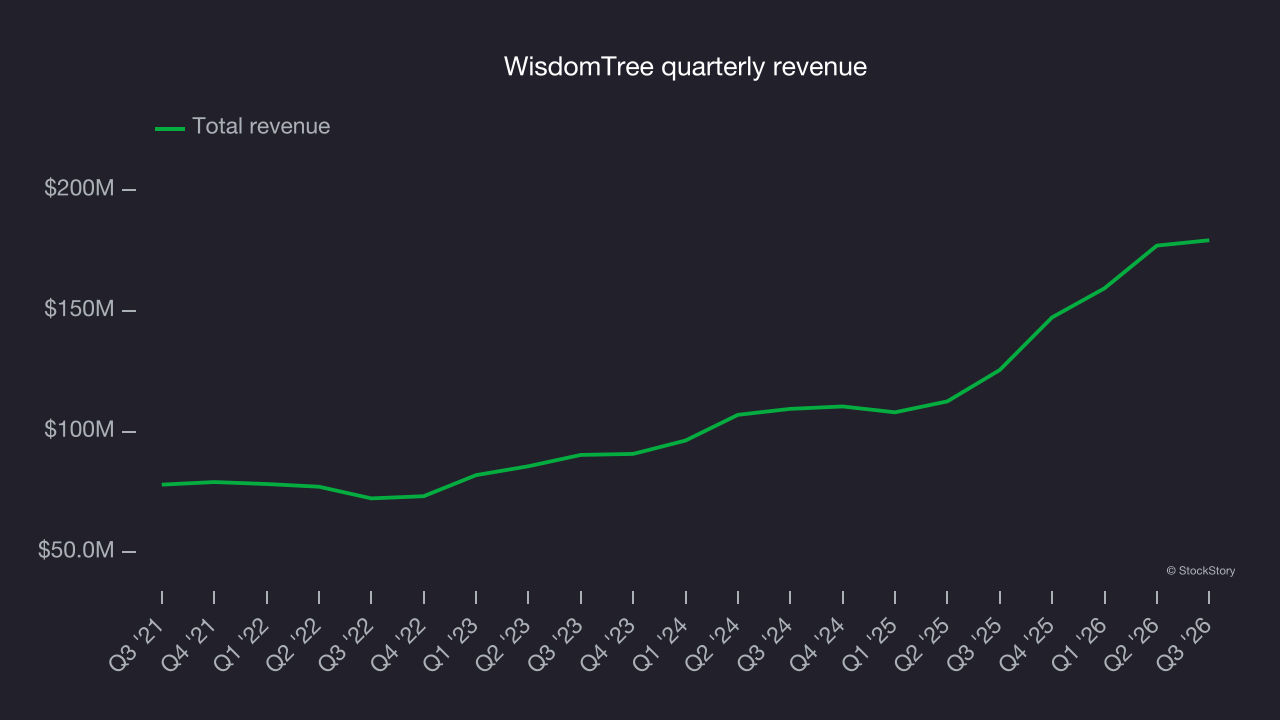
Long-term growth is the most important, but within financials, a half-decade historical view may miss recent interest rate changes and market returns. WisdomTree’s annualized revenue growth of 28.2% over the last two years is above its five-year trend, suggesting its demand was strong and recently accelerated. 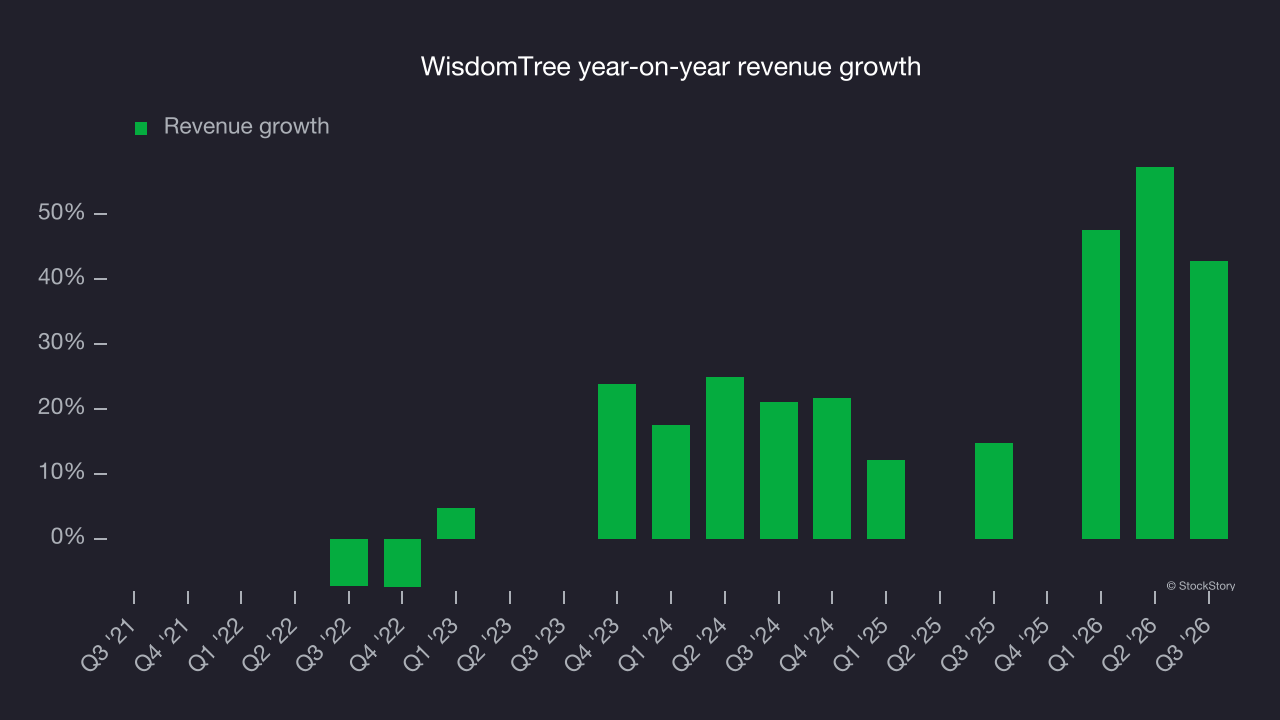 Note: Quarters not shown were determined to be outliers because they were impacted by outsized investment gains/losses that are not indicative of the recurring fundamentals of the business.
This quarter, WisdomTree’s revenue grew 42.8% year over year, but its $179.4 million in revenue fell short of Wall Street’s consensus estimates.
Assets under management (AUM)
Assets Under Management (AUM) encompasses all client funds under a firm’s investment management umbrella. The recurring fee structure on these assets provides consistent revenue generation, offering financial stability even during periods of poor investment returns, though sustained underperformance can impact future asset flows.
WisdomTree’s AUM has grown at an annual rate of 17.3% over the last five years, better than the broader financials industry but slower than its total revenue. AUM growth accelerated to 21.2% annually over the last two years. Fundraising or short-term investment performance was a net detractor to the company over this shorter period since assets grew slower than total revenue. Assets are worth watching but warrant limited emphasis because they fluctuate with the market.
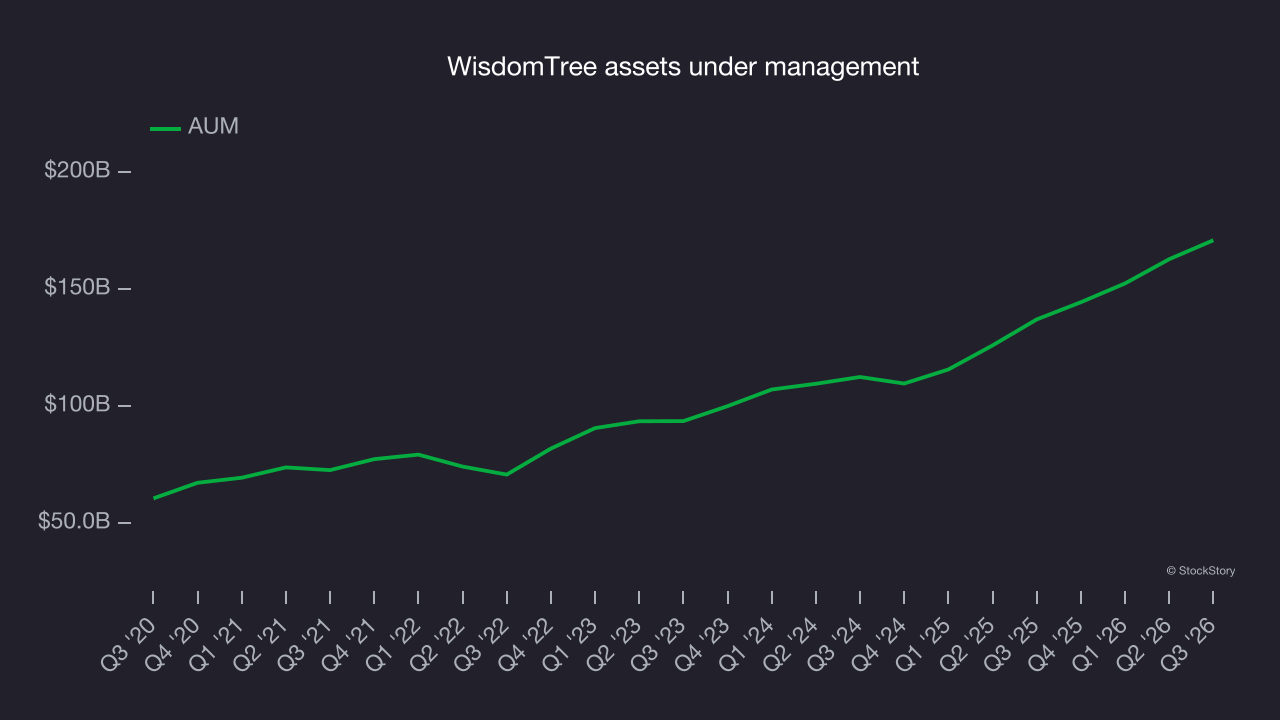
WisdomTree’s AUM reached $171 billion this quarter, meeting analysts’ consensus estimates. That was 24.7% higher than the same quarter last year.
Yield
The yield on financial assets demonstrates how effectively a firm converts its lending portfolio into interest income. This metric is fundamental for assessing an institution’s ability to generate returns while managing credit risk exposure.
WisdomTree’s yield might have fluctuated slightly, but it has generally held steady over the last five years and was 0% in the most recent quarter.
Key takeaways from WisdomTree’s Q3 results
WisdomTree’s quarter was mixed: Yield and EPS beat consensus estimates, but revenue fell slightly short. The market seemed to be hoping for more, with shares falling 2.3% to $21.07 immediately after the report.
The latest quarter is only one part of the longer-term business quality picture. Quality, combined with valuation, can help determine whether the stock is a buy. Read the full research report here (it’s free).