IT distributor Ingram Micro (NYSE: INGM) reported Q3 2026 results topping the market’s revenue expectations, with revenue up 20.8% year on year to $15.22 billion. On top of that, next quarter’s revenue guidance ($17.7 billion at the midpoint) was a surprising 11.9% above analysts’ consensus estimates. Its non-GAAP profit of $0.91 per share was 17.2% above analysts’ consensus estimates.
For more on Ingram Micro, read our free full research report.
Ingram Micro (INGM) Q3 2026 highlights:
- Revenue $15.22 billion vs S&P analysts’ consensus estimates of $13.88 billion (20.8% year-on-year growth, 9.7% beat)
- Adjusted EPS $0.91 vs S&P analysts’ consensus estimates of $0.78 (17.2% beat)
- Adjusted EBITDA $390.1 million vs analysts’ consensus estimates of $339.3 million (2.6% margin, 15% beat)
- Revenue guidance $17.7 billion at the midpoint for Q4 2026, above analysts’ consensus estimates of $15.82 billion
- Adjusted EPS guidance $1.10 at the midpoint for Q4 2026, above analysts’ consensus estimates of $1.06
- Operating margin 1.9%, in line with the same quarter last year
- Free cash flow $211.2 million, an increase from -$175 million in the same quarter last year
- Market capitalization $6.55 billion
“Our record third-quarter performance reflects the breadth and resilience of our business and continued execution against the strategy we outlined at our Capital Markets Day in September. We delivered broad-based growth across all four regions, and across our primary lines of business, while continuing to scale XvantageTM and advance our intelligent operating model," said Paul Bay, Ingram Micro’s chief executive officer. "The investments we are making in our platform, data and AI are enabling us to deepen customer engagement, improve productivity and increasingly turn intelligence into action. With our unmatched global scale, expanding platform capabilities and growing leadership in agentic commerce, we believe we are well positioned to capture the opportunities ahead and create long-term value for our shareholders.”
Revenue growth
A company’s long-term revenue performance can indicate its overall quality. Any business can experience short-term success, but top-performing ones sustain growth for years.
With $58.59 billion in revenue over the past 12 months, Ingram Micro is a major player in the business services sector and benefits from economies of scale, giving it an edge in distribution. This also gives it more leverage over fixed costs than smaller competitors and the flexibility to offer lower prices. However, its scale is a double-edged sword because it’s harder to find incremental growth after penetrating most of the market. To expand meaningfully, Ingram Micro likely needs to adjust its prices, innovate with new offerings or enter new markets.
Ingram Micro’s 1.2% annualized revenue growth over the last five years was sluggish, showing it failed to generate meaningful demand growth.
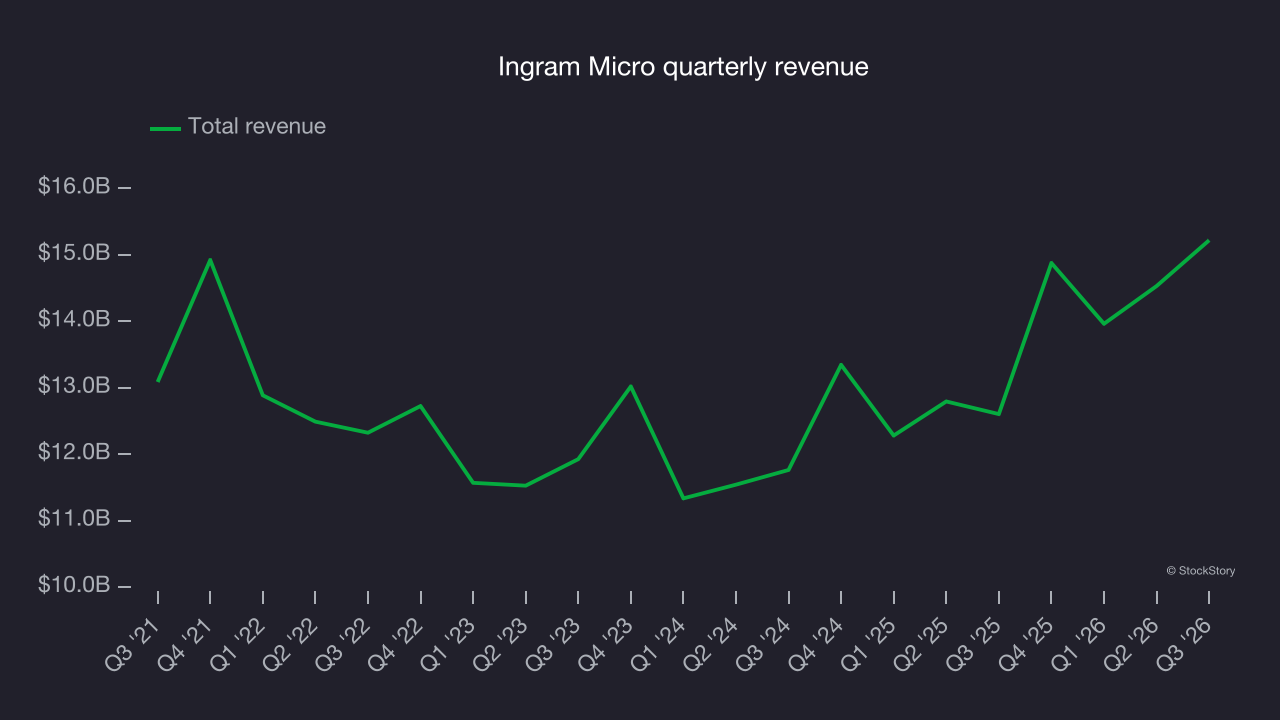
Long-term growth matters most, but within business services, a half-decade historical view may miss recent innovations or disruptive industry trends. Ingram Micro’s annualized revenue growth of 10.9% over the last two years is above its five-year trend, suggesting its demand recently accelerated. 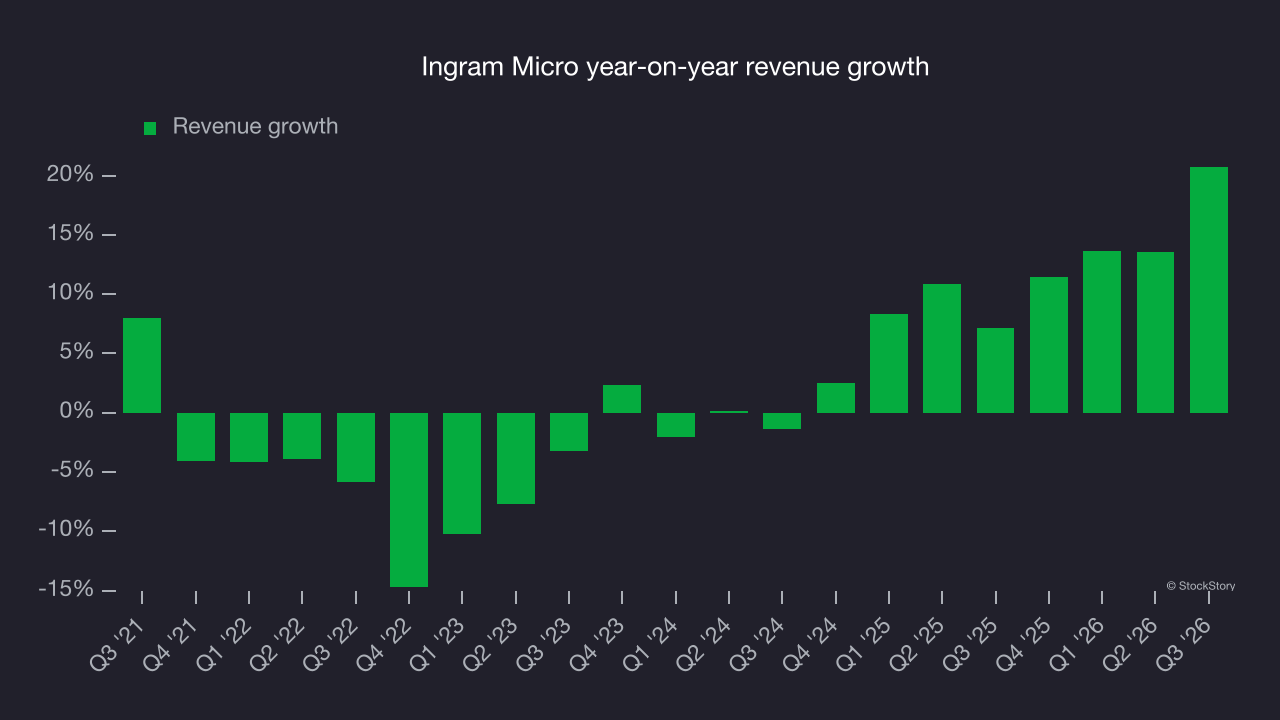
This quarter, Ingram Micro reported strong year-on-year revenue growth of 20.8%, and its $15.22 billion in revenue topped Wall Street’s consensus estimates by 9.7%. Company management is currently guiding for a 19% year-on-year increase in revenue next quarter.
Looking further ahead, sell-side analysts expect revenue to grow 1.6% over the next 12 months, according to S&P, a deceleration versus the last two years. This underwhelming projection suggests its products and services will face some demand challenges.
Adjusted operating margin
Ingram Micro’s adjusted operating margin has stayed roughly unchanged over the last 12 months, averaging 1.7% over the last five years. This profitability was inadequate for a business services company because of its suboptimal cost structure.
Looking at the trend in its profitability, Ingram Micro’s adjusted operating margin might have fluctuated slightly but has generally stayed the same over the last five years. This raises questions about the company’s expense base because its revenue growth should have given it leverage on its fixed costs, resulting in better economies of scale and profitability.
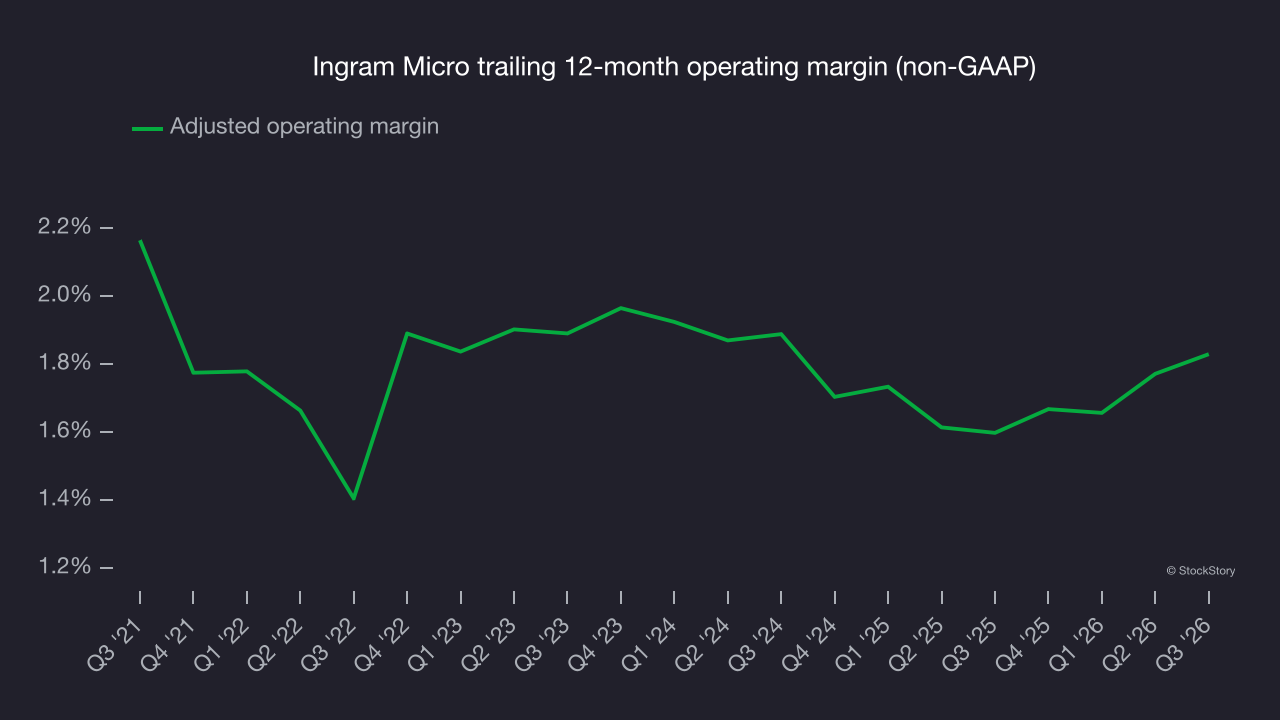
In Q3, Ingram Micro reported an adjusted operating margin of 2%, in line with the same quarter last year. This indicates the company’s overall cost structure has been relatively stable.
Free cash flow
Free cash flow isn’t a prominently featured metric in company financials and earnings releases, but it’s informative because it accounts for all operating and capital expenses, making it difficult to manipulate.
Ingram Micro broke even from a free cash flow perspective over the last five years, giving the company limited opportunities to return capital to shareholders.
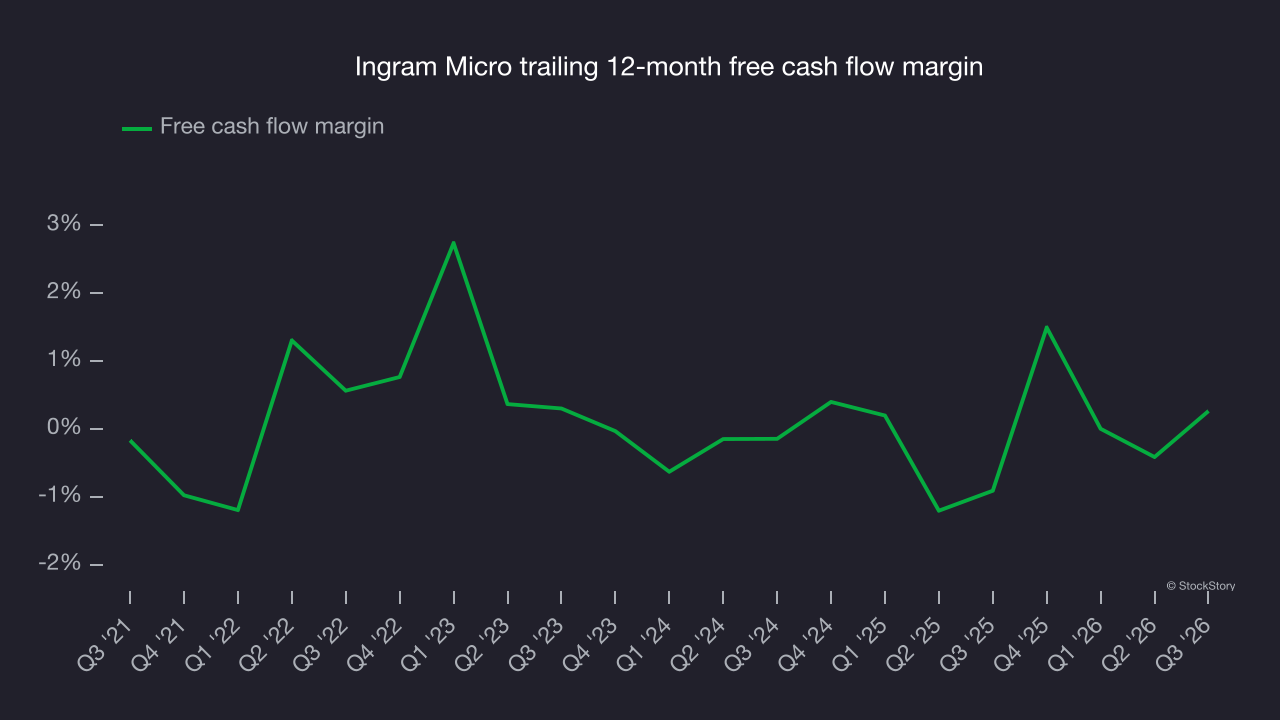
Ingram Micro’s free cash flow totaled $211.2 million in Q3, equivalent to a 1.4% margin. Its cash flow turned positive after being negative in the same quarter last year, but short-term results shouldn’t carry too much weight because investment needs can be seasonal, causing temporary swings. Long-term trends carry greater meaning.
Key takeaways from Ingram Micro’s Q3 results
A wide revenue beat helped make Ingram Micro’s third quarter a solid one, with EPS also topping analysts’ consensus estimates. Shares remained flat at $28.75 immediately after the results.
Ingram Micro had a solid quarter, but one earnings result doesn’t necessarily make the stock a buy. When deciding whether to invest, consider its valuation, business quality and what happened in the latest quarter. For more on those factors, read our full research report here (it’s free).