Chocolate company Hershey (NYSE: HSY) reported Q3 2026 results exceeding the market’s revenue expectations, with revenue up 3% year on year to $3.28 billion. Its non-GAAP profit of $2.64 per share was 25.1% above analysts’ consensus estimates.
For more on Hershey, read our free full research report.
Hershey (HSY) Q3 2026 highlights:
- Revenue $3.28 billion vs S&P analysts’ consensus estimates of $3.25 billion (3% year-on-year growth, 0.8% beat)
- Adjusted EPS $2.64 vs S&P analysts’ consensus estimates of $2.11 (25.1% beat)
- Adjusted EPS guidance Management raised its full-year adjusted EPS guidance to $8.66 at the midpoint, a 2.6% increase
- Operating margin 25%, up from 13.7% in the same quarter last year
- Organic revenue was flat year on year (beat)
- Market capitalization $32.91 billion
"Our third-quarter results show steady progress on our 2026 priorities," said Kirk Tanner, The Hershey Company President and Chief Executive Officer. "Our second-half demand creation initiatives are gaining momentum, even as consumers grow more cautious. We remain on track to deliver solid sales growth, a meaningful recovery in margin and earnings, and disciplined investment to fuel our next chapter of growth."
Revenue growth
A company’s long-term performance is an indicator of its overall quality. Any business can experience short-term success, but top-performing ones enjoy sustained growth for years.
With $12.26 billion in revenue over the past 12 months, Hershey is one of the larger consumer staples companies and benefits from a well-known brand that influences purchasing decisions. However, its scale is a double-edged sword because there are only so many big store chains to sell into, making it harder to find incremental growth. To accelerate revenue growth, Hershey likely needs to optimize its pricing or focus on new products and international expansion.
Hershey’s 3.2% annualized revenue growth over the last three years was sluggish, but on the positive side, consumers bought more of its products.
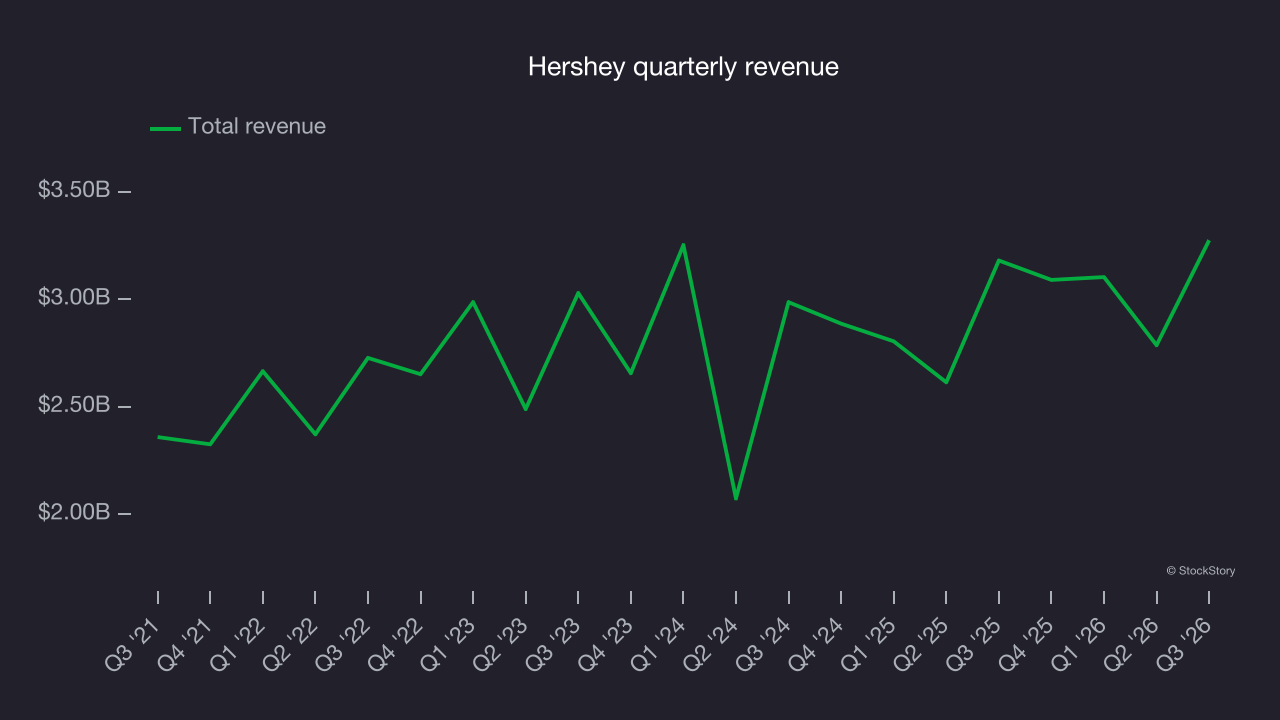
This quarter, Hershey reported modest year-on-year revenue growth of 3% but beat Wall Street’s consensus estimates by 0.8%.
Looking ahead, sell-side analysts expect revenue to grow 2% over the next 12 months, according to S&P, similar to its three-year rate. This projection is uninspiring and suggests its products will see some demand headwinds. Still, the company is performing well on other measures of financial health.
Organic revenue growth
When analyzing revenue growth, the most important measure is organic revenue growth. This metric captures a business’s performance excluding one-time events such as mergers, acquisitions and divestitures as well as foreign currency fluctuations.
Hershey has generated solid demand for its products over the last two years. On average, the company’s organic revenue has grown by 5.8% year on year. 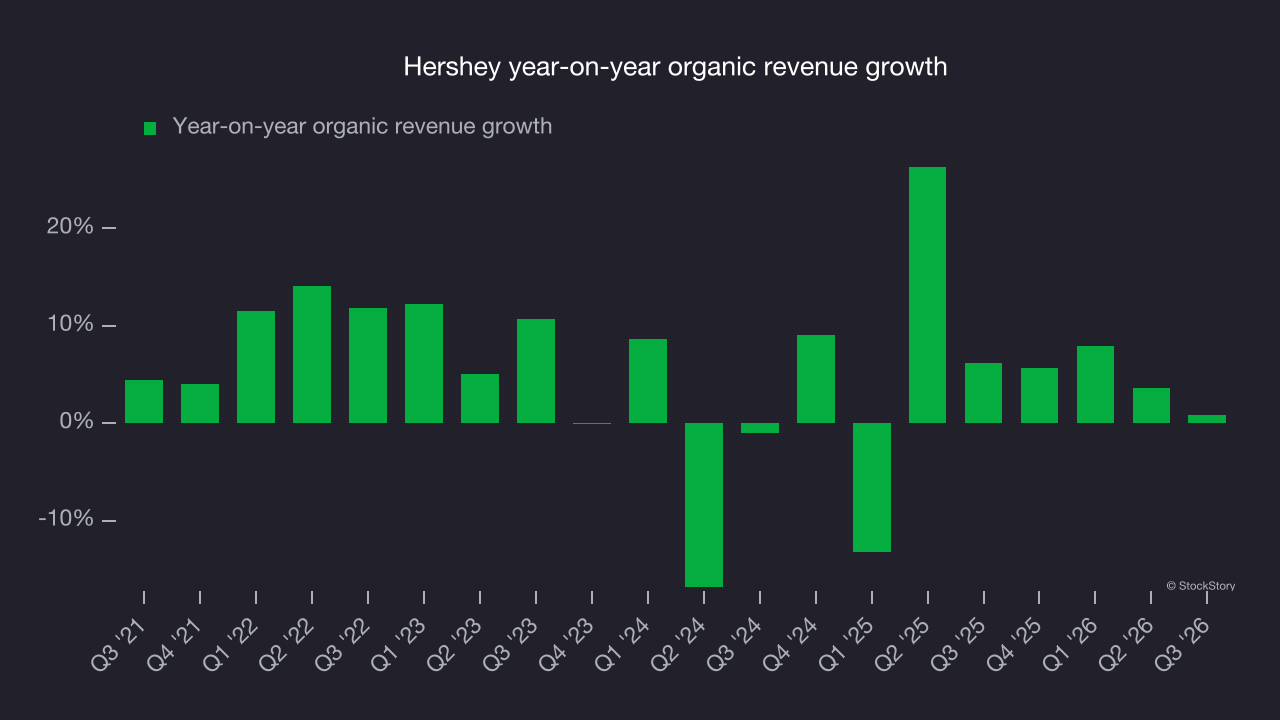
In the latest quarter, Hershey’s organic revenue was flat year on year. This was a meaningful deceleration from its historical levels. The question now is whether Hershey can reaccelerate growth.
Key takeaways from Hershey’s Q3 results
Hershey’s gross margin beat analysts’ consensus estimates by a wide margin, and EPS also topped Wall Street’s expectations, giving its Q3 results some key positives. Investors were likely hoping for more, however: Shares fell 3.4% to $158.15 immediately after the results.
The latest quarter matters when deciding whether to buy the stock, but longer-term fundamentals and valuation matter much more. Read our full research report here (it’s free).