Casual restaurant chain Brinker International (NYSE: EAT) reported calendar Q3 2026 (fiscal Q1 2027) results exceeding the market’s revenue expectations, with revenue up 9.4% year on year to $1.48 billion. The company expects the full year’s revenue to be around $6.28 billion, close to analysts’ consensus estimates. Its non-GAAP profit of $2.77 per share was 13.2% above analysts’ consensus estimates.
For more on Brinker International, read our full research report for free.
Brinker International (EAT) Q3 CY2026 highlights:
- Revenue $1.48 billion vs S&P analysts’ consensus estimates of $1.46 billion (9.4% year-on-year growth, 1.2% beat)
- Adjusted EPS $2.77 vs S&P analysts’ consensus estimates of $2.45 (13.2% beat)
- Adjusted EBITDA $209.1 million vs analysts’ consensus estimates of $195.1 million (14.2% margin, 7.2% beat)
- Revenue guidance The company lifted its revenue guidance for the full year to $6.28 billion at the midpoint from $6.21 billion, a 1.1% increase
- Adjusted EPS guidance Management raised its full-year adjusted EPS guidance to $13.60 at the midpoint, a 4.6% increase
- Operating margin 10.2%, up from 8.7% in the same quarter last year
- Free cash flow margin 7.2%, up from 4.6% in the same quarter last year
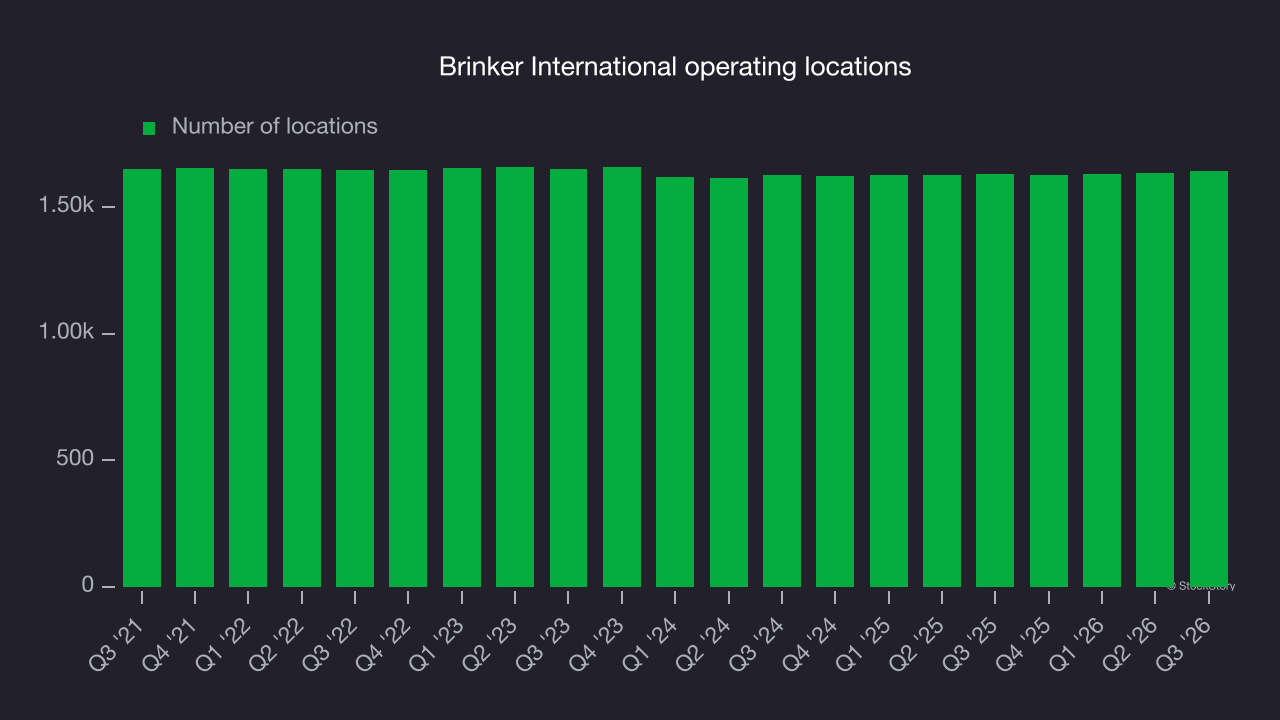
- Locations 1,641 at quarter end, up from 1,630 in the same quarter last year
- Same-store sales rose 8.9% year on year (18.9% in the same quarter last year)
- Market capitalization $8.22 billion
"Chili's delivered its 22nd consecutive quarter of same-store sales growth, up +10%, lapping a +21% from last year and a +14% from 2024 for a 3 year cumulative comp of +52%," said Kevin Hochman, President and CEO of Brinker International. "The Chili's flywheel of sustainable growth and market share gains keeps spinning, with industry leading value, world class marketing, and continued investments in operations that both attract new guests and keep regular guests coming back."
Revenue growth
A company’s long-term performance is an indicator of its overall quality. Any business can report a good quarter or two, but many enduring ones grow for years.
With $5.93 billion in revenue over the past 12 months, Brinker International is one of the larger restaurant chains in the industry and benefits from a well-known brand that influences consumer purchasing decisions.
Brinker International grew its revenue at a decent 9% compounded annual growth rate over the last seven years despite not opening many new restaurants, implying that growth was driven by higher revenue at existing, established dining locations.
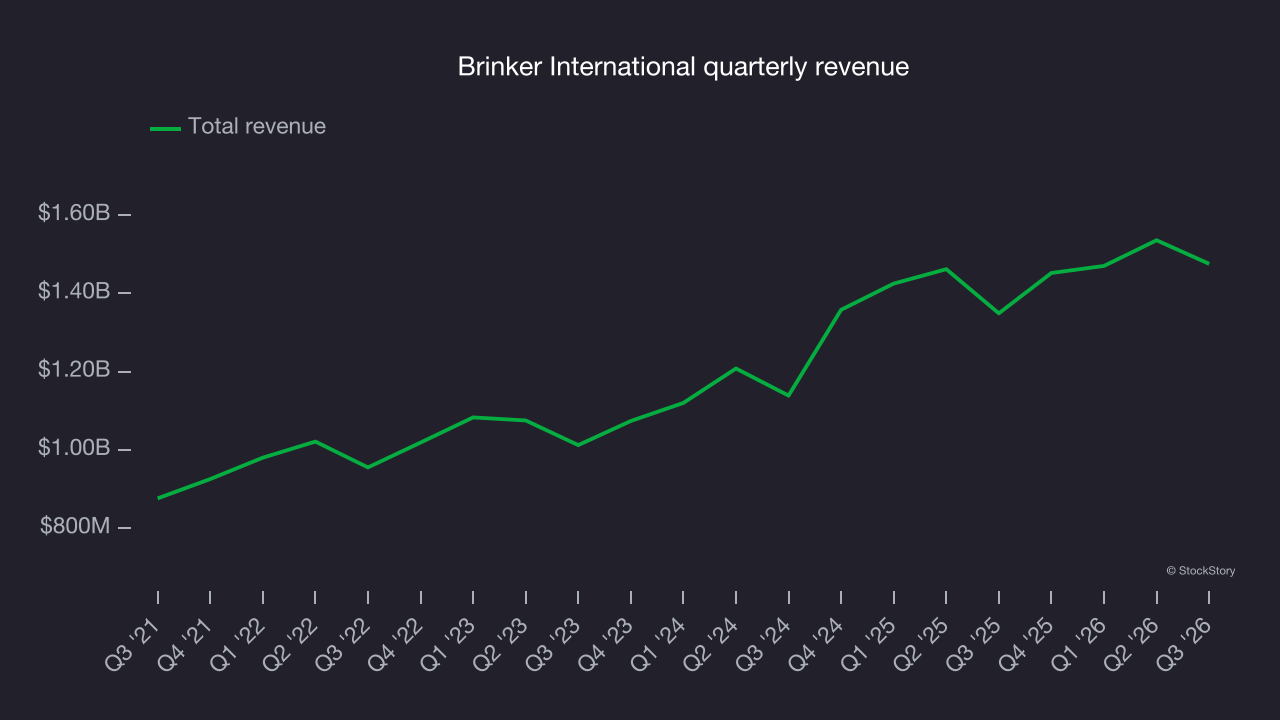
This quarter, Brinker International reported year-on-year revenue growth of 9.4%, and its $1.48 billion of revenue exceeded Wall Street’s consensus estimates by 1.2%.
Looking ahead, sell-side analysts expect revenue to grow 7.3% over the next 12 months, according to S&P, a slight deceleration versus the last seven years. Despite the slowdown, this projection is above the sector average and suggests the market expects some success from its newer menu offerings.
Restaurant performance
Number of restaurants
A restaurant chain’s total number of dining locations often determines how much revenue it can generate.
Brinker International operated 1,641 locations in the latest quarter, and over the last two years, has kept its restaurant count flat while other restaurant businesses have opted for growth.
When a chain doesn’t open many new restaurants, it usually means there’s stable demand for its meals and it’s focused on improving operational efficiency to increase profitability.
Same-store sales
The change in a company’s restaurant base only tells one side of the story. The other is the performance of its existing locations, which informs management teams whether they should expand or downsize their physical footprints. Same-store sales is an industry measure of whether revenue is growing at those existing restaurants and is driven by customer visits (often called traffic) and the average spending per customer (ticket).
Brinker International has been one of the most successful restaurant chains over the last two years thanks to strong demand at its existing dining locations. On average, the company has posted year-on-year same-store sales growth of 14.2%. Given its flat restaurant base over the same period, this performance stems from a mixture of higher prices and increased foot traffic at existing locations.
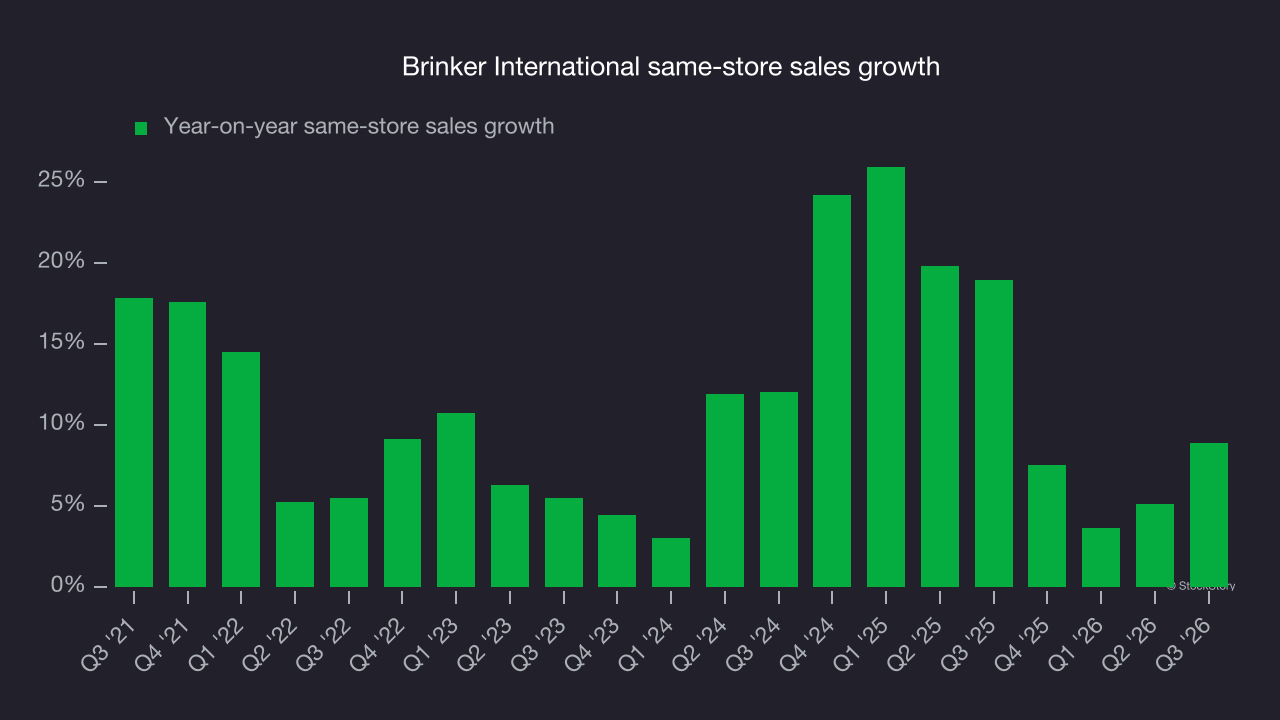
In the latest quarter, Brinker International’s same-store sales rose 8.9% year on year. This growth was a deceleration from its historical levels, showing the business is still performing well but its growth is slowing.
Key takeaways from Brinker International’s Q3 results
Brinker International’s same-store sales came in well ahead of analysts’ consensus estimates, and EBITDA also topped Wall Street’s expectations, making for a solid quarter with clear positives. Shares rose 3.4% to $203.51 immediately after the results.
Brinker International had a solid quarter, but does the bigger picture support buying the stock? To make that decision, consider valuation and business quality alongside the latest earnings. For more on Brinker International, read the full research report here (it’s free).