Pest control company Rollins (NYSE: ROL) missed Wall Street’s revenue expectations in Q3 2026, but sales rose 6.2% year on year to $1.09 billion. Its non-GAAP profit of $0.34 per share was in line with analysts’ consensus estimates.
Is now the time to buy Rollins? Find out by accessing our full research report, it’s free.
Rollins (ROL) Q3 2026 highlights:
- Revenue: $1.09 billion vs analyst estimates of $1.11 billion (6.2% year-on-year growth, 1.7% miss)
- Adjusted EPS: $0.34 vs analyst estimates of $0.34 (in line)
- Adjusted EBITDA: $256.6 million vs analyst estimates of $260.3 million (23.5% margin, 1.4% miss)
- Operating Margin: 20.5%, down from 21.9% in the same quarter last year
- Free Cash Flow Margin: 21.6%, up from 17.8% in the same quarter last year
- Organic Revenue rose 4.4% year on year (miss)
- Market Capitalization: $16.04 billion
"We are disappointed with our third quarter performance and are acting with urgency to address the challenges impacting our results. We now have a clearer understanding of how the customer acquisition landscape is evolving and are taking concrete steps to optimize our approach. This remains a dynamic environment that requires us to continually assess and adapt how we reach and win new customers. At the same time, our record of 100 consecutive quarters of revenue growth reflects the durability of our business and our ability to successfully adapt through changing conditions. With recurring customer relationships, a diversified portfolio and the underlying resilience of the pest control market, we remain confident in our ability to deliver sustainable, profitable growth over the long term," said Jerry Gahlhoff, Jr., President and Chief Executive Officer.
Company overview
Operating under multiple brands like Orkin and HomeTeam Pest Defense, Rollins (NYSE: ROL) provides pest and wildlife control services to residential and commercial customers.
Revenue growth
A company’s long-term sales performance can indicate its overall quality. Any business can put up a good quarter or two, but many enduring ones grow for years. Over the last five years, Rollins grew its sales at an impressive 11.1% compounded annual growth rate. Its growth beat the average industrials company and shows its offerings resonate with customers, a helpful starting point for our analysis.
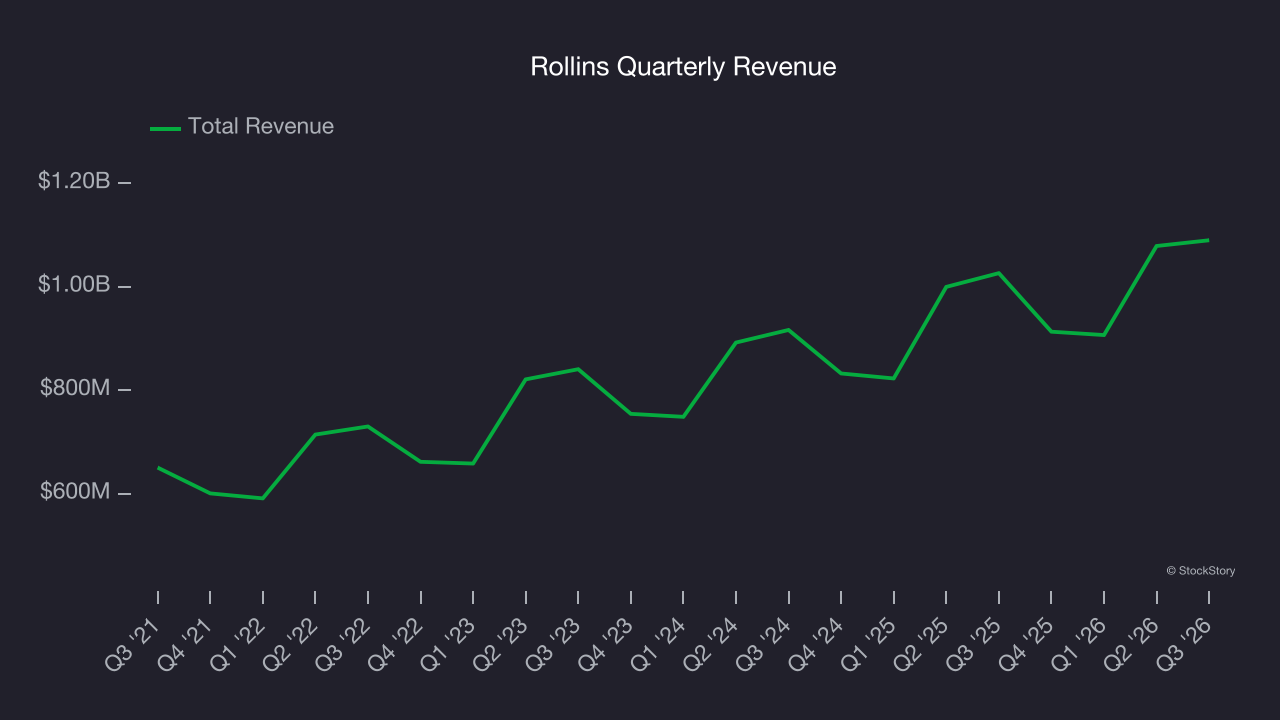
We at StockStory place the most emphasis on long-term growth, but within industrials, a half-decade historical view may miss cycles, industry trends, or a company capitalizing on catalysts such as a new contract win or a successful product line. Rollins’s annualized revenue growth of 9.7% over the last two years is below its five-year trend, but we still think the results suggest healthy demand. 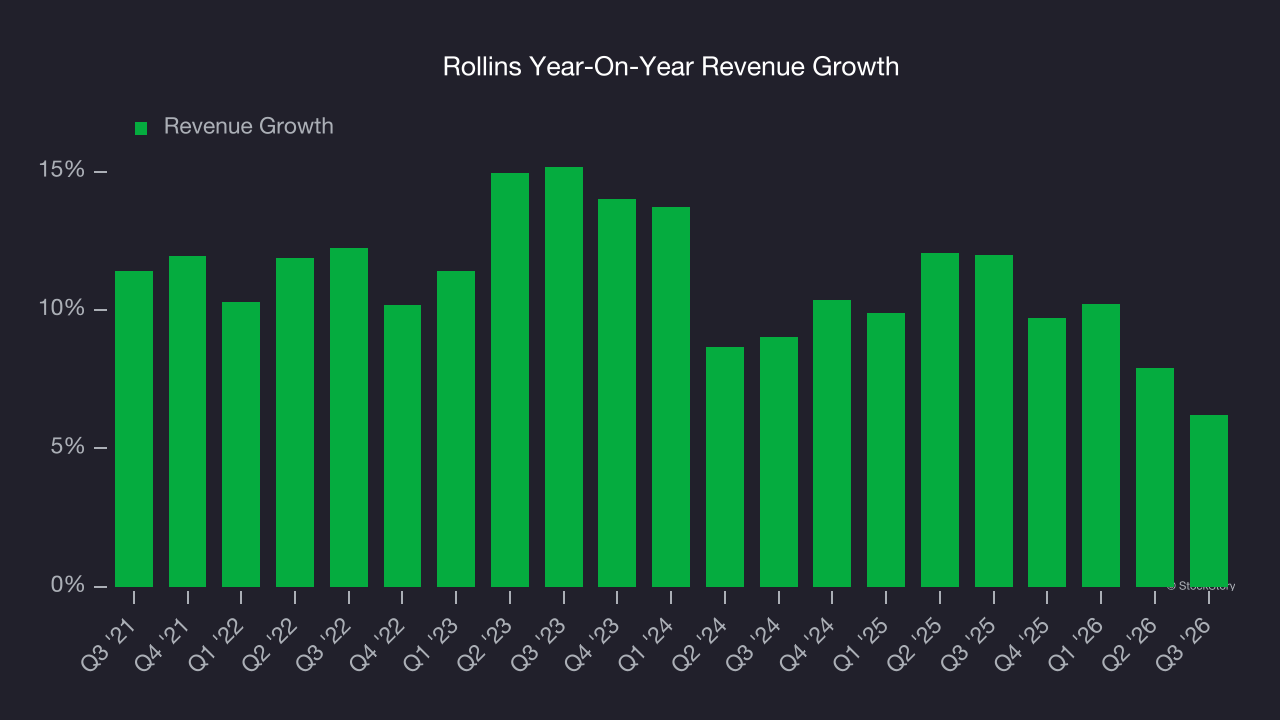
Rollins also reports organic revenue, which strips out one-time events like acquisitions and currency fluctuations that don’t accurately reflect its fundamentals. Over the last two years, Rollins’s organic revenue averaged 6.6% year-on-year growth. Because this number is lower than its two-year revenue growth, we can see that some mixture of acquisitions and foreign exchange rates boosted its headline results. 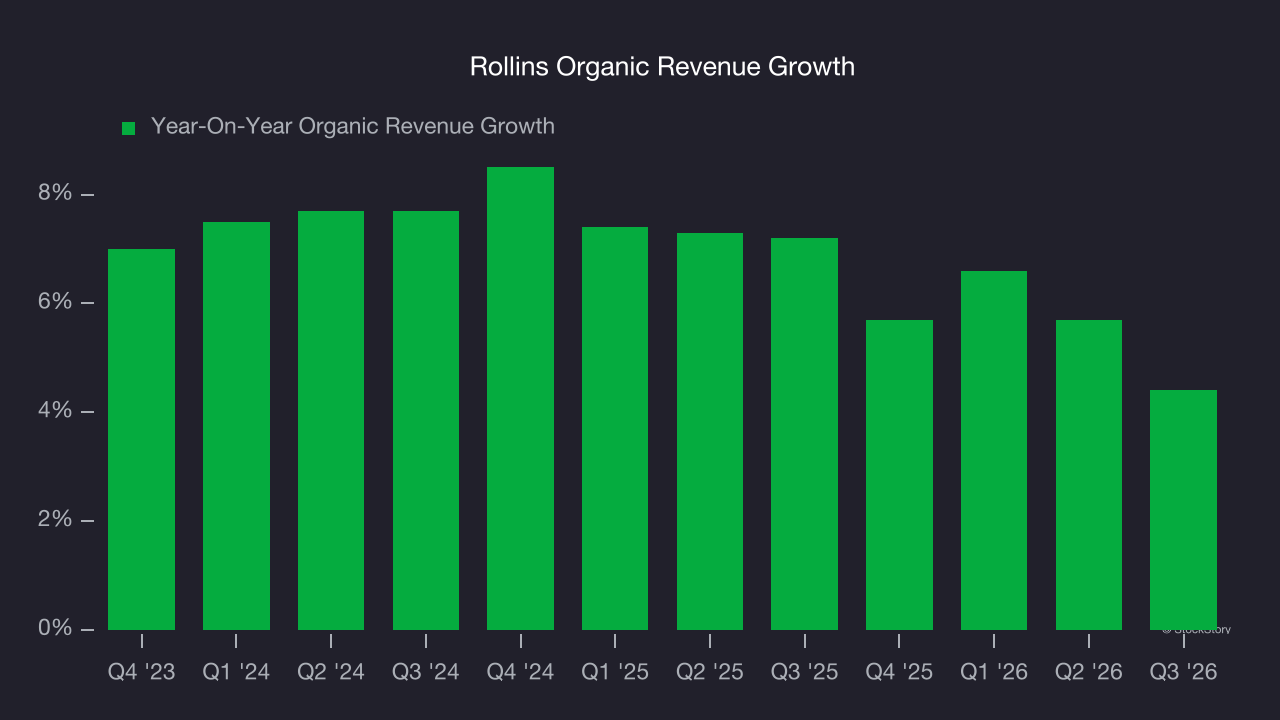
This quarter, Rollins’s revenue grew by 6.2% year on year to $1.09 billion, missing Wall Street’s estimates.
Looking ahead, sell-side analysts expect revenue to grow 9.1% over the next 12 months, similar to its two-year rate. This projection is admirable and indicates the market sees success for its products and services.
ONE MORE THING: 3 Hidden Platforms Growing 3X Faster than Amazon, Google, and PayPal. Amazon, Google, and Meta all followed the same playbook: Dominate an ignored market. Build an unbeatable moat. Scale until you’re unstoppable.
These three platforms are running that exact playbook right now. The early investors in Amazon made fortunes. The early investors in these could do the same. Get All 3 Stocks Here for FREE.
Operating margin
Rollins’s operating margin has generally stayed the same over the last 12 months, averaging 18.9% over the last five years. This profitability was elite for an industrials business thanks to its efficient cost structure and economies of scale. This is seen in its fast historical revenue growth and healthy gross margin, which is why we look at all three data points together.
Looking at the trend in its profitability, Rollins’s operating margin might have fluctuated slightly but has generally stayed the same over the last five years. This raises questions about the company’s expense base because its revenue growth should have given it leverage on its fixed costs, resulting in better economies of scale and profitability.
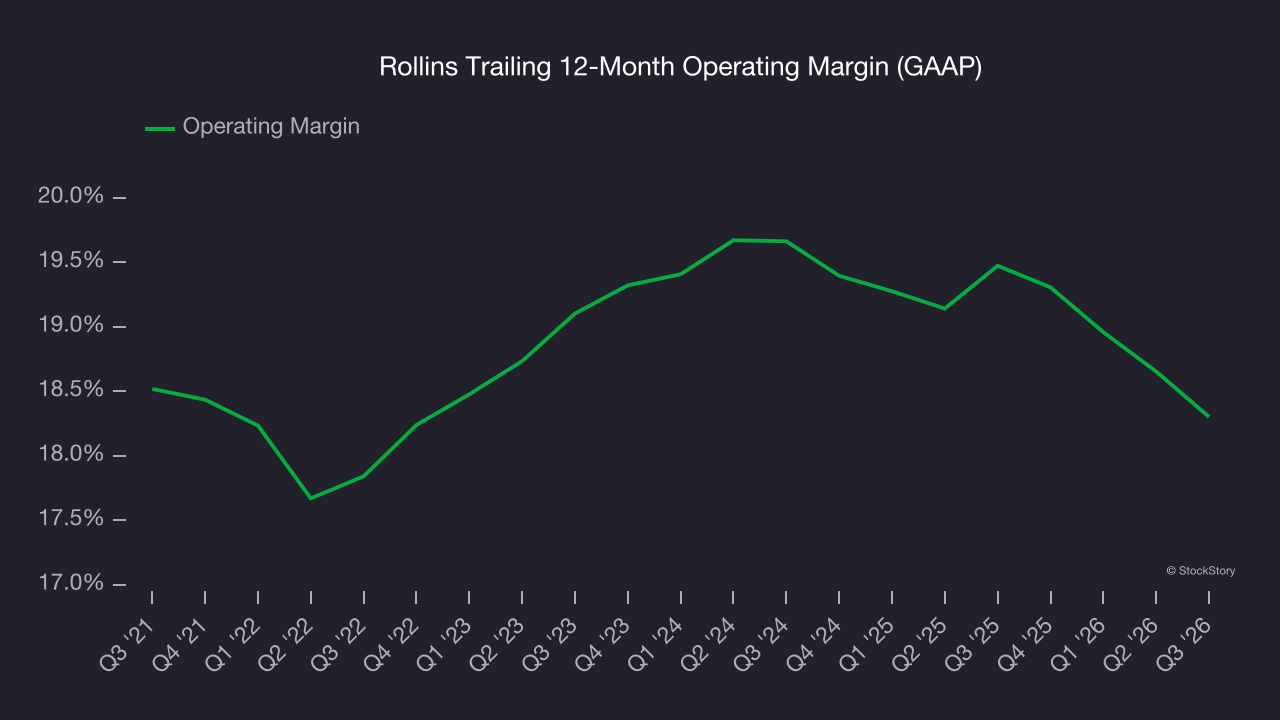
This quarter, Rollins generated an operating margin profit margin of 20.5%, down 1.5 percentage points year on year. Since Rollins’s operating margin decreased more than its gross margin, we can assume it was less efficient because expenses such as marketing, R&D, and administrative overhead increased.
Earnings per share
Revenue trends explain a company’s historical growth, but the long-term change in earnings per share (EPS) points to the profitability of that growth — for example, a company could inflate its sales through excessive spending on advertising and promotions.
Rollins’s solid 11.7% annual EPS growth over the last five years aligns with its revenue performance. This tells us it maintained its per-share profitability as it expanded.
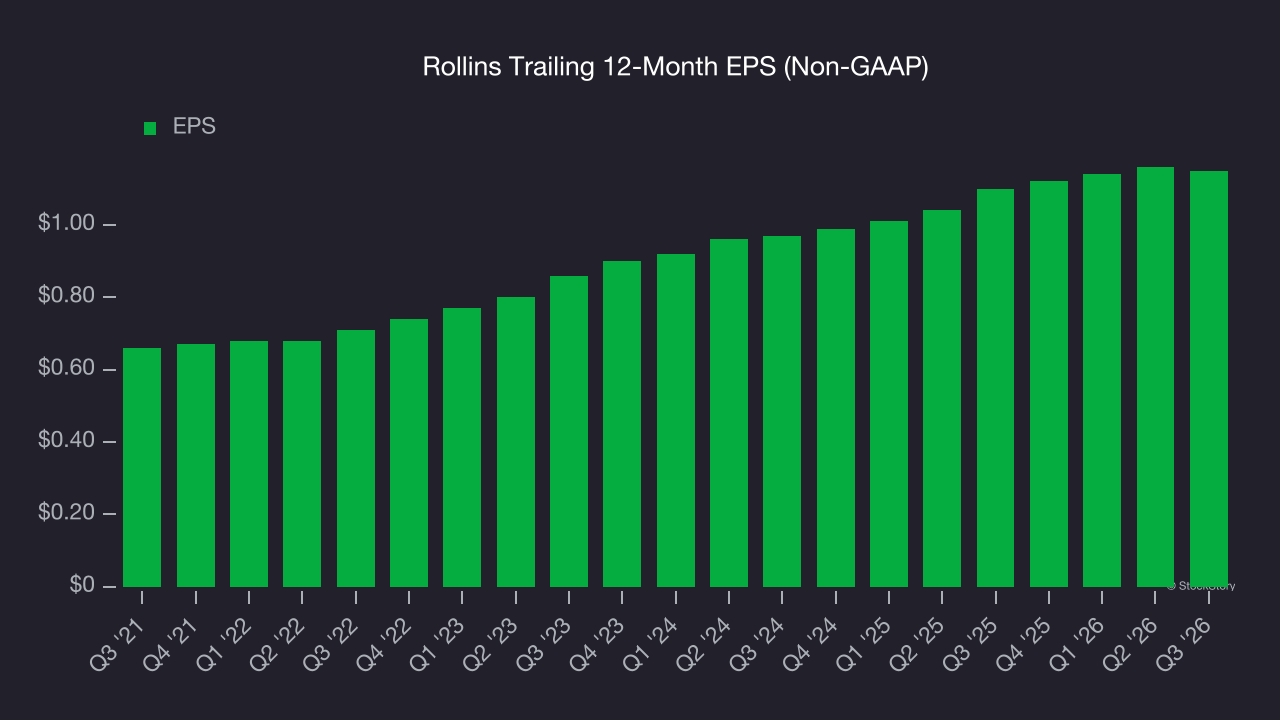
Like with revenue, we analyze EPS over a shorter period to see if we are missing a change in the business.
For Rollins, its two-year annual EPS growth of 8.9% was lower than its five-year trend. This wasn’t great, but at least the company was successful in other measures of financial health.
In Q3, Rollins reported adjusted EPS of $0.34, in line with the same quarter last year. This print slightly missed analysts’ estimates, but we care more about long-term adjusted EPS growth than short-term movements. Over the next 12 months, Wall Street expects Rollins’s full-year EPS to grow 7.8% from $1.15 to $1.24.
Key takeaways from Rollins’s Q3 results
We struggled to find many positives in these results. Its revenue missed and its organic revenue fell slightly short of Wall Street’s estimates. Overall, this quarter could have been better. The stock traded down 5.1% to $31.75 immediately following the results.
Rollins didn’t show its best hand this quarter, but does that create an opportunity to buy the stock right now? When making that decision, it’s important to consider its valuation, business qualities, as well as what has happened in the latest quarter. We cover that in our actionable full research report which you can read here (it’s free).