Regional banking company First Merchants (NASDAQ: FRME) missed Wall Street’s revenue expectations in Q3 2026, but sales rose 15.5% year on year to $199.1 million. Its non-GAAP profit of $1.10 per share was 5.4% above analysts’ consensus estimates.
Is now the time to buy First Merchants? Find out by accessing our full research report, it’s free.
First Merchants (FRME) Q3 2026 highlights:
- Net Interest Income: $161.1 million vs analyst estimates of $165.5 million (20.5% year-on-year growth, 2.7% miss)
- Net Interest Margin: 3.4% vs analyst estimates of 3.4% (5.2 basis point beat)
- Revenue: $199.1 million vs analyst estimates of $203.9 million (15.5% year-on-year growth, 2.3% miss)
- Efficiency Ratio: 54.6% vs analyst estimates of 54.9% (31 basis point beat)
- Adjusted EPS: $1.10 vs analyst estimates of $1.04 (5.4% beat)
- Tangible Book Value per Share: $28.86 vs analyst estimates of $30.15 (flat year on year, 4.3% miss)
- Market Capitalization: $2.52 billion
"First Merchants delivered strong third quarter results. Earnings per diluted share were $1.09, up 11 percent from the third quarter of last year, fully taxable equivalent net interest margin1 rose 6 basis points to 3.44 percent, and deposit growth was solid," said Mark Hardwick, Chief Executive Officer. "We made meaningful progress resolving the two commercial credits identified last quarter, and nonperforming assets remained stable. Our capital position remains very strong and we continue to return capital to shareholders through dividends and share repurchases."
Company overview
Dating back to 1893 when it first opened its doors in Indiana, First Merchants (NASDAQ: FRME) is a Midwest regional bank providing commercial, consumer, and wealth management services through branches in Indiana, Ohio, Michigan, and Illinois.
Sales growth
Two primary revenue streams drive bank earnings. While net interest income, which is earned by charging higher rates on loans than paid on deposits, forms the foundation, fee-based services across banking, credit, wealth management, and trading operations provide additional income. Unfortunately, First Merchants’s 7.7% annualized revenue growth over the last five years was tepid. This was below our standard for the banking sector and is a poor baseline for our analysis.
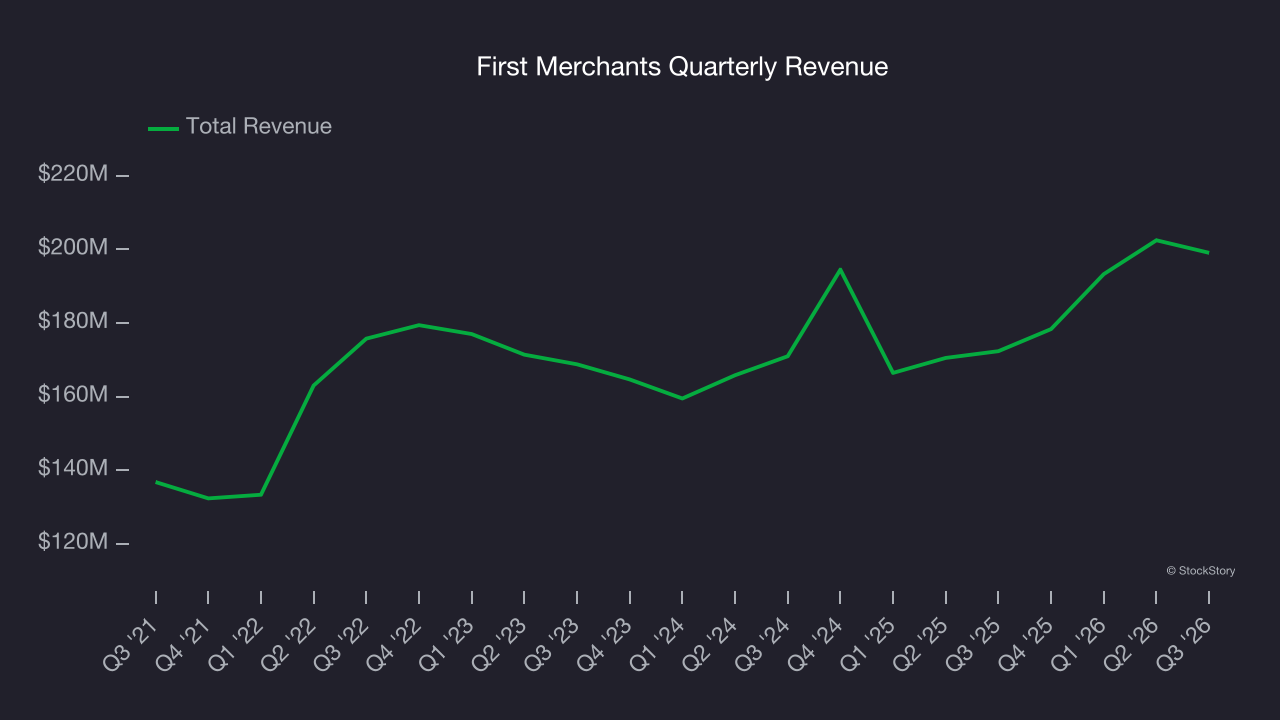
Long-term growth is the most important, but within financials, a half-decade historical view may miss recent interest rate changes and market returns. First Merchants’s annualized revenue growth of 8.2% over the last two years aligns with its five-year trend, suggesting its demand was consistently weak. 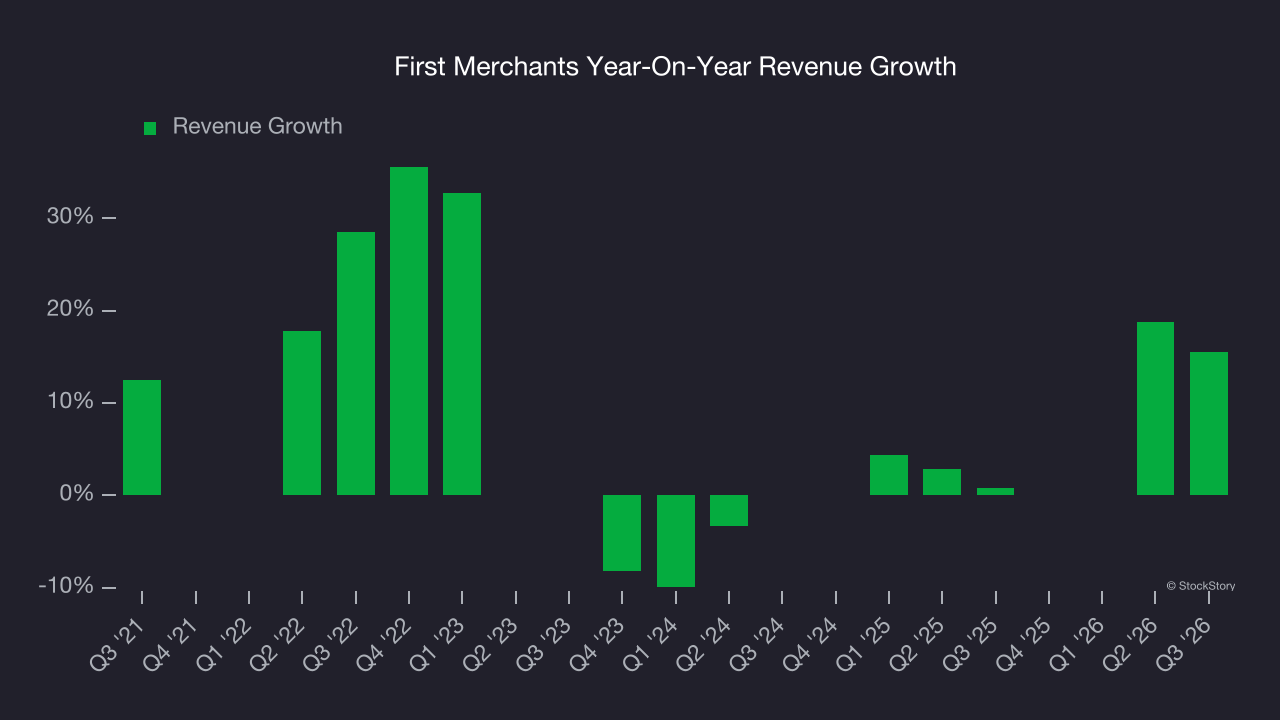 Note: Quarters not shown were determined to be outliers because they were impacted by outsized investment gains/losses that are not indicative of the recurring fundamentals of the business.
This quarter, First Merchants’s revenue grew by 15.5% year on year to $199.1 million but fell short of Wall Street’s estimates.
Net interest income made up 78.4% of the company’s total revenue during the last five years, meaning lending operations are First Merchants’s largest source of revenue.
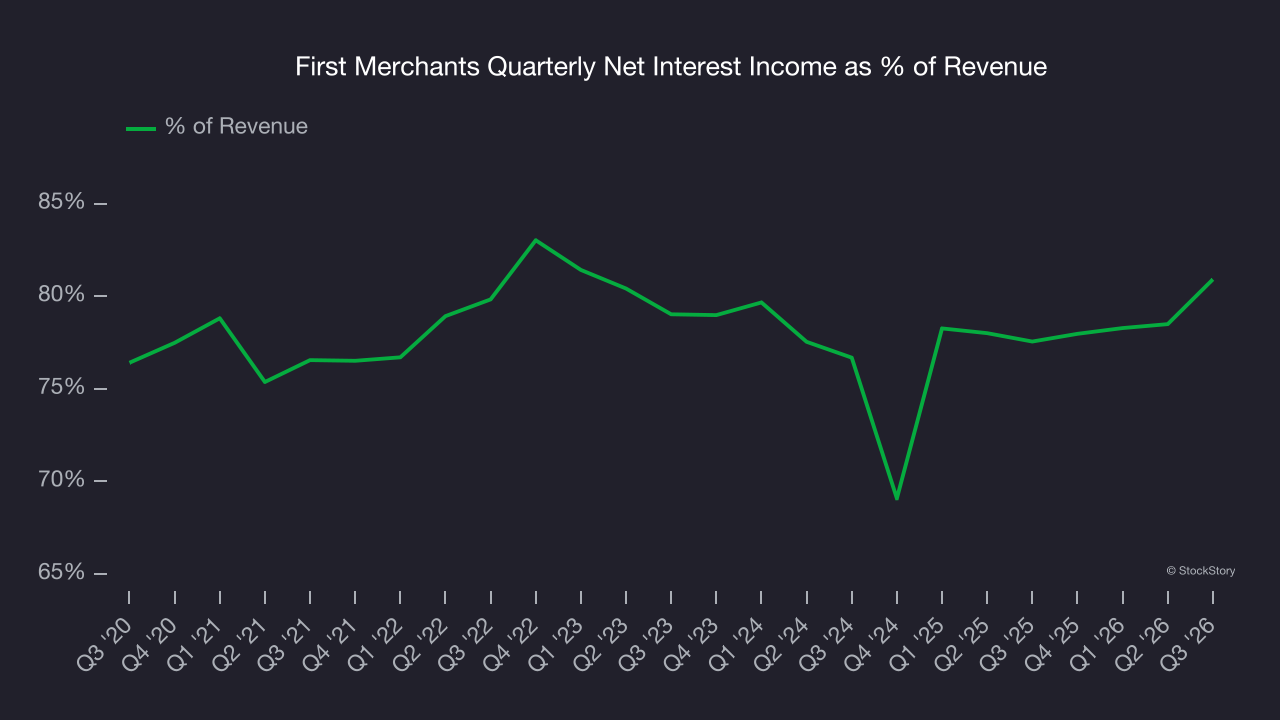
Markets consistently prioritize net interest income growth over fee-based revenue, recognizing its superior quality and recurring nature compared to the more unpredictable non-interest income streams.
WHILE YOU’RE HERE: The Next Palantir? One satellite company captures images of every point on Earth. Every single day. The Pentagon wants it. Hedge funds are using it to beat earnings. You’ve probably never heard of it.
This is what the early days of Palantir looked like before it became a giant. Same playbook. Different technology. If you missed Palantir, you need to see this. Claim The Stock Ticker for Free HERE.
Tangible book value per share (TBVPS)
Banks profit by intermediating between depositors and borrowers, making them fundamentally balance sheet-driven enterprises. Market participants emphasize balance sheet quality and sustained book value growth when evaluating these institutions.
When analyzing banks, tangible book value per share (TBVPS) takes precedence over many other metrics. This measure isolates genuine per-share value by removing intangible assets of debatable liquidation worth. On the other hand, EPS is often distorted by mergers and flexible loan loss accounting. TBVPS provides clearer performance insights.
First Merchants’s TBVPS grew at a tepid 3.6% annual clip over the last five years. The last two years show a similar trajectory as TBVPS grew by 4.2% annually from $26.56 to $28.86 per share.
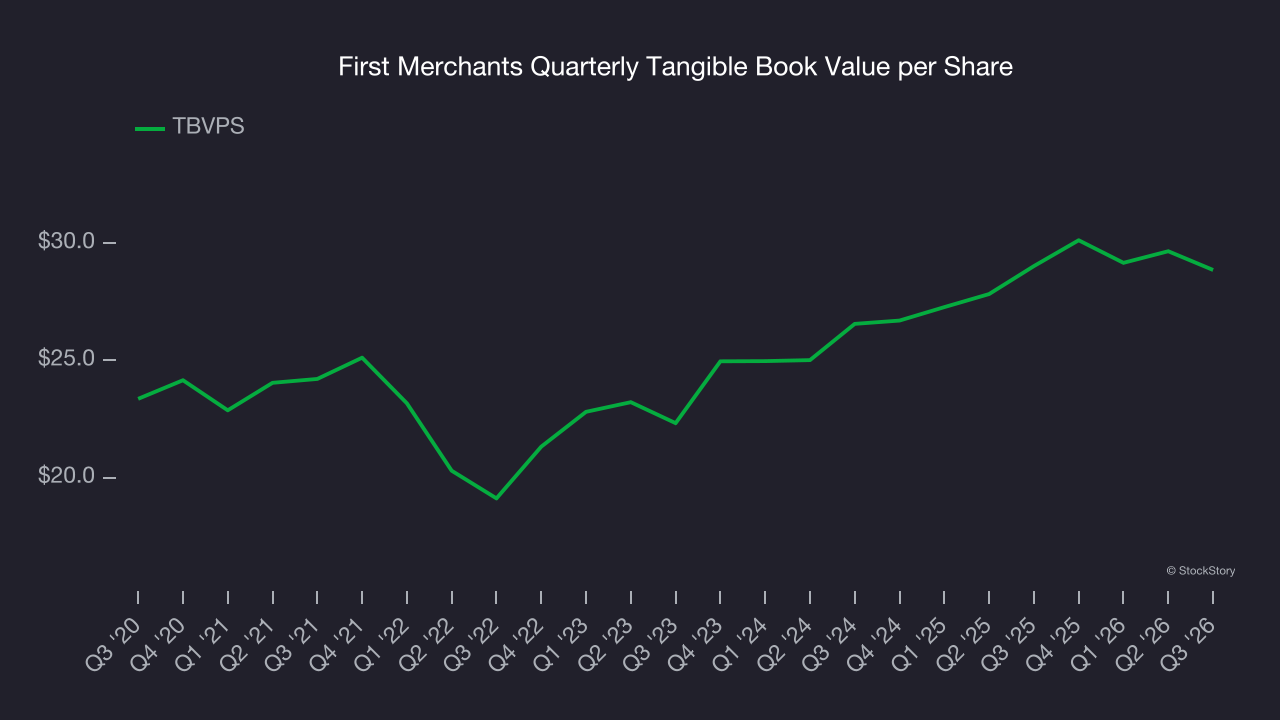
Over the next 12 months, Consensus estimates call for First Merchants’s TBVPS to grow by 14.1% to $32.92, decent growth rate.
Key takeaways from First Merchants’s Q3 results
We struggled to find many positives in these results. Its net interest income missed and its revenue fell short of Wall Street’s estimates. Overall, this quarter could have been better. The stock remained flat at $39.97 immediately after reporting.
Is First Merchants an attractive investment opportunity right now? When making that decision, it’s important to consider its valuation, business qualities, as well as what has happened in the latest quarter. We cover that in our actionable full research report which you can read here (it’s free).