Financial services company Capital One (NYSE: COF) reported Q3 2026 results exceeding the market’s revenue expectations, with sales up 5.7% year on year to $16.34 billion. Its non-GAAP profit of $6.69 per share was 21.6% above analysts’ consensus estimates.
Is now the time to buy Capital One? Find out by accessing our full research report, it’s free.
Capital One (COF) Q3 2026 Highlights:
- Net Interest Margin: 8.4% vs analyst estimates of 8.2% (18.1 basis point beat)
- Revenue: $16.34 billion vs analyst estimates of $16.26 billion (5.7% year-on-year growth, 0.5% beat)
- Efficiency Ratio: 54.2% vs analyst estimates of 53.2% (101.3 basis point miss)
- Adjusted EPS: $6.69 vs analyst estimates of $5.50 (21.6% beat)
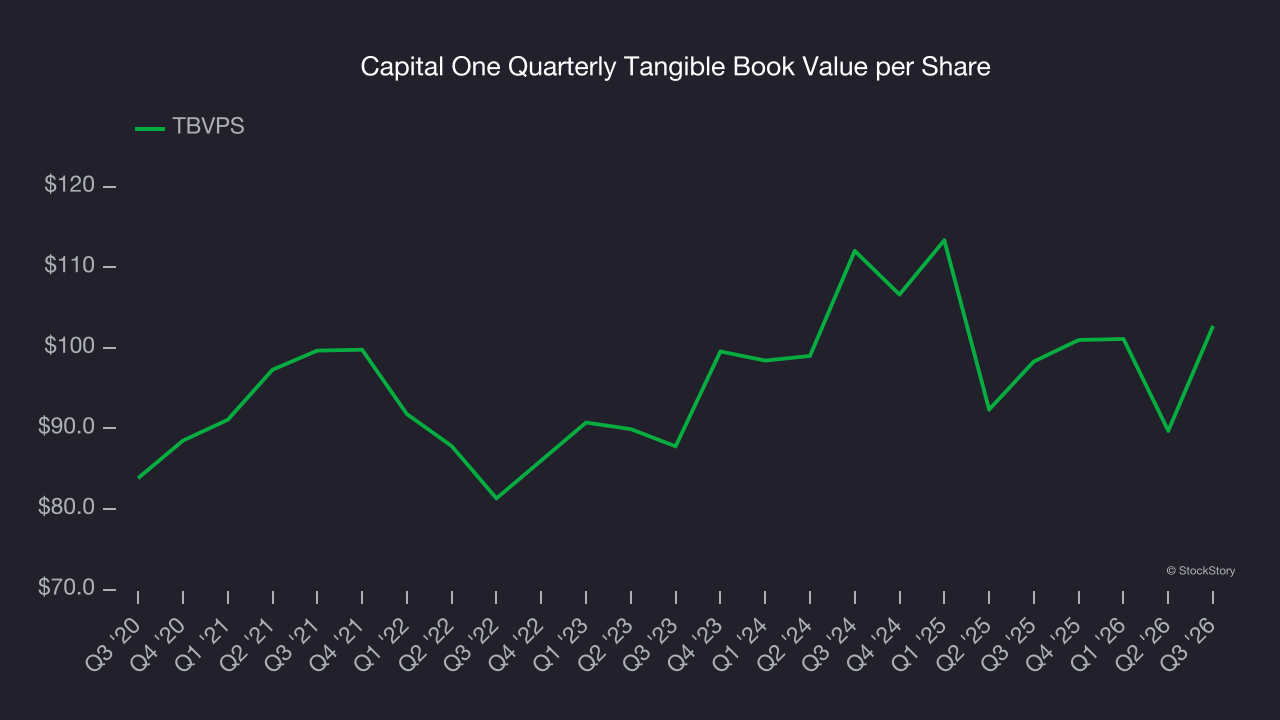
- Tangible Book Value per Share: $102.72 vs analyst estimates of $109.12 (5.9% miss)
- Market Capitalization: $122.6 billion
"The Discover integration continues to go well and we’re making good progress on delivering the expected synergies," said Richard D. Fairbank, Founder, Chairman, and Chief Executive Officer. "We continue to invest to deliver sustained growth and value creation over the long-term."
Company Overview
Starting as a credit card company in 1988 before expanding into a full-service bank, Capital One (NYSE: COF) is a financial services company that offers credit cards, auto loans, banking services, and commercial lending to consumers and businesses.
Revenue Growth
A company’s long-term sales performance can indicate its overall quality. Any business can experience short-term success, but top-performing ones enjoy sustained growth for years. Thankfully, Capital One’s 16.3% annualized revenue growth over the last five years was impressive. Its growth beat the average financials company and shows its offerings resonate with customers.
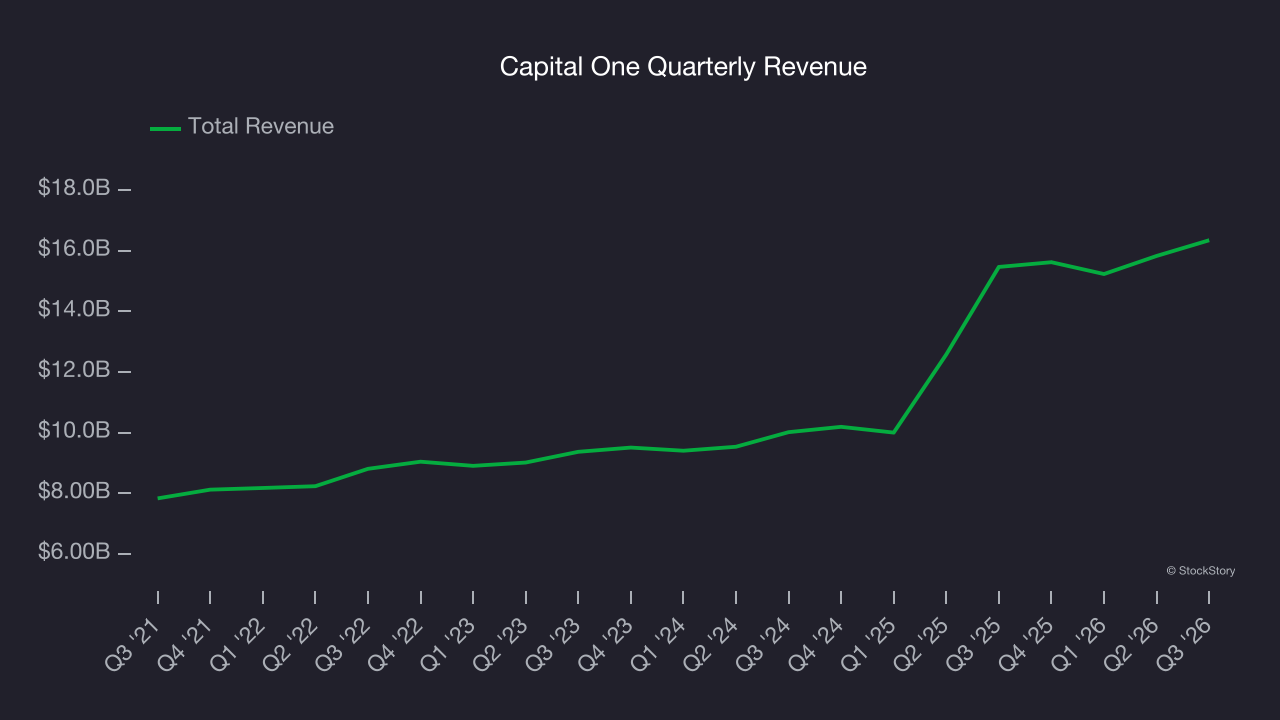
Long-term growth is the most important, but within financials, a half-decade historical view may miss recent interest rate changes and market returns. Capital One’s annualized revenue growth of 28% over the last two years is above its five-year trend, suggesting its demand was strong and recently accelerated. 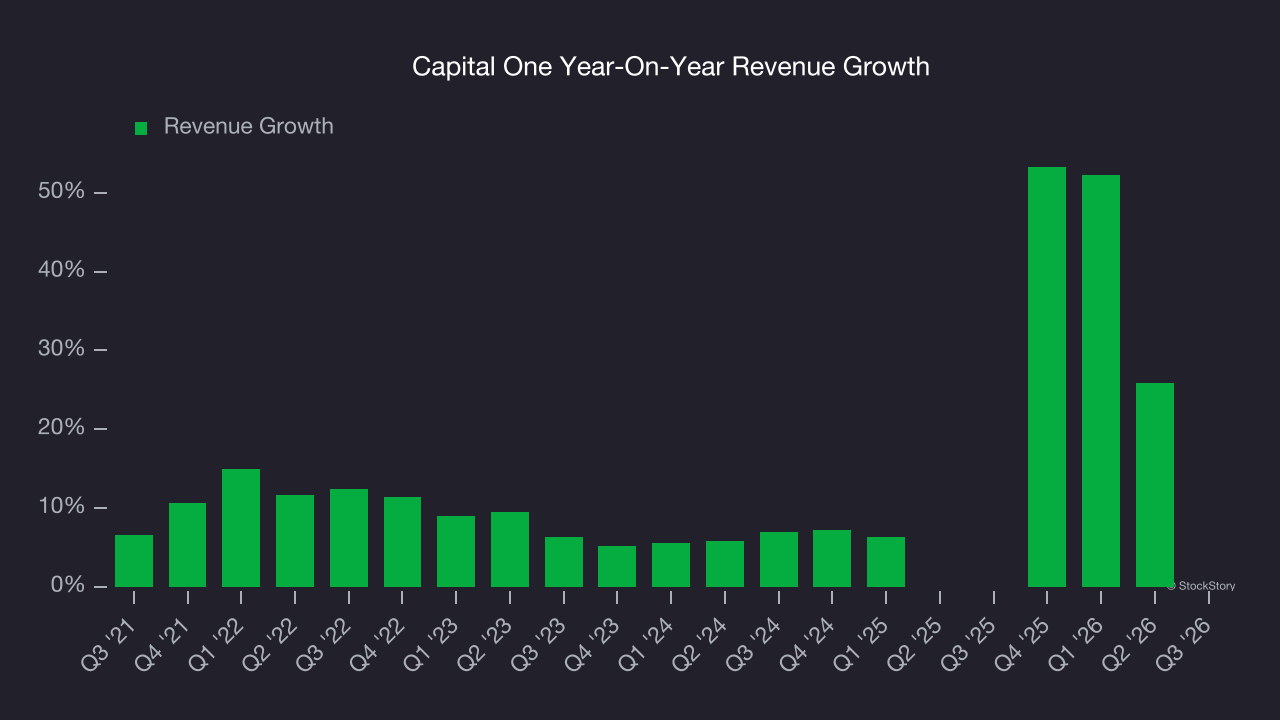 Note: Quarters not shown were determined to be outliers because they were impacted by outsized investment gains/losses that are not indicative of the recurring fundamentals of the business.
This quarter, Capital One reported year-on-year revenue growth of 5.7%, and its $16.34 billion of revenue exceeded Wall Street’s estimates by 0.5%.
ONE MORE THING: 3 Hidden Platforms Growing 3X Faster than Amazon, Google, and PayPal. Amazon, Google, and Meta all followed the same playbook: Dominate an ignored market. Build an unbeatable moat. Scale until you’re unstoppable.
These three platforms are running that exact playbook right now. The early investors in Amazon made fortunes. The early investors in these could do the same. Get All 3 Stocks Here for FREE.
Tangible Book Value Per Share (TBVPS)
The balance sheet drives profitability for financial firms since earnings flow from managing diverse assets and liabilities across multiple business lines. As such, valuations for these companies concentrate on capital strength and sustainable equity accumulation potential across their varied operations.
This explains why tangible book value per share (TBVPS) is a premier metric for the sector. TBVPS provides concrete per-share net worth that investors can trust when evaluating companies with complex, multi-faceted business models. Other (and more commonly known) per-share metrics like EPS can sometimes be murky due to the complexity of multiple business lines, M&A activity, or accounting rules that vary across different financial services segments.
Capital One’s TBVPS was flat over the last five years. A turnaround doesn’t seem to be in sight as its TBVPS also dropped by 4.2% annually over the last two years ($112.04 to $102.72 per share).
Key Takeaways from Capital One’s Q3 Results
It was good to see Capital One beat analysts’ EPS expectations this quarter. We were also excited its net interest margin outperformed Wall Street’s estimates by a wide margin. Zooming out, we think this was a good print with some key areas of upside. The stock traded up 7.4% to $214.73 immediately after reporting.
Capital One may have had a good quarter, but does that mean you should invest right now? When making that decision, it’s important to consider its valuation, business qualities, as well as what has happened in the latest quarter. We cover that in our actionable full research report which you can read here (it’s free).