OrinewPCB’s published service information brings together two connected parts of electronics production: manufacturing the bare printed circuit board and coordinating the components and operations needed to deliver an assembled board. For engineering and purchasing teams, the connection raises a practical question that goes beyond a unit-price comparison: who owns the information and approvals between each production stage?
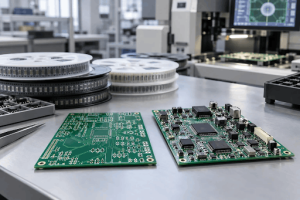
According to the company’s PCB manufacturing service description, its work supports prototypes, new product introduction, and repeat production, with build requirements reviewed before release. Its separate turnkey offering describes fabrication, procurement, assembly, and project-defined inspection or testing. The descriptions frame each project around its required build package and agreed scope.
The operational significance lies in the handoffs. A fabricated board can meet its drawing while the assembly team is still waiting for a component decision. A complete set of parts can be available while firmware or test instructions remain unresolved. Coordinating those dependencies is part of making a production order executable, regardless of whether a customer uses one supplier or several.
The work between a design release and a build
Electronics production involves several definitions of readiness. A designer may consider the circuit complete when the schematic and layout are approved. Purchasing needs an identifiable and orderable component list. Fabrication needs a consistent construction specification. Assembly needs placement and population instructions, while test personnel need a procedure that distinguishes an acceptable unit from a failed one.
Those definitions overlap, but they are not interchangeable. A project can appear complete from one team’s perspective while still containing an unresolved decision for another. The delay becomes especially visible when production is scheduled against an assumed start date rather than an agreed set of release conditions.
Consider a hypothetical board whose preferred connector becomes unavailable after the layout has been released. A replacement may share the same pin count but differ in mating height or mechanical features. Approving it can require more than updating the purchasing spreadsheet. The design, enclosure fit, assembly instructions, and test connection may all need review.
The example illustrates why the information moving between teams matters as much as the individual operations. An integrated supplier can coordinate the conversation, but the customer still needs an authorized technical decision. The value of coordination depends on making that decision visible before material and labor are committed.
Fabrication requirements set conditions for later stages
The company’s manufacturing page identifies data review and project-specific confirmation as part of its service description. For buyers, the broader issue is whether the quoted board construction matches the design that was evaluated. A layer count and overall thickness do not, by themselves, describe every relevant feature of a multilayer board.
Material selection, copper requirements, hole dimensions, and surface finish can affect both the fabricated board and its later use. Where controlled impedance is required, the relationship between routing geometry and the actual stackup needs attention. Where a connector depends on board thickness or mechanical positioning, the relevant dimensions need clear tolerances.
Production documents can also conflict. An order form may contain an old finish selection while a drawing specifies a different one. Resolving the conflict is a small administrative task before release, but it can become a costly question after fabrication begins. A clear package reduces the need for a supplier to interpret which document represents the customer’s latest intent.
Panel design creates another connection between fabrication and assembly. Tooling features, support, edge clearance, and separation methods affect how boards travel through production. A panel that efficiently uses fabrication area may still create problems for component access or handling. The arrangement needs to suit the intended process rather than being treated as an isolated purchasing choice.
For a buyer comparing suppliers, these details make the quotation basis important. Two prices may reflect different assumptions about materials, tolerances, inspection, or documentation. A useful comparison exposes those differences before presenting the totals as directly equivalent.
Turnkey sourcing still requires customer decisions
OrinewPCB’s turnkey PCB assembly service describes a coordinated scope covering board fabrication, component purchasing, assembly, and agreed testing. Its published information states that proposed substitutes require customer approval. That distinction matters because responsibility for obtaining a part is different from authority to change the product.
The same distinction applies across turnkey projects generally. A supplier can identify a shortage and propose an alternative, but a similar package or catalog description does not establish technical interchangeability. Electrical behavior, thermal characteristics, mechanical fit, and software dependencies may need assessment before the replacement is acceptable.
For procurement teams, a complete bill of materials provides the starting point. Manufacturer names, full part numbers, reference designators, quantities, and variant information allow purchasing and assembly to work from the same definition. Approved alternatives should be distinguishable from candidates that have not yet passed review.
Inventory decisions also require explicit agreement. Packaging quantities and purchasing commitments can exceed the number of parts installed in the current batch. If the design changes, unused material may remain. Ownership, storage, cancellation conditions, and authorization limits belong in the commercial discussion before those commitments are made.
This is where the appeal and limits of turnkey coordination meet. One commercial interface can make communication easier, but it does not remove the need for engineering approval or inventory planning. The arrangement works best when responsibility is consolidated without obscuring who is entitled to make each decision.
Inspection and testing define the delivered product
A finished assembly is not fully described by the fact that components have been soldered to a board. Depending on the application, shipment readiness may also require programming, calibration, functional checks, identification, or specific records. These requirements affect the scope of work and should be visible in the agreement.
The company’s turnkey page lists inspection and test options, with the applicable plan and records agreed for the project. The important implication for a buyer is that available equipment and included coverage are separate questions. A service provider’s ability to perform a test does not mean that the test is part of every order.
Optical inspection, for example, can assess visible assembly conditions but cannot demonstrate every electrical function. Electrical testing can address selected circuit conditions, while functional testing exercises defined operations under specified inputs and loads. The coverage depends on the board, access, procedure, and acceptance limits.
A hypothetical controller might successfully communicate with a test computer while its output stage remains untested under load. That would not invalidate the communications result; it would show that the result answers only one part of the acceptance question. A clear test plan distinguishes what has been checked from what remains outside the scope.
Programming introduces another configuration dependency. The correct hardware can still be delivered with an incorrect firmware version or incomplete device-specific data. Controlled software identification and verification help connect the physical assembly with the configuration the customer actually intends to receive.
For teams assessing production readiness, the useful evidence is therefore specific: which revision was built, which requirements were checked, which exceptions were approved, and what results were retained. General descriptions such as “tested” or “production-ready” need that supporting definition.
Repeat orders depend on a reproducible record
The transition from a successful initial build to a repeat order is another test of the handoff process. A prototype may contain an approved substitution, a manual modification, or a test adjustment that helped the project move forward. Unless those decisions enter the controlled record, the next order can reproduce the original files without reproducing the working configuration.
The distinction between intended and as-built information is useful here. Released documents state what should be manufactured. Production records capture approved exceptions and the configuration actually delivered. Reconciling the two gives the next build a clearer starting point and helps engineering investigate any later difference in behavior.
A pilot run can also reveal whether instructions are understandable without the original designer standing beside the operator. Missing orientation details, difficult handling steps, and unstable test connections may become visible only when the process is repeated. Recording those findings turns the pilot into a source of process improvement rather than simply a small shipment.
The eventual release decision should identify what has been resolved and what remains open. A limited engineering batch may tolerate an exception that would be inappropriate for customer delivery. Making that boundary explicit allows production planning to proceed with a defined basis instead of an informal assumption that every working board is ready for every use.
For customers evaluating manufacturing and turnkey services, the practical questions extend beyond capability lists. They include the documents required to release work, the treatment of shortages, approval of changes, the start conditions for lead time, and the evidence supplied with delivery. These questions help establish whether the service matches the actual project.
OrinewPCB’s published offerings provide a starting point for those discussions. The final scope still needs to be agreed against the customer’s board, component list, production quantities, and acceptance requirements. A coordinated service becomes useful when the required decisions are documented well enough that fabrication, purchasing, assembly, and testing can all act on the same approved information.
About OrinewPCB
OrinewPCB presents PCB fabrication and assembly services through its company website. Its published service information addresses prototype and production projects, including turnkey coordination. Specific construction, sourcing arrangements, inspection, testing, documentation, and delivery requirements should be confirmed for the individual order.
Company Details
Company Name: Orinew Technology Development Co., LTD
Contact Person: Alek
Email: sales@pcbandassembly.com
Phone: +86-18123905375
Address: shenzhen, China
Website: https://pcbandassembly.com/