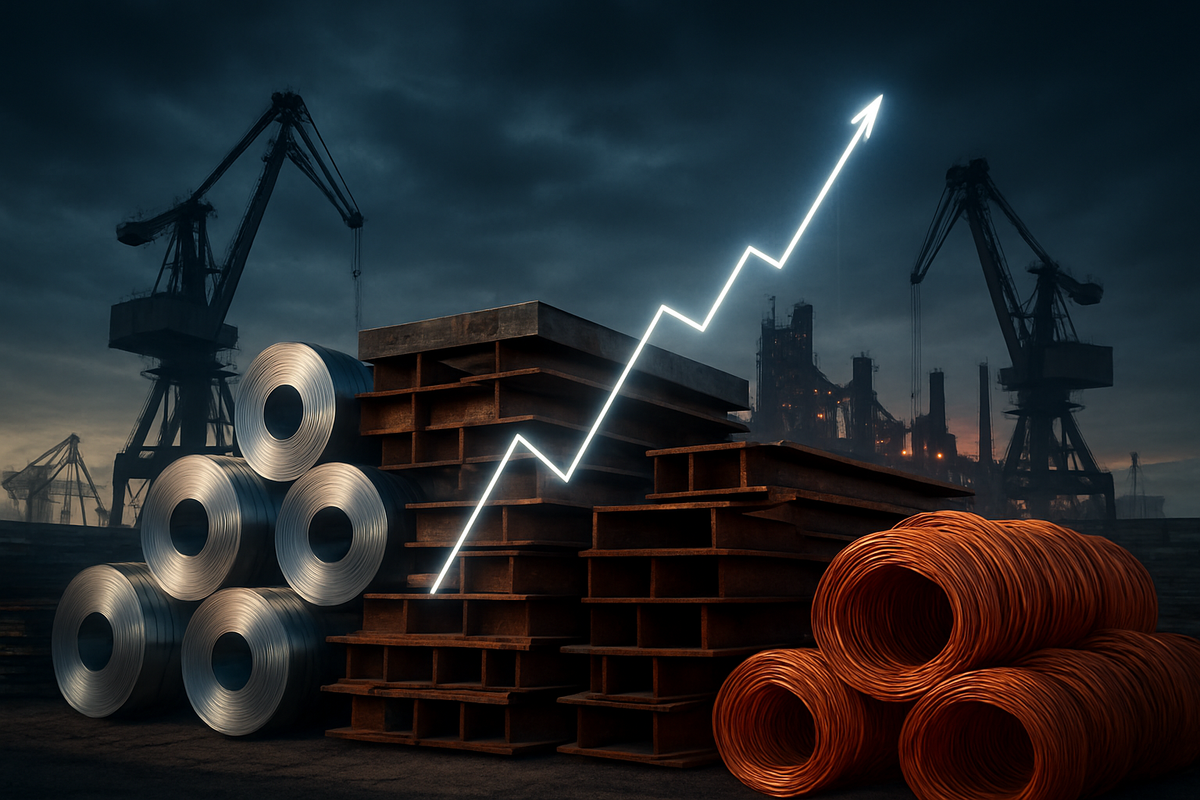
As of April 3, 2026, the American industrial landscape is grappling with the most aggressive protectionist shift in a generation. Following a series of escalations that began in early 2025, the Trump administration has finalized an adjusted tariff regime that levies a massive 50% duty on the full value of imported steel, aluminum, and copper. This move, intended to "rebuild the forge of American greatness," has triggered what traders are calling the "Aluminum Squeeze"—a volatile cocktail of supply shortages and record-breaking price premiums that is forcing U.S. manufacturers to choose between double-digit price hikes or terminal margin erosion.
The immediate implications are stark: while domestic metal producers are seeing a windfall, the broader manufacturing sector is reeling. The "Midwest Premium," the benchmark cost for delivering aluminum to the American heartland, has soared to an unprecedented $1.05 per pound. With raw material costs for essential goods like automobiles and appliances jumping by nearly 15% overnight, the Federal Reserve’s battle against inflation has entered a complicated new phase where "cost-push" pressures from metal prices threaten to decouple from broader monetary policy.
The Path to 50%: A Timeline of Protectionism
The current crisis did not emerge in a vacuum but is the result of a calculated, year-long tightening of trade barriers. The timeline began in February 2025, shortly after President Trump’s inauguration, with the reinstatement of 25% tariffs on steel and aluminum under Section 232 of the Trade Expansion Act. By June 2025, citing "insufficient protection for the national security interest," the administration doubled those rates to 50%. In July, the scope was expanded to include semi-finished copper products—pipes, wires, and rods—marking the first time copper had been targeted with such intensity.
The most recent adjustment, announced on April 2, 2026, sought to simplify the "derivative" rules that have plagued the administration's policy. Under the new guidelines, any imported product consisting of more than 15% metal by weight is subject to the full 50% tariff. This move was designed to close loopholes that allowed companies to import pre-fabricated metal parts to circumvent raw material duties. However, the timing coincided with a "force majeure" declaration from Aluminium Bahrain (Alba), the world’s largest single-site smelter, following regional instability in the Middle East. This geopolitical shock effectively removed 9% of the global aluminum supply just as U.S. domestic demand was peaking.
Compounding the supply crunch is a new domestic rival for energy: the Artificial Intelligence sector. In 2026, data center expansion has reached such a fever pitch that these facilities are outbidding industrial smelters for baseload electricity. In states like Ohio and Oklahoma, the very energy required to ramp up domestic aluminum production is being diverted to power AI clusters. This "Energy War" has left domestic producers like Century Aluminum (NASDAQ: CENX) unable to expand capacity fast enough to replace the now-prohibitively expensive imports, creating the structural bottleneck known as the "squeeze."
Winners and Losers in the Material Sector
The market reaction has been bifurcated, creating a clear line between those who pull metal from the earth and those who shape it into products. On the winning side, domestic steel giants have seen their stock prices decouple from the broader indices. Nucor (NYSE: NUE) and Cleveland-Cliffs (NYSE: CLF) are operating at near-total capacity, enjoying the luxury of domestic price leadership. With the 50% tariff floor, these firms have been able to raise prices while still remaining the most "affordable" option for U.S. builders, leading to profit growth expected to hit five-year highs.
In the aluminum and copper space, the benefits are even more pronounced. Alcoa (NYSE: AA) has seen its valuation surge as the LME aluminum price breached $3,500 per tonne, while Freeport-McMoRan (NYSE: FCX) has become a darling of the "national security" trade. These companies are effectively shielded from international competition, allowing them to capture the record "Midwest Premium" as pure profit. For investors, the material sector has transitioned from a cyclical laggard to a defensive powerhouse in the 2026 portfolio.
Conversely, the "losers" list includes some of the most iconic names in American industry. Ford Motor Company (NYSE: F) and General Motors (NYSE: GM) have warned that the 50% tariff on specialized steel and aluminum alloys could add upwards of $2,500 to the sticker price of a new electric vehicle. Similarly, Whirlpool (NYSE: WHR) and Caterpillar (NYSE: CAT) are facing a "margin trap," where the cost of raw materials is rising faster than their ability to pass those costs onto consumers. Boeing (NYSE: BA), already struggling with supply chain reliability, now faces a massive spike in the cost of aerospace-grade aluminum, threatening its competitive standing against international rivals who still have access to cheaper global metal markets.
A Fundamental Shift in Industrial Policy
The 2026 metal regime represents more than just a trade dispute; it is a fundamental pivot toward "autarkic industrialism." This event fits into a broader trend of "just-in-case" inventory management. Manufacturers are no longer ordering metal as they need it; they are stockpiling it like a precious currency. This shift has tied up billions in working capital across the S&P 500, slowing down R&D and capital expenditure in other areas. The policy implies that the U.S. government is willing to accept higher consumer inflation in exchange for a "hard" domestic industrial base that is decoupled from global volatility.
Historical comparisons are being drawn to the 1930s, though with a modern twist. While the Smoot-Hawley era was characterized by a general collapse in trade, the 2026 regime is targeted and strategic. By focusing on "industrial bread and butter"—steel, aluminum, and copper—the administration is betting that the long-term benefit of reshoring smelters will outweigh the short-term pain of the "Aluminum Squeeze." However, the ripple effects are significant; as U.S. prices rise, Canadian and Mexican partners are pushing for a return to the original USMCA exemptions, creating a diplomatic friction point that could redefine North American trade for the next decade.
The Outlook: Adaptation or Stagnation?
In the short term, market participants should expect continued volatility in metal futures. The "Aluminum Squeeze" is unlikely to resolve until new domestic capacity comes online, a process that takes years, not months. Strategic pivots are already underway; some manufacturers are investigating "material substitution," looking to high-strength plastics or composites to replace metal components, though this is often not feasible for structural or high-heat applications.
The long-term scenario hinges on whether the "15% rule" provides enough of a pressure valve for consumer goods. If the administration sees that the 50% tariff is causing a genuine industrial recession, we may see a move toward "targeted exemptions" for specific high-tech alloys that cannot be produced domestically. However, for now, the "America First" metal policy is the law of the land, and companies that cannot adapt their supply chains to a high-tariff environment risk being left behind in the 2026 market.
Conclusion: Navigating the New Industrial Reality
The adjustment of President Trump's tariff regime to a flat 50% on industrial metals has fundamentally rewritten the rules for the U.S. manufacturing sector. The "Aluminum Squeeze" is the first major stress test of this policy, highlighting the friction between national security goals and the economic realities of global supply chains. For investors, the key takeaway is the rise of the "Metal Sovereignty" trade—long positions in domestic miners and smelters and a cautious approach to "metal-heavy" downstream manufacturers.
Moving forward, the market will be watching the energy grid as closely as the trade headlines. If the U.S. cannot solve its power capacity issues, the domestic metal industry will struggle to grow, even behind a 50% tariff wall. In the coming months, keep a close eye on quarterly earnings from the "Big Three" automakers and domestic steel producers; their ability to manage these input costs will be the definitive signal of whether this policy is a masterstroke of reshoring or a catalyst for industrial stagnation.
This content is intended for informational purposes only and is not financial advice