As of April 15, 2026, a stark divide has emerged in the global agricultural markets. While international grain supplies remain at historically robust levels, a localized crisis in the U.S. Great Plains is forcing a significant weather premium into the wheat market. Severe multi-year drought conditions, exacerbated by devastating late-winter wildfires, have sent U.S. winter wheat quality ratings to their lowest levels in years, creating a "tale of two markets" where domestic scarcity is clashing with a global surplus.
The immediate implication for traders and consumers is a decoupling of Hard Red Winter (HRW) wheat prices from the broader global commodity curve. Even as the U.S. Department of Agriculture (USDA) reports record ending stocks in some regions, the specific high-protein wheat required for breadmaking is becoming increasingly scarce in the United States. This divergence is placing immense pressure on the domestic supply chain, from rural grain elevators in Kansas to the boardrooms of multinational agribusinesses.
A Perfect Storm Over the Great Plains
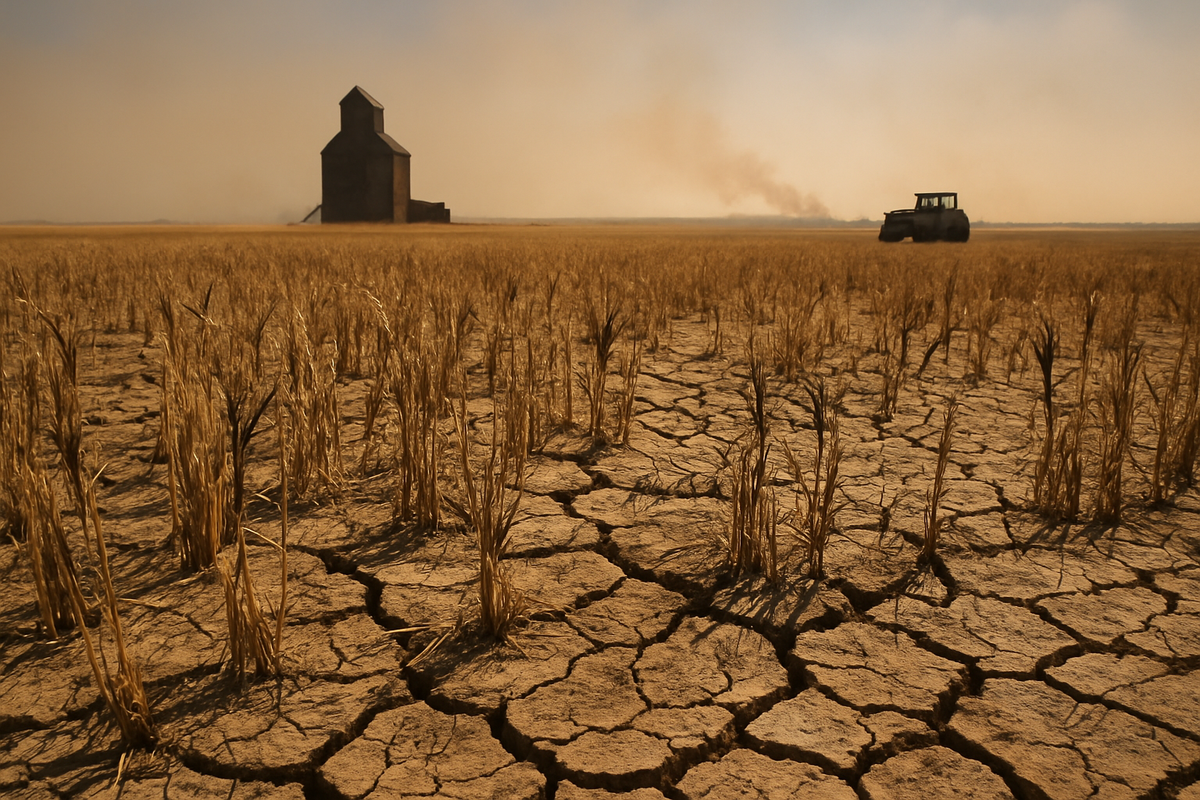
The deterioration of the 2026 winter wheat crop has been a slow-motion disaster that reached a boiling point this April. According to the latest USDA Crop Progress reports, the national "Good to Excellent" rating for winter wheat has plummeted to just 35%, a sharp decline from the already struggling 48% seen this time last year. The situation is most dire in the "breadbasket" states of Kansas, Oklahoma, and Texas. In Oklahoma, the crop rating has hit a dismal 12% Good/Excellent, with more than half the planted acreage now classified as "Poor" or "Very Poor."
This crisis was catalyzed by a brutal combination of environmental factors. A persistent "La Niña" pattern left much of the Southern Plains with its fourth-driest September-to-February period in over 130 years. This was followed by a series of catastrophic wildfires in late February and March 2026, which scorched tens of thousands of acres of dormant wheat. As the crop emerged from dormancy in early April, the lack of subsoil moisture led to immediate "blue-ing" and stunting of the plants. Farmers in western Nebraska and the Texas Panhandle are already reporting abandonment rates of nearly 50%, with many choosing to till under their failing crops rather than invest in expensive harvest fuel and labor for a non-viable yield.
Market reactions have been swift but nuanced. On the Chicago Board of Trade, wheat futures settled near $5.87 per bushel as of mid-April—a modest 7% year-over-year increase. However, the real story lies in the Kansas City Hard Red Winter (HRW) futures, which are trading at a significant "Quality Premium" of nearly $0.40 to $0.50 over Chicago Soft Red Winter (SRW) wheat. This weather premium reflects the market's fear that while there is plenty of wheat in the world, there will be very little high-quality milling wheat available from the U.S. heartland this summer.
Corporate Fallout: From Grain Silos to Tractor Lines
The volatile mix of local crop failure and global oversupply is creating a challenging environment for the giants of the agricultural sector. Archer-Daniels-Midland (NYSE: ADM) and Bunge (NYSE: BG) are navigating a low-margin landscape where their merchandising segments are squeezed. While high local prices in the U.S. suggest a "bull market," these companies find it increasingly difficult to export U.S. wheat because it is significantly more expensive than the bumper crops arriving from Russia and the European Union.
For Bunge (NYSE: BG), which recently finalized its massive merger with Viterra, 2026 has become a test of operational synergy. The company recently updated its 2026 adjusted earnings per share (EPS) forecast to a range of $7.50 to $8.00, trailing analyst expectations. Management cited "limited forward visibility" and the difficulty of optimizing global trade flows when the U.S. market is effectively "priced out" of the international export scene due to the drought-driven weather premium. ADM faces similar hurdles, as the high cost of procuring U.S. wheat for its domestic flour mills eats into its processing margins.
Perhaps the most visible sign of the market's stress is seen in the heavy machinery sector. John Deere (NYSE: DE) has officially identified 2026 as the "trough" of the current large agricultural equipment cycle. The company has forecasted a 15% to 20% decline in North American large ag sales this year. With wheat yields expected to be below the break-even point for many Great Plains farmers, the appetite for high-ticket capital expenditures like the X9 Combine or 9R Tractors has vanished. Farmers are opting to repair old equipment rather than upgrade, leading Deere to proactively cut production to prevent a glut of unsold inventory at dealerships.
Global Context and the Weight of the WASDE
The broader significance of this event lies in the tension between local weather shocks and the "macro" supply picture. The April 9, 2026, World Agricultural Supply and Demand Estimates (WASDE) report painted a picture that seemingly contradicts the dust clouds in Kansas. U.S. ending stocks are projected at 938 million bushels—the highest since the 2019/20 season. This paradox exists because U.S. wheat exports have stalled, and domestic "seed use" has fallen as farmers plan to shift toward more drought-resistant crops in the next planting cycle.
On the global stage, world ending stocks were revised upward to 283.12 million metric tons. Massive harvests in Russia have effectively placed a "price ceiling" on the global market. In historical precedents, a crop failure of this magnitude in the U.S. would have sent wheat prices skyrocketing toward the $10.00 mark. In 2026, however, the global abundance acts as a massive anchor. This represents a significant shift in the geopolitical landscape of food; the U.S. is no longer the "swing producer" that dictates global prices, but rather a high-cost niche provider currently struggling with its own environment.
This situation has also sparked renewed discussions regarding federal crop insurance and the "Safety Net" policies for American farmers. As the cost of inputs like specialized fertilizers and diesel remains high, the low yield from the drought-stricken fields may not be enough to cover the interest on operating loans. Analysts expect that if the drought persists into the summer fallow period, we may see a significant increase in farm consolidations as smaller family operations are forced to exit the market.
What Lies Ahead: Pivot or Perish?
In the short term, the market will be hyper-focused on the "May rains." If the Southern Plains do not receive significant moisture in the next three weeks, abandonment rates will likely spike above the 50% mark, potentially forcing flour millers to import wheat into the U.S. heartland—a rare and costly logistical reversal. Over the long term, we may see a strategic pivot among the major grain handlers. Companies like Bunge and ADM are already increasing their investments in Latin American and Eastern European infrastructure, diversifying away from the climate-volatile U.S. Plains.
Investors should also watch for a potential shift in planting intentions for the 2027 season. If the current weather premium persists without a corresponding drop in input costs, many farmers may abandon wheat entirely in favor of alternative crops or "regenerative" fallowing techniques. This would create a structural supply deficit in HRW wheat that could last for several years, eventually forcing the global market to re-price the "quality spread" more permanently.
Market Wrap-Up and Investor Outlook
The spring of 2026 serves as a stark reminder of the "weather versus world" dynamic. While the global supply of calories remains sufficient, the local supply of specific, high-quality grain is in a state of emergency. The primary takeaway for the market is that the U.S. winter wheat crop is facing a generational challenge, but the global "grain glut" is preventing a full-scale price breakout.
Moving forward, the market will likely remain in a state of high-volatility "choppiness." For investors, the key metric to watch will not be the headline CBOT price, but the basis levels at local grain elevators and the inter-commodity spreads between Kansas City and Chicago. As John Deere and the grain majors navigate this "cycle bottom," the resilience of their balance sheets will be tested. Watch for the June USDA Acreage report for the first concrete signs of how many acres have been officially abandoned, as that will determine the finality of the 2026 weather premium.
This content is intended for informational purposes only and is not financial advice.