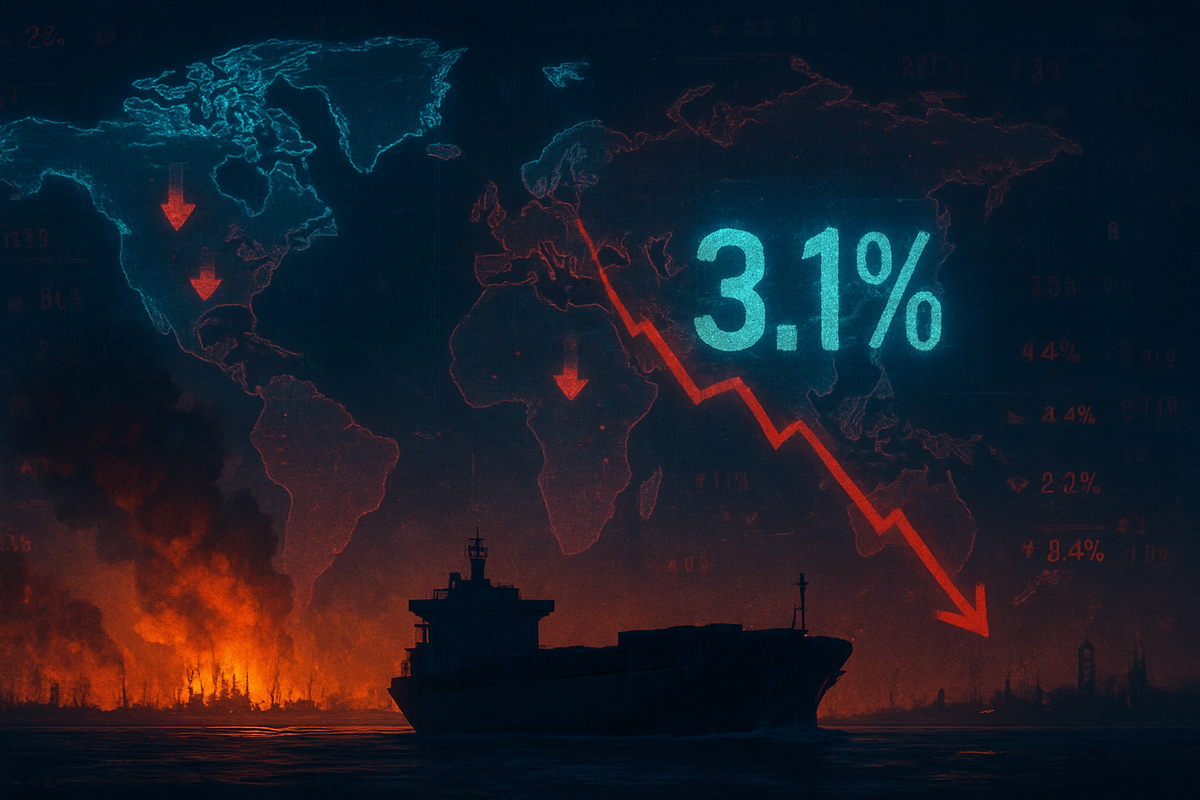
The International Monetary Fund (IMF) has delivered a sobering assessment of the global economy, significantly downgrading its growth outlook for 2026 while warning that the "shadow of war" now looms over international markets. In its latest World Economic Outlook (WEO) released on April 14, 2026, the IMF lowered its global GDP growth projection to 3.1%, a retreat from previous estimates that had suggested a more robust recovery was within reach. This downgrade is accompanied by a sharp upward revision of global headline inflation to 4.4%, driven primarily by a geopolitical crisis in the Middle East that has upended energy stability and reignited supply chain anxieties.
The immediate implications of this report are stark. The revision reflects the abrupt halt of a post-pandemic growth trajectory that many analysts had hoped would be sustained by artificial intelligence and high-tech investment. Instead, the global economy is now grappling with a "negative supply shock" that threatens to trap major economies in a cycle of stagflation. As energy costs soar and trade routes remain imperiled, central banks—which were previously signaling a pivot toward interest rate cuts—now face the agonizing task of maintaining restrictive monetary policies to combat a fresh wave of price increases.
Escalation in the Gulf: A Timeline of Economic Disruption
The descent into the current economic volatility began on February 28, 2026, with a sudden and intense escalation of hostilities in the Middle East involving U.S.-Israeli strikes on Iranian military and energy infrastructure. The conflict rapidly widened, leading to a direct confrontation that paralyzed the world’s most critical energy artery. On March 4, 2026, the effective closure of the Strait of Hormuz—through which 20% of global oil and 21% of liquefied natural gas (LNG) pass—sent shockwaves through the commodities market. This disruption has been characterized by the International Energy Agency (IEA) as the single largest supply shock in the history of the global oil market.
Specific targets in the early weeks of the conflict included Iran’s South Pars gas field and Qatar’s Ras Laffan complex, the latter of which saw an estimated 17% of its LNG export capacity sidelined by retaliatory strikes. By mid-March, Brent Crude futures, which had been trading at a relatively stable $77 per barrel at the start of the year, rocketed past $120. While prices have slightly moderated to the $105–$110 range as of mid-April, the structural damage to production and the ongoing naval blockade have removed nearly 10 million barrels per day of Gulf production from the global market.
The IMF's Managing Director emphasized that before this geopolitical flare-up, the fund was actually preparing to upgrade its 2026 growth forecast to 3.4% on the back of easing trade tensions and strong tech sector gains. The current 3.1% projection represents a significant "risk-off" adjustment, accounting for a total loss of roughly 0.3 percentage points of global GDP. The IMF also warned of an "Adverse Scenario" where an extended conflict could see growth plummet to 2.5%, a level that historically signals a global recession.
Market Bifurcation: Energy Giants Surge While Consumer Staples Sink
The current environment has created a sharp divide between market winners and losers, with energy and defense companies benefiting from the volatility while consumer-facing and logistics-heavy firms struggle. ExxonMobil (NYSE: XOM) and Chevron (NYSE: CVX) have seen their valuations climb as the scarcity of crude and the resulting price spike bolster their profit margins. Similarly, Shell PLC (NYSE: SHEL) has seen increased demand for non-Middle Eastern energy sources as European nations scramble to diversify their energy security amid the loss of Qatari LNG imports.
On the other side of the ledger, the transportation and retail sectors are reeling from the combined pressure of higher fuel costs and waning consumer confidence. Airlines such as United Airlines Holdings Inc. (NASDAQ: UAL) and Delta Air Lines, Inc. (NYSE: DAL) have had to implement aggressive fuel surcharges and scale back flight schedules, leading to a sharp sell-off in their stock prices. Logistics giants like Amazon.com, Inc. (NASDAQ: AMZN) are also under pressure, as the cost of maintaining global delivery networks rises in tandem with diesel and jet fuel prices, potentially squeezing margins during the crucial second-quarter period.
The defense sector has emerged as a clear hedge for investors, with companies like Lockheed Martin Corporation (NYSE: LMT) and Northrop Grumman (NYSE: NOC) seeing a surge in orders as regional tensions necessitate increased military spending by the U.S. and its allies. Conversely, the technology sector, led by giants like NVIDIA Corporation (NASDAQ: NVDA) and Apple Inc. (NASDAQ: AAPL), has faced a valuation correction. The combination of rising input costs and the "higher for longer" interest rate environment—highlighted by the US 10-year Treasury yield reaching 4.38% in March—has dampened the enthusiasm for growth stocks that characterized the start of the year.
Geopolitical Realignment and the Ghost of Stagflation
The IMF’s report suggests that the global economy is entering a period of forced realignment. The disruption of 33% of global seaborne trade in fertilizers, a byproduct of the energy crisis, is already sparking fears of a global food security crisis similar to the one experienced in 2022. This event fits into a broader trend of "geopolitical fragmentation," where economic efficiency is increasingly sacrificed for national security and supply chain resilience. The shift from "just-in-time" to "just-in-case" logistics is becoming a permanent fixture of corporate strategy, further embedding inflationary pressures into the system.
Regulatory and policy implications are profound. Governments in major economies are likely to renew their focus on domestic energy production and accelerated renewable transitions to reduce dependence on the volatile Middle East. However, the IMF warns that the high cost of capital will make these transitions more expensive and potentially slower than previously hoped. Central banks, particularly the Federal Reserve and the European Central Bank, now find themselves in a policy trap: raising rates further could trigger a deep recession, while cutting rates could let 4.4% inflation spiral out of control.
Historical precedents for this moment are few, but comparisons are being drawn to the 1973 oil embargo and the subsequent decade of stagflation. Unlike the 1970s, however, the modern global economy is more interconnected and reliant on complex semiconductor supply chains. A prolonged conflict in the Middle East does not just affect the gas pump; it threatens the digital infrastructure that underpins modern finance and commerce, making the current crisis potentially more pervasive than its historical predecessors.
The Path Forward: Scenarios and Strategic Pivots
In the short term, the primary focus for markets will be the duration of the naval blockades in the Strait of Hormuz. If a diplomatic resolution is found quickly, the IMF suggests a "partial recovery" could begin by late 2026. However, if infrastructure damage to gas fields is as extensive as preliminary reports suggest, the supply of LNG may remain constrained well into 2027. Corporations will likely continue their strategic pivots, prioritizing near-shoring and building redundant supply chains, even at the cost of lower profit margins.
Market opportunities may emerge in the transition to nuclear energy and alternative fuels, as the vulnerability of fossil fuel routes becomes an undeniable risk factor. Investors will likely remain defensive, favoring "safe haven" assets like the U.S. Dollar (DXY) and gold. For emerging markets, the outlook is particularly grim; commodity-importing nations face the dual threat of currency depreciation and rising import bills, which could lead to a wave of sovereign debt restructuring if interest rates remain elevated through the end of the year.
The coming months will likely see a period of "asymmetric volatility." While the U.S. economy has shown some resilience due to its domestic energy production, the Eurozone and major Asian importers like Japan and South Korea are far more exposed. Strategic adaptations, such as the implementation of more robust energy rationing in Europe or increased government subsidies for essential goods in developing nations, may become necessary if the "Severe Scenario" of 2.0% global growth begins to materialize.
Conclusion: A Delicate Balance for Global Markets
The IMF’s April 2026 World Economic Outlook serves as a stark reminder of how quickly geopolitical events can dismantle economic stability. The reduction of global growth to 3.1% and the spike in inflation to 4.4% represent more than just numbers; they signal a fundamental shift in the risk landscape for investors and policymakers alike. The primary takeaway for the market is the definitive end of the "low inflation, low rate" era that many had hoped was returning.
Moving forward, the market will remain hypersensitive to any news of de-escalation or further infrastructure damage in the Gulf. Investors should closely watch for the Federal Reserve's next meeting, as any shift in rhetoric regarding inflation targets will be a major market mover. The resilience of the consumer, particularly in the face of rising energy costs and potential price hikes at retailers like Walmart Inc. (NYSE: WMT), will be the ultimate test of whether the global economy can avoid a full-scale recession.
The lasting impact of this period may be a permanent re-pricing of geopolitical risk in all asset classes. For now, the global economy remains in a defensive crouch, waiting to see if the fires in the Middle East can be contained before they consume the fragile progress of the last two years. Investors should prepare for a volatile summer, characterized by high energy costs and a cautious, protective approach to capital allocation.
This content is intended for informational purposes only and is not financial advice.