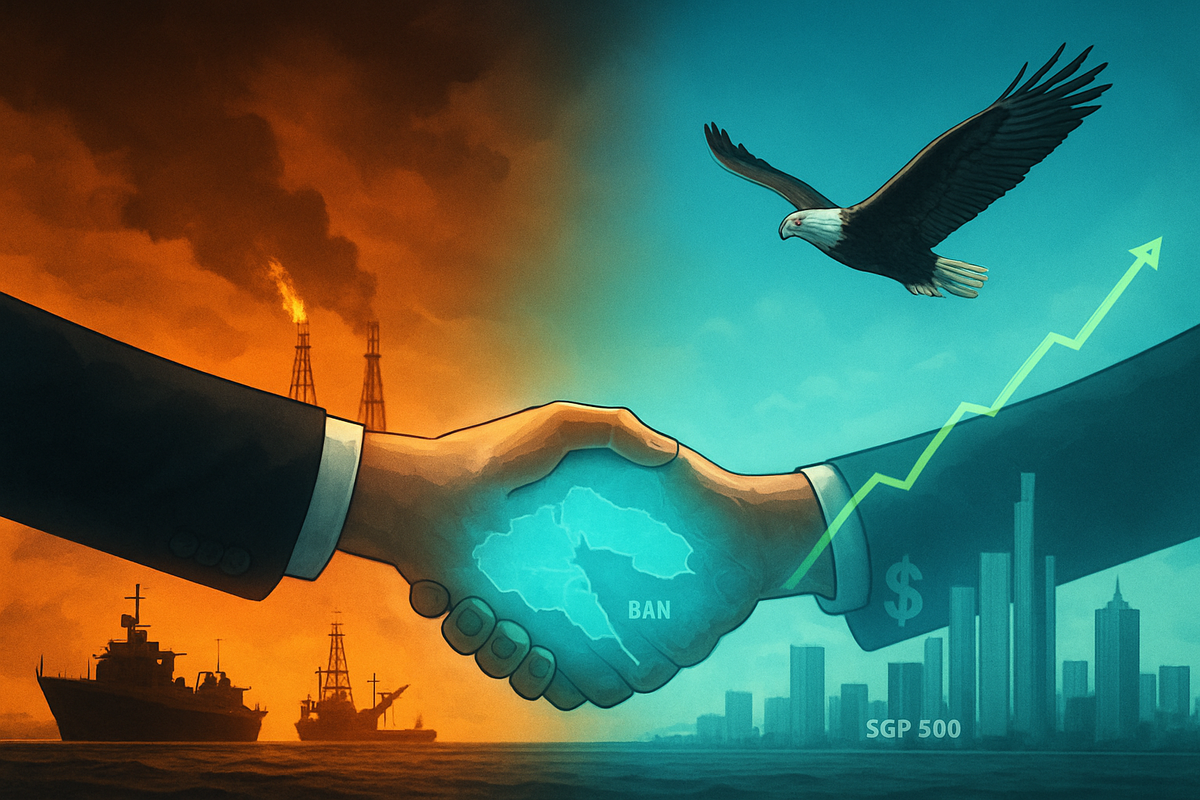
Global financial markets experienced a significant relief rally this week as President Donald Trump signaled that the intense military and diplomatic standoff with Iran is "very close to over." Following a period of heightened volatility that saw direct kinetic engagements earlier this year, the optimistic rhetoric from the White House has sparked a robust recovery in the S&P 500 (NYSEARCA: SPY), which has surged from its March lows. Investors, previously braced for a prolonged conflict in the Middle East, are now pivoting toward a "risk-on" stance as the prospect of a diplomatic breakthrough in Islamabad begins to stabilize global energy markets and cooling inflation expectations.
The shift in sentiment comes as West Texas Intermediate (WTI) crude oil prices eased to approximately $91 per barrel, a sharp decline from the triple-digit peaks seen just weeks ago. The de-escalation optimism has provided a much-needed tailwind for the broader market, allowing the S&P 500 to reclaim critical technical levels. As of April 15, 2026, the market appears to be pricing in a successful "off-ramp" that would prevent a wider regional war and secure the vital shipping lanes of the Strait of Hormuz, which had been intermittently disrupted during the height of the tensions in February and March.
From "Operation Epic Fury" to the Islamabad Talks
The road to this moment has been marked by unprecedented escalation. Following the breakdown of nuclear negotiations in late 2025, the situation culminated in "Operation Epic Fury" on February 28, 2026—a series of coordinated U.S. and allied strikes on Iranian enrichment facilities and command centers. The move initially sent shockwaves through the global economy, pushing oil prices toward $115 per barrel and causing a sharp 15% correction in U.S. equities. However, the subsequent "Maximum Pressure 2.0" campaign, orchestrated by the Trump administration, appears to have brought Tehran back to the negotiating table under extreme duress.
The turning point occurred on April 7, 2026, when a temporary ceasefire was brokered to allow for humanitarian corridors and high-level diplomatic engagement. Since then, Vice President J.D. Vance and Special Envoy Steve Witkoff have been leading a delegation in Islamabad, Pakistan, hammering out a potential 15-point peace framework. Key stakeholders, including the Saudi-led GCC and European allies, have monitored these talks closely, as the proposed deal reportedly includes a permanent halt to Iranian ballistic missile development in exchange for a phased lifting of the naval blockade that has strangled the Iranian economy.
Initial market reactions have been overwhelmingly positive, particularly following President Trump’s statement from the Oval Office yesterday evening. "We are talking, and we are talking very seriously," Trump told reporters. "It’s been a long road, but we are very close to over. We want a great deal for the world, and we’re going to get it." This "dealmaker" rhetoric has historically served as a potent catalyst for market optimism, and this instance has proved no different, with the VIX volatility index dropping below 20 for the first time in two months.
Winners and Losers of the De-escalation
The pivot toward peace has created a distinct set of winners and losers across various sectors. The most immediate beneficiaries have been fuel-sensitive industries, particularly the major airlines. Shares of Delta Air Lines (NYSE: DAL) and United Airlines (NASDAQ: UAL) have soared over 8% this week, as the retreat in WTI oil prices to the $91 level promises a significant reduction in operational costs. Similarly, consumer discretionary stocks have seen an uptick, as lower energy prices are expected to act as a "tax cut" for the American consumer, potentially boosting retail spending heading into the summer months.
In the technology sector, high-growth companies that were punished during the "flight to safety" in March are leading the recovery. Giants like NVIDIA (NASDAQ: NVDA) and Apple (NASDAQ: AAPL) have seen renewed institutional interest as the geopolitical risk premium fades. Investors are betting that a stable Middle East will allow the Federal Reserve more room to maneuver, as cooling oil prices take some of the heat off of headline inflation figures, potentially clearing the path for interest rate cuts later in 2026.
Conversely, the defense and traditional energy sectors are facing headwinds as the "war premium" evaporates. Defense stalwarts like Lockheed Martin (NYSE: LMT) and Northrop Grumman (NYSE: NOC), which saw their order books swell during the height of the 2025-2026 tensions, have seen their stock prices consolidate as the likelihood of a massive, multi-year ground conflict diminishes. Likewise, integrated oil majors such as ExxonMobil (NYSE: XOM) and Chevron (NYSE: CVX) are trading lower as the supply-side fears that drove oil to $113 have been replaced by the prospect of Iranian crude eventually returning to the global market.
Broader Significance and Historical Precedents
This potential peace deal represents a significant milestone in 21st-century geopolitics, echoing the "Peace through Strength" doctrine often cited by the current administration. The event fits into a broader industry trend where geopolitical stability is increasingly viewed as the primary driver of market liquidity. Historically, markets have shown a remarkable ability to "climb a wall of worry," and the current recovery mirrors the post-1991 Gulf War rally and the market's resilience following the initial shocks of the Russia-Ukraine conflict earlier in the decade.
The ripple effects extend far beyond the U.S. and Iran. A formalized peace agreement could lead to a permanent stabilization of the Strait of Hormuz, a move that would be celebrated by global shipping giants and commodity traders. It also signals a potential shift in U.S. foreign policy toward "transactional diplomacy," where economic incentives are used as heavily as military deterrents. For competitors like China, a U.S.-brokered peace in the Middle East could complicate their own regional ambitions while simultaneously benefiting their energy-dependent economy.
Regulatory and policy implications are also at play. If the "Islamabad Accord" is signed, the U.S. Treasury Department would likely begin the arduous task of drafting "snap-back" provisions for sanctions. This would create a complex compliance landscape for multinational corporations looking to re-enter the Iranian market, ensuring that any economic normalization is contingent on continued Iranian compliance with the 15-point plan.
The Path Forward: What Comes Next?
In the short term, the market will be hyper-focused on the "verification" phase of the peace talks. Any signs of Iranian non-compliance or a breakdown in the Islamabad negotiations could quickly send oil prices back above $100 and trigger a sharp reversal in the S&P 500. Strategically, companies may need to prepare for a period of "disinflationary growth" if energy prices continue to fall, requiring a pivot from cost-cutting measures toward expansion and capital expenditure.
Long-term, the opportunity for a "Peace Dividend" is substantial. If the Middle East stabilizes, trillions of dollars in global capital could be reallocated from defense spending toward infrastructure and emerging technologies. However, the challenge remains: the 2026 mid-term election cycle in the U.S. is approaching, and any deal will undoubtedly be scrutinized through a political lens, potentially introducing new domestic volatility into the equation.
Market participants should also watch for the "OPEC+ response." With the potential for Iranian oil to flood a market that is already seeing high U.S. production, a price war within the cartel is a tail-risk that could drive oil even lower, further benefiting consumers but hurting the domestic energy sector.
Conclusion and Investor Outlook
The current optimism surrounding U.S.-Iran peace talks has provided a vital lifeline to a struggling market. The S&P 500’s recovery and the easing of WTI oil to $91 suggest that the "fear trade" is being replaced by a "hope trade," anchored by President Trump’s confident rhetoric and the tangible progress in Islamabad. Key takeaways for investors include the renewed dominance of tech and transport stocks and the relative cooling of the "defense and energy" play.
Moving forward, the market will remain sensitive to the fine print of any formal agreement. While the "end game" appears to be in sight, the transition from conflict to a lasting peace is rarely a straight line. Investors should watch for the official signing of the Islamabad Accord and any subsequent moves by the Federal Reserve, as the geopolitical thaw could be the missing piece of the puzzle for a sustained bull market in the second half of 2026.
This content is intended for informational purposes only and is not financial advice.