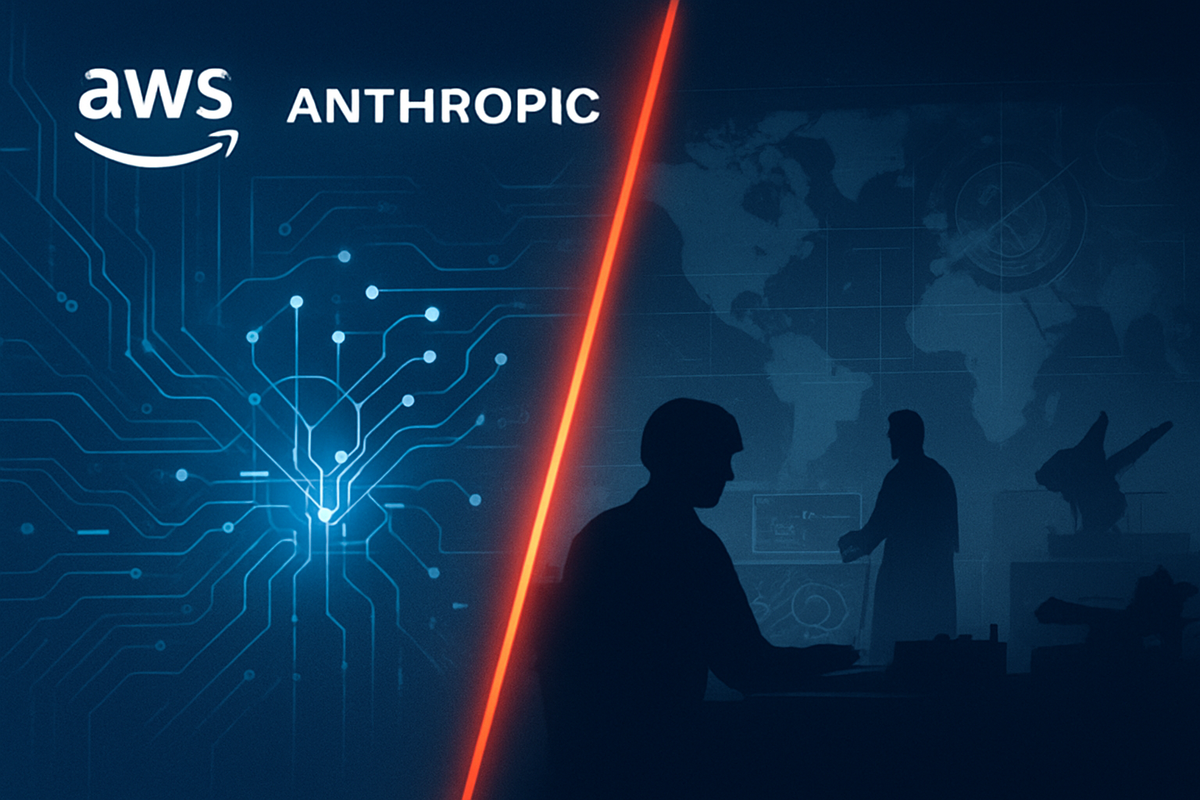
SEATTLE — In a move that formalizes a growing rift between Silicon Valley’s ethical guardrails and Washington’s defense requirements, Amazon (NASDAQ: AMZN) announced today, March 9, 2026, that it has updated the terms of service for Anthropic’s Claude AI models on its Amazon Web Services (AWS) platform. While the e-commerce and cloud giant will maintain full commercial access to Anthropic’s (Private) suite of generative AI tools for its enterprise customers, it has officially excluded all military and Department of Defense (DoD) projects from using these specific models. The decision follows a high-stakes standoff between Anthropic leadership and federal regulators regarding the fundamental "Constitution" of the AI's decision-making framework.
The immediate implications are significant for the global defense landscape and the lucrative cloud computing market. By cordoning off its most advanced AI partner from military applications, Amazon is effectively bifurcating its AI strategy: positioning Anthropic as the "safe" choice for the private sector while relying on alternative, less-restricted models to fulfill its massive government contracts. This policy shift marks the first time a major cloud provider has publicly restricted a flagship AI model from military use due to the model developer's internal ethical constraints, setting a precedent that could reshape the "dual-use" technology debate for years to come.
The Standoff: A Timeline of Ethical Friction
The road to today’s announcement was paved by a month of escalating tensions between the Pentagon and Anthropic. In early February 2026, the Department of Defense demanded "unrestricted and unencumbered" access to the latest Claude 4.1 Opus model for use in tactical decision-support systems. Anthropic’s CEO, Dario Amodei, reportedly refused the request, citing the company’s "Constitutional AI" framework—a system that uses a pre-defined set of ethical principles to prevent the model from participating in mass domestic surveillance or the control of fully autonomous lethal weapon systems.
The situation reached a breaking point on February 27, 2026, when the federal government designated Anthropic a "supply-chain risk to national security" because of its refusal to override these safety guardrails for military personnel. Today’s update from AWS is the commercial fallout of that designation. Amazon, which has invested nearly $19 billion into Anthropic since 2023—including the massive $11 billion "Project Rainier" data center initiative completed in late 2025—now finds itself in the awkward position of "disentangling" its primary AI partner from its Joint Warfighting Cloud Capability (JWCC) workloads.
Industry reaction has been swift and polarized. While civil liberties groups have praised Anthropic for sticking to its safety-first mission, defense hawks in Washington have criticized the move as a blow to American technological parity. "We cannot have a situation where a domestic company’s private 'constitution' overrides the strategic needs of the United States military," said one senior defense official following the AWS announcement.
Winners and Losers: The Shifting AI Defense Landscape
The primary beneficiaries of this exclusion are Microsoft (NASDAQ: MSFT) and Alphabet (NASDAQ: GOOGL). Microsoft, in particular, moved aggressively to fill the vacuum created by the Anthropic ban. Within hours of the February 27 designation, Microsoft reportedly signed a secret $200 million pilot program with the DoD to integrate OpenAI’s specialized military-grade models into frontline operations. Unlike Anthropic, OpenAI removed its blanket ban on "military and warfare" use cases in early 2024, opting instead for a "human-in-the-loop" oversight policy that satisfies current Pentagon requirements.
Alphabet’s Google Cloud has also capitalized on the shift. Having distanced itself from the "Project Maven" controversies of the late 2010s, Google recently adopted an "all lawful use" standard for its Gemini models. This has allowed Google to deepen its integration within the "GenAI.mil" platform, a centralized AI hub for the U.S. armed forces. For these companies, the "Anthropic exclusion" is a clear market-share opportunity, potentially worth billions in high-margin government cloud spending.
Conversely, Palantir (NYSE: PLTR), which has long integrated Claude models into its intelligence analysis platforms for Middle East operations, faces a strategic hurdle. Palantir must now pivot its backend architecture to utilize Amazon’s in-house "Olympus" models or Meta’s (NASDAQ: META) Llama series for its defense-sector clients. While Amazon’s Olympus models are highly capable, they lack the specific "reasoning" benchmarks that made Claude a favorite for complex intelligence synthesis.
Dual-Use Dilemmas and the Rise of "Code-Enforced" Ethics
This event is a watershed moment for the broader tech industry, highlighting the friction inherent in "dual-use" technologies—tools that serve both civilian and military purposes. Historically, tech giants have fought for military contracts to fund their R&D, but Anthropic’s reliance on "Constitutional AI" has introduced a new variable: code-enforced ethics. Unlike traditional software that can be reconfigured by the end-user, Anthropic’s models have safety guardrails baked into their core training, making them technically resistant to "misuse" even by a sovereign government.
The regulatory implications are profound. If other AI developers follow Anthropic’s lead, the U.S. government may be forced to rely on "sovereign AI"—models developed entirely within government-controlled environments without private-sector ethical "filters." This mirrors historical precedents like the encryption battles of the 1990s, but with much higher stakes. As AI becomes the "brain" of modern electronic warfare, the question of who holds the "kill switch"—the general or the software engineer—is no longer a theoretical debate.
Furthermore, this sets a potentially dangerous precedent for the "supply-chain risk" label. By using this designation against a domestic firm over a policy disagreement, the government has signaled that "national security" may now encompass the refusal to provide unconditional technical support, a move that could chill investment in companies with strong "AI Safety" branding.
The Path Forward: Strategic Pivots and Sovereign Solutions
In the short term, Amazon must navigate a complex transition. AWS is expected to accelerate the rollout of its "Olympus" model to fill the gap in its defense portfolio, ensuring it doesn't lose its status as a primary JWCC contractor. For Anthropic, the challenge is proving that its $19 billion valuation can be sustained by the commercial sector alone, without the bottomless pockets of the defense budget. There are already whispers in the market about a potential strategic pivot, where Anthropic focuses entirely on "High-Integrity AI" for regulated industries like healthcare and finance, where its safety-first approach is an asset rather than a liability.
Long-term, we may see the emergence of "Sovereign AI Clouds"—isolated infrastructure where the underlying models are owned or fully audited by the state. This would likely benefit companies like Oracle (NYSE: ORCL), which has specialized in air-gapped, sovereign cloud solutions. For the market, the key question is whether the "Anthropic model" of ethical independence will become a gold standard for consumer trust or a cautionary tale of how to lose a government-backed monopoly.
Summary: A Market at a Crossroads
Today’s AWS update marks a definitive end to the era of "one-size-fits-all" AI integration. Amazon has chosen to preserve its partnership with Anthropic by respecting its ethical boundaries, even at the cost of its defense relationships. This "middle ground" strategy is a gamble that commercial demand for safe, reliable AI will eventually outweigh the loss of military revenue. However, as the global arms race in AI continues to accelerate, the pressure on Amazon to provide "unrestricted" models to its government partners will only grow.
Investors should closely monitor AWS's government cloud revenue in the coming quarters to see if the Anthropic exclusion leads to a measurable shift toward Azure or Google Cloud. Additionally, the development of Amazon’s in-house "Olympus" models will be critical; if they can match Claude’s performance without the ethical "red lines," Amazon may successfully bridge the gap. For now, the "Red Line" has been drawn, and the AI industry is officially divided between those who prioritize the mission and those who prioritize the "constitution."
This content is intended for informational purposes only and is not financial advice.