

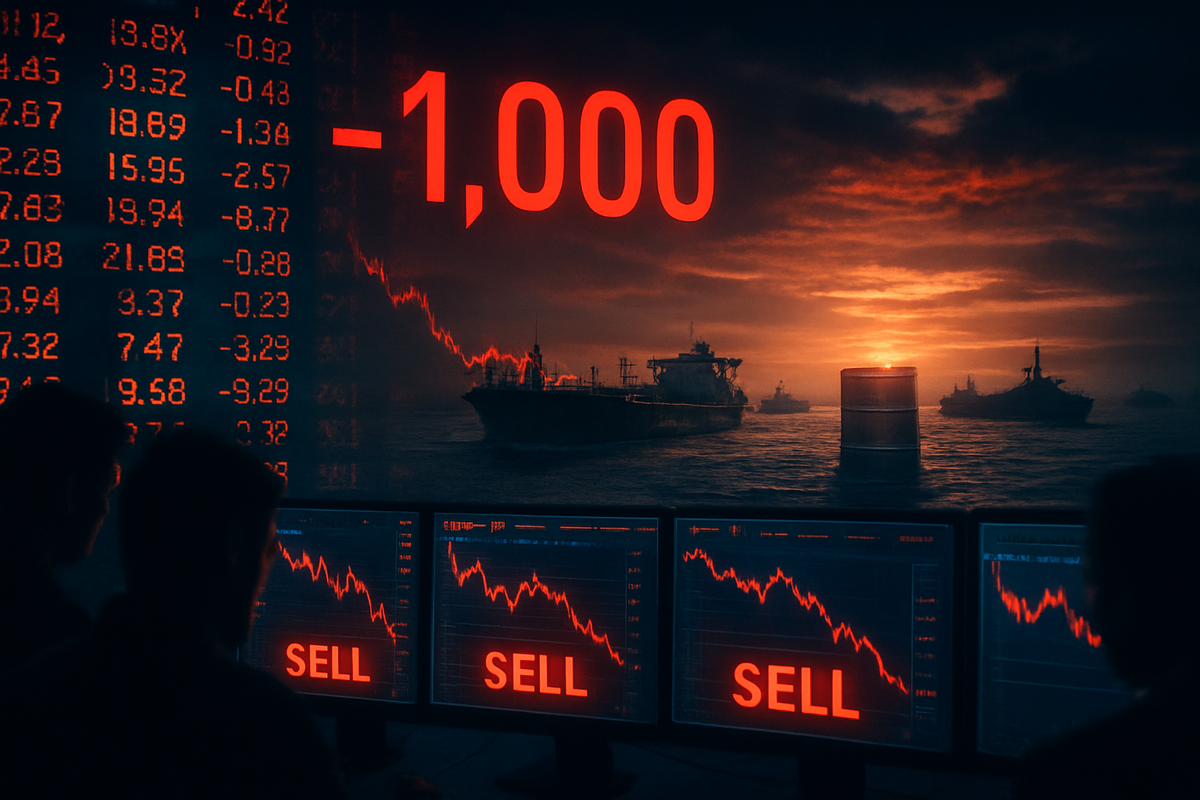
The Dow Jones Industrial Average (INDEXDJX: .DJI) suffered one of its most punishing sessions in recent history today, March 5, 2026, plunging more than 1,000 points as a sudden and sharp escalation in the Middle East sent shockwaves through global financial markets. The sell-off was triggered by reports of a significant Iranian military maneuver in the Strait of Hormuz, threatening a critical artery for the world’s oil supply and sending Brent Crude prices soaring above $120 per barrel.
The immediate implications are stark: the massive drop marks a 2.1% decline for the blue-chip index, erasing months of gains and reigniting fears of a stagflationary shock. As investors scrambled for safe havens, the broader market sentiment shifted from cautious optimism to outright panic, with the CBOE Volatility Index (VIX) jumping over 30% in a single trading session. The crash underscores the market's extreme sensitivity to energy costs and geopolitical instability in an already fragile global economy.
The turmoil began in the early hours of March 5, 2026, following an official statement from Tehran announcing the "indefinite closure" of the Strait of Hormuz for "security reasons" following a series of unclaimed drone strikes on Iranian coastal facilities. By the time the opening bell rang on Wall Street at 9:30 AM ET, the Dow was already down 450 points in pre-market trading. The slide accelerated throughout the afternoon as the U.S. State Department warned of "severe consequences" and moved a carrier strike group toward the Persian Gulf.
This latest crisis follows a year of mounting friction under the "Maximum Pressure 2.0" policy initiated in early 2025. After the "12-Day War" in June 2025—which saw limited U.S. and Israeli strikes on Iranian nuclear infrastructure—a period of relative calm had settled over the region. However, that peace was shattered this morning. By 2:00 PM ET, as news broke that two commercial tankers had been intercepted by the Iranian Revolutionary Guard, the Dow’s losses crossed the 800-point threshold, eventually settling at a 1,024-point loss by the closing bell. The S&P 500 (INDEXSP: .INX) and the Nasdaq Composite (INDEXNASDAQ: .IXIC) followed suit, dropping 2.4% and 2.9%, respectively.
The primary "winners" in today’s chaotic session were concentrated in the energy and defense sectors, which historically act as hedges against geopolitical upheaval. ExxonMobil (NYSE: XOM) and Chevron (NYSE: CVX) saw their shares jump 4.5% and 3.8%, respectively, as traders bet on sustained high oil prices. Defense giants also saw significant inflows; Lockheed Martin (NYSE: LMT) and RTX Corporation (NYSE: RTX) surged as the prospect of a prolonged military engagement in the Middle East became increasingly likely.
Conversely, the "losers" were numerous and diverse. The transportation sector was decimated by the prospect of surging fuel costs, with Delta Air Lines (NYSE: DAL) and United Airlines (NYSE: UAL) falling nearly 7%. High-growth technology stocks, which are particularly sensitive to the inflationary pressures that rising oil prices bring, also took a massive hit. Apple (NASDAQ: AAPL) and Nvidia (NASDAQ: NVDA) both saw significant retreats as investors moved capital out of "risk-on" assets and into the safety of U.S. Treasuries and gold. Retailers like Walmart (NYSE: WMT) also faced selling pressure, as investors feared that higher gas prices would further squeeze consumer discretionary spending.
Today’s market rout fits into a broader trend of "geopolitical risk premium" returning to the forefront of investor consciousness. For much of late 2025, markets had focused on domestic concerns like the Federal Reserve's interest rate path and the burgeoning AI-driven productivity boom. However, the events of March 5 serve as a brutal reminder that the global energy supply remains the world economy's Achilles' heel. The current situation draws eerie parallels to the 1973 oil embargo and the 1990 Gulf War, periods where energy shocks led to prolonged market volatility and economic downturns.
The ripple effects are likely to be felt far beyond the trading floor. For the Federal Reserve, this energy spike complicates an already difficult balancing act. Rising oil prices act as an "inflationary tax," potentially forcing the Fed to pause planned rate cuts or even consider hikes to keep inflation expectations anchored, despite the slowing economy. Furthermore, the regulatory focus may shift toward emergency energy policies, including a potential further release from the Strategic Petroleum Reserve (SPR), which is already at historically low levels following the interventions of 2022 and 2024.
In the short term, analysts expect the market to remain in a state of high volatility as it awaits a definitive military or diplomatic response from the international community. If the Strait of Hormuz remains closed for more than a few days, some analysts warn that oil could test the $150 mark, which would almost certainly tip the global economy into a recession. Strategic pivots are already underway at many hedge funds, with a sharp increase in "tail-risk" hedging and a move toward "defensive value" stocks.
Longer-term, this crisis may accelerate the global transition away from fossil fuels, as energy security once again becomes a matter of national survival. However, the immediate challenge for 2026 will be navigating the supply chain disruptions and the increased cost of shipping and logistics. Market opportunities may emerge in the renewable energy sector and domestic shale producers, who could see increased investment as the U.S. seeks to bolster its energy independence in the face of Middle Eastern volatility.
The 1,000-point plunge on March 5, 2026, represents a watershed moment for the markets this year. It has effectively ended the "complacency phase" of the current bull market and forced a re-evaluation of global risk. The key takeaways for investors are the fragility of global supply chains and the enduring power of geopolitical events to override domestic economic data. The market's move today was not just about oil; it was about the uncertainty of what comes next in a multi-polar, high-friction world.
Moving forward, the market will likely be characterized by "headline risk" for the foreseeable future. Investors should watch for the Biden-Trump transition’s ongoing effects on foreign policy, the status of international maritime corridors, and any signs of a coordinated global response to the oil spike. While the initial shock has been profound, historical precedent suggests that markets eventually find a floor once the extent of the disruption is known. For now, however, caution is the order of the day as the world watches the Persian Gulf with bated breath.
This content is intended for informational purposes only and is not financial advice.