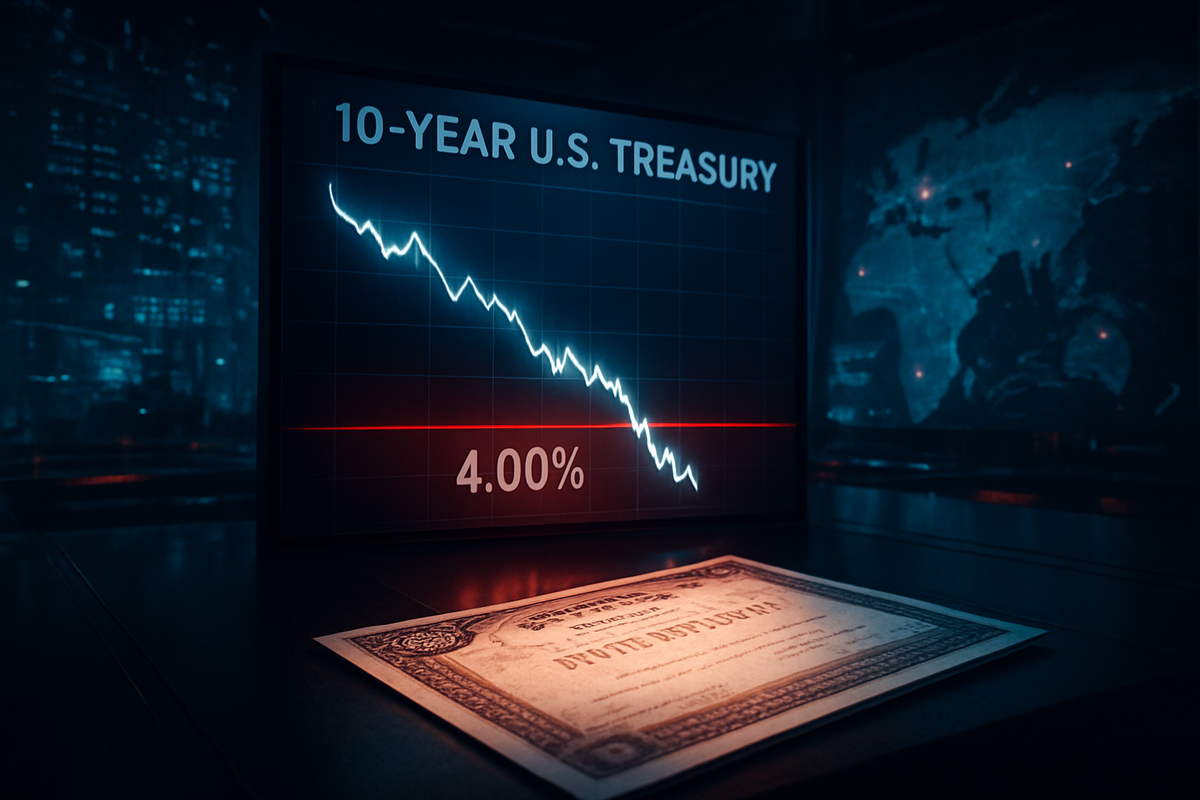
NEW YORK — In a dramatic shift for global markets, the yield on the benchmark 10-year U.S. Treasury note fell below the psychologically significant 4% mark on Tuesday, reaching its lowest level since late 2025. This sudden "flight to quality" comes as investors grapple with a volatile cocktail of deteriorating tech sector earnings, an escalation of military conflict in the Middle East, and a deepening sense of chaos surrounding international trade policies.
The move marks a sharp reversal from the "higher-for-longer" narrative that dominated the start of 2026. As of mid-day trading on March 3, 2026, the 10-year yield sat at 3.94%, reflecting a widespread move by institutional investors to exit risky equity positions and park capital in the perceived safety of government debt. "What we are seeing is a textbook rotation," said one senior macro strategist. "When the pillars of growth—tech and global trade—begin to wobble simultaneously with a geopolitical flare-up, the bond market becomes the only port in the storm."
The Descent Below 4%: A Timeline of Market Erosion
The decline in yields did not happen in a vacuum but followed a week of intensifying pressure across several global fronts. The primary catalyst arrived on February 28, 2026, with the launch of Operation Epic Fury, a coordinated series of U.S. and Israeli air strikes against Iranian military infrastructure. The strikes, which reportedly targeted high-level command centers, led to an immediate retaliatory threat from Tehran to close the Strait of Hormuz. While energy prices initially spiked, the broader market reaction was a "risk-off" panic, as the prospect of a wider regional war clouded the global economic outlook.
Compounding the geopolitical tension is a burgeoning "trade policy chaos" stemming from the mandatory six-year review of the U.S.-Mexico-Canada Agreement (USMCA). In recent days, negotiations have stalled over aggressive new "rules of origin" for the automotive sector and the threat of a 10% baseline tariff on European imports. This uncertainty has paralyzed cross-border investment, leading many to fear a return to the protectionist volatility of the late 2010s.
The third leg of this instability is the sudden "reckoning" in the technology sector. After years of riding the AI wave, major software and SaaS providers are facing a structural challenge from autonomous AI agents. The recent release of advanced coding and legal automation tools by firms like Anthropic has sparked fears that the traditional seat-based subscription model—the lifeblood of the tech industry—is being cannibalized. This "Anthropic Effect" has led to a massive sell-off in high-valuation tech stocks, providing the final push for investors to seek refuge in Treasuries.
Winners and Losers: Defensive Plays vs. Growth Casualties
The rotation has created a stark divide between market winners and losers. Among the primary beneficiaries are long-duration bond funds and defensive staples. The iShares 20+ Year Treasury Bond ETF (NASDAQ: TLT) saw its highest single-day volume of the year as yields plummeted. Similarly, consumer staple giants like Procter & Gamble (NYSE: PG) have seen an uptick in interest as investors seek reliable dividends and low-beta exposure. Defense contractors, including Lockheed Martin (NYSE: LMT) and RTX Corporation (NYSE: RTX), have also outperformed the broader market, buoyed by the escalation of military activity in the Middle East.
Conversely, the technology sector has borne the brunt of the "trade and tech" double-whammy. NVIDIA (NASDAQ: NVDA), the poster child for the AI boom, has faced significant headwind as macro fears weigh on capital expenditure forecasts. Enterprise software leaders such as Salesforce (NYSE: CRM) and ServiceNow (NYSE: NOW) have seen their valuations compressed as markets re-evaluate the longevity of their subscription models in an AI-agent world.
The banking sector is also feeling the pinch. Large institutional banks like JPMorgan Chase & Co. (NYSE: JPM) are facing potential margin compression as the yield curve continues to shift. Meanwhile, the automotive and logistics sectors are reeling from the USMCA uncertainty; Ford Motor Company (NYSE: F) and General Motors (NYSE: GM) have both issued warnings regarding supply chain disruptions and potential tariff-related cost increases, further souring investor sentiment.
Wider Significance: A Paradigm Shift in Risk Assessment
This breach of the 4% threshold is more than just a technical milestone; it signals a potential paradigm shift in how the market views the 2026 economic landscape. For much of 2025, investors were focused on the "Goldilocks" scenario of cooling inflation and steady growth. However, the current convergence of events suggests a transition into a "Geopolitical Protectionist" era, where traditional growth drivers are hampered by borders and bombs.
Historically, periods of extreme trade friction—such as the 1930s or the more recent 2018-2019 cycle—have led to prolonged periods of yield suppression as growth expectations are dialed back. The current situation is unique due to the speed of technological disruption. Unlike previous cycles, the "tech weakness" isn't just about high interest rates making growth more expensive; it's about a fundamental shift in the software business model itself.
Furthermore, the Fed’s role is now under intense scrutiny. With yields falling below 4%, the market is effectively "pricing in" more aggressive rate cuts than the Federal Reserve has officially signaled. This creates a disconnect between policy makers and market participants, increasing the risk of further volatility if the Fed chooses to prioritize fighting energy-driven inflation over supporting the sagging tech and trade sectors.
The Road Ahead: Potential Scenarios for 2026
As we look toward the second half of 2026, the market faces two primary paths. The "de-escalation" scenario assumes that the Iran strikes remain localized and that the USMCA negotiations reach an interim compromise. In this case, the yield drop below 4% might be a temporary "overshoot," and we could see a return to a more balanced 4.2% - 4.5% range as tech companies pivot their business models to incorporate AI agents rather than being replaced by them.
Alternatively, a "deepening crisis" scenario would see the Strait of Hormuz remain closed for an extended period, sending oil prices into the triple digits and forcing the Fed into a difficult "stagflation" corner. If trade barriers continue to rise, the flight to safety could intensify, potentially pushing the 10-year yield toward the 3.5% level—a mark not seen since the early 2020s. Companies in the hardware and defense sectors would likely need to rapidly reorganize supply chains, while software firms may be forced into massive restructuring efforts to preserve margins.
Summary and Final Thoughts
The drop in the 10-year Treasury yield below 4% is a clear warning sign from the bond market that the relative calm of 2025 has evaporated. The combination of Operation Epic Fury, the "Anthropic Effect" in the tech sector, and the fracturing of the USMCA has created a "perfect storm" of risk. While defensive sectors and Treasury-linked assets are currently providing a haven, the underlying causes of this volatility—geopolitical instability and structural technological change—are not easily resolved.
Investors should watch for three key indicators in the coming months: the progress of USMCA renegotiations in July, the scale of Iranian retaliation in the Persian Gulf, and the upcoming Q1 earnings calls from major tech firms, which will likely address the "AI agent" threat directly. For now, the bond market is telling a story of caution, suggesting that the path to a "soft landing" in 2026 has become significantly narrower.
This content is intended for informational purposes only and is not financial advice