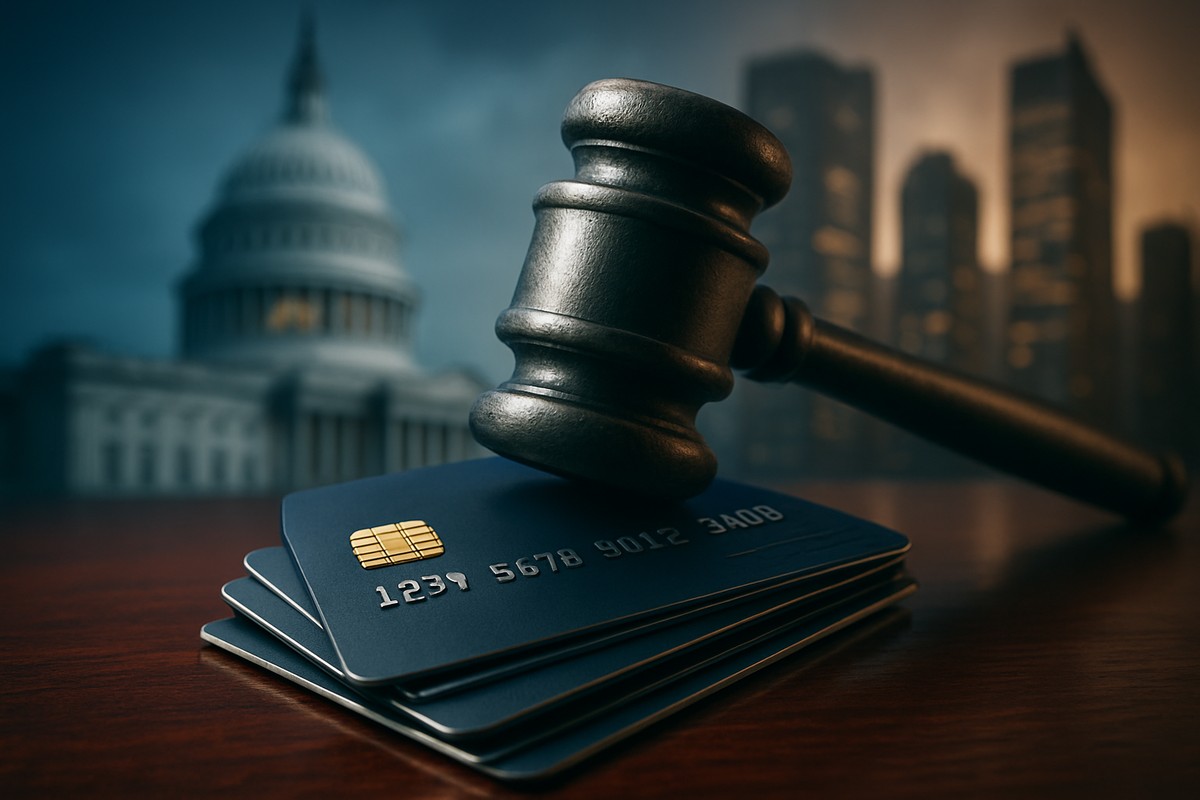
As of March 26, 2026, the American financial sector finds itself at a historic crossroads. A mounting political movement to impose a hard 10% ceiling on credit card annual percentage rates (APRs) has transitioned from a populist campaign slogan into a legislative reality that threatens to upend the foundational revenue models of the nation's largest lenders. With the "10 Percent Credit Card Interest Rate Cap Act" gaining bipartisan traction in Congress, the tension between consumer affordability and the stability of the credit markets has reached a fever pitch.
The immediate implications are stark: major banks are already beginning to shore up capital and adjust their liability management strategies in anticipation of a potential regulatory squeeze. While proponents argue the cap is a necessary antidote to a post-inflationary "affordability crisis," financial giants warn that such a move would trigger an unprecedented contraction in credit availability, effectively locking out millions of subprime and middle-income borrowers from the modern economy.
A Standoff in the Capital: The Path to the 10% Cap
The legislative centerpiece of this conflict, the 10 Percent Credit Card Interest Rate Cap Act (S. 381 / H.R. 1944), remains currently lodged in the Senate Committee on Banking, Housing, and Urban Affairs. However, the political momentum behind it is undeniable. An unusual coalition of populist lawmakers, including Senators Bernie Sanders (I-VT) and Josh Hawley (R-MO), alongside Representatives Alexandria Ocasio-Cortez (D-NY) and Anna Paulina Luna (R-FL), has successfully framed the issue as a bipartisan fight against "corporate usury."
This legislative push followed a failed executive deadline set by the Trump administration. Earlier this year, President Trump issued a demand that credit card issuers voluntarily comply with a 10% interest rate cap by January 20, 2026. When that deadline passed without compliance—largely because the executive branch lacks the statutory authority to mandate interest rates—the administration pivoted to pressuring Congress for a permanent change to the Truth in Lending Act. A report published this morning, March 26, 2026, by The Washington Post, characterized the proposal as "seductive" to voters but "repulsive" to economists, who fear the long-term fallout of price controls in a complex credit ecosystem.
The industry reaction has been swift and defensive. In the days leading up to today’s developments, the banking lobby has intensified its warnings, citing a volatile credit environment where delinquency rates have begun to tick upward. For major issuers, the proposed cap represents a direct threat to the "net interest margin"—the difference between what a bank earns on loans and what it pays out on deposits—which has been a primary driver of bank profitability in the high-rate environment of the mid-2020s.
Banking Giants Brace for the Impact: JPM and Citi Under Pressure
Among the institutions most exposed to this regulatory shift is JPMorgan Chase & Co. (NYSE: JPM). CEO Jamie Dimon has been the most vocal critic of the 10% cap, recently describing the proposal as a "catastrophic error" that would force the bank to "significantly change and cut back" its credit card offerings. According to internal projections shared by the bank, a hard cap could strip credit access from as many as 80% of current cardholders who fall outside the "prime" credit tier. On March 23, 2026, JPM released February metrics showing a delinquency rate of 0.92%, a slight increase that critics of the bank say proves the need for rate relief, while the bank argues it proves the increasing risk inherent in the current market.
Citigroup Inc. (NYSE: C) has taken even more tangible steps to prepare for a potential revenue shortfall. Just yesterday, on March 25, 2026, Citibank N.A. announced a $3 billion redemption of notes due later this year. Analysts view this move as a strategic effort to optimize funding costs and reduce interest expenses ahead of any potential legislative cap. Citigroup CEO Jane Fraser has publicly compared the current proposal to the failed credit restrictions of the 1980 Carter era, which she contends caused a sharp economic contraction. CFO Mark Mason reiterated that at a 10% cap, lending to anyone but the most affluent customers would become "completely unprofitable," potentially forcing the bank to exit certain consumer segments entirely.
The "losers" in this scenario are clearly the large-scale credit card issuers who rely on high APRs to offset the risk of unsecured lending. Conversely, potential "winners" are harder to identify. While consumers with existing debt might see immediate relief, the long-term "win" is clouded by the likelihood that many of these same consumers would lose access to revolving credit lines altogether. Some analysts suggest that smaller credit unions or specialized fintech firms might find a niche, though they too would struggle with the razor-thin margins imposed by a 10% ceiling.
Wider Significance: Populism vs. Monetary Policy
The struggle over interest rate caps fits into a broader global trend of "financial populism," where governments are increasingly willing to intervene in market pricing to appease a restive electorate. This event is not an isolated incident; it follows years of aggressive oversight by the Consumer Financial Protection Bureau (CFPB). Interestingly, as of March 26, 2026, the CFPB itself is embroiled in a legal battle over its funding. A March 13 court ruling in California recently upheld the agency’s independence, ensuring that even if the rate cap bill stalls, regulatory pressure on "junk fees" and credit practices will remain a permanent fixture of the landscape.
Historically, interest rate caps—often referred to as usury laws—were common at the state level until the Supreme Court’s 1978 Marquette decision allowed banks to export the interest rates of their home states across the country. This led to a decades-long explosion in credit availability but also in credit card debt. A return to a federal cap would essentially reverse 50 years of financial deregulation. The ripple effects would likely extend to the retail sector; if consumers lose credit card spending power, retail giants and e-commerce platforms could see a significant drop in transaction volume, potentially slowing the overall GDP growth.
The Road Ahead: Strategic Pivots and Market Uncertainty
In the short term, the market should expect a prolonged "wait-and-see" period as the Senate Banking Committee debates the bill. However, the long-term strategic pivots are already visible. Major banks like JPMorgan Chase (NYSE: JPM) and Citigroup (NYSE: C) are likely to shift their business models away from interest-income dependency and toward fee-based services. This could mean the end of "no-annual-fee" cards for all but the wealthiest clients, as banks seek to recoup lost interest revenue through administrative and membership fees—a move that the "anti-evasion" clauses in the current bill are specifically designed to prevent.
Another potential scenario is a compromise cap. Some moderate lawmakers have suggested a ceiling tied to the Federal Funds Rate (e.g., Prime + 10%) rather than a hard 10% limit. This would provide banks with a floating buffer but still provide the "protection" sought by populist advocates. If a hard 10% cap is indeed passed, the most likely outcome is a "credit crunch" for subprime borrowers, who may be forced toward less regulated, and potentially more predatory, alternative lending markets.
Summary and Investor Outlook
The developments of March 2026 represent a fundamental challenge to the "American way of debt." The 10% interest rate cap proposal has moved beyond political theater into a viable threat to the earnings of major financial institutions. For investors, the key takeaways are the heightened regulatory risk for the banking sector and the potential for a significant contraction in consumer spending power.
Moving forward, the market will likely remain volatile for bank stocks. Investors should keep a close watch on the Senate floor for any movement of S. 381, as well as the quarterly earnings calls for JPMorgan Chase (NYSE: JPM) and Citigroup (NYSE: C), where management will undoubtedly be grilled on their contingency plans. The coming months will determine whether the "plastic ceiling" becomes a permanent fixture of the U.S. economy or a populist experiment that the banking industry manages to successfully lobby into oblivion.
This content is intended for informational purposes only and is not financial advice.